A Minecraft Movie (2025)
Minecraft is one of the most popular games in history, allowing players to fully express their creativity – building unusual and memorable structures out of cubes. It is therefore surprising that a movie was made only 14 years after the release of this beloved sandbox game.
In an ideal world, this would be a film where the limitless potential of the game allowed three main characters to shine:
- Steve: Jack Black's character. As a child, Steve dreamed of working in a mine and breaking rock. The game world would allow him to bring his dream to life – carving out mines in a matter of hours and connecting them with an extensive network of tunnels;
- Garrett “The Garbage Man” Garrison: Jason Momoa's character. In the 80s, Garrett was an arcade champion, and his soul remained in that era. Minecraft would allow him to ease into the world of modern gaming – thanks to its low barrier to entry, diverse gameplay, and simple graphics;
- Henry: a representative of the younger generation who possesses a talent for crafting complex items. And Minecraft is perfect for combining items into something extraordinary!
Image rights belong to Warner Bros. Pictures
Alas, we do not live in an ideal world, and this trio did not complement each other's strengths and weaknesses. Instead, Henry crafted items during rare bouts of inspiration, while Jason Momoa faced constant attacks. Jack Black, on the other hand, was busy building and combining items rather than digging. He also constantly sang and shouted whenever gameplay elements appeared on screen. Unfamiliar with the modern version of Minecraft, I missed most of the references.
For some inexplicable reason, two additional characters were added: Henry's sister Natalie and a real estate agent named Dawn. Natalie does too little to be perceived as a full-fledged character, while Dawn exists merely to put down the unfortunate Jason Momoa.
Surprisingly, Malgosha – the queen of the piglins (anthropomorphic pigs) – does a great job as the main villain. Malgosha wants to obtain as much gold as possible. And to achieve this goal, she is ready to blackmail, kill, and even sacrifice her own people.
Free Guy (2021)
Most of the screen time takes place in the video game “Free City.” Its mechanics resemble GTA Online, where players profit from crimes and wipe each other out using a vast arsenal of weapons and vehicles. Meanwhile, the “NPCs” living in the game casually tolerate robots strolling down the street and the fact that they are robbed and killed on a regular basis.
The main character, Guy, lived the usual routine of a non-player character until he fell in love with a female player. Love prompted Guy to step out of his comfort zone and steal a pair of sunglasses worn only by players. It turns out that the glasses display an interface and unlock gameplay mechanics – revealing the true nature of the virtual world. This plot device is reminiscent of the 1988 classic “They Live,” where special glasses allow the wearer to see aliens hiding among humans.
Image rights belong to 20th Century Studios
These discoveries allow Guy to alter his relationship with players, who previously viewed non-player characters merely as bullet sponges and sources of XP. He also tracks down the player girl he fell in love with and reveals the game world to her from a perspective only an in-game program could see.
Surprisingly, over its two-hour runtime, the film never gets boring. However, immersion is broken when Guy turns out to be the only one leveling up through peaceful means. If an online game offered an efficient way to level up peacefully, players would establish entire guilds dedicated to doing just that!
Ready Player One (2018)
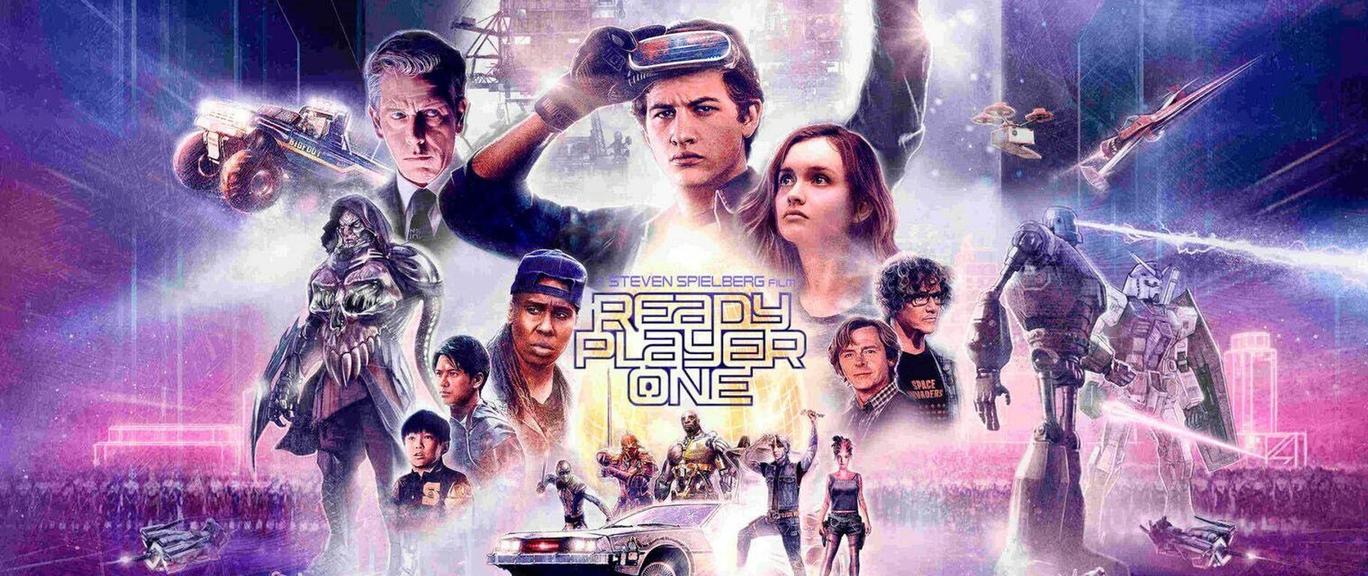
The film is based on Ernest Cline's novel of the same name, but shares little with it – only the bare-bones framework of the universe and the character names were adapted. The resulting gaps were filled with pop culture references and dubious creative choices.
The movie is set in a dystopian future where residents of overcrowded cities spend days on end hooked up to a virtual simulation called the OASIS. The OASIS allows players to customize their appearance to their liking, show off, and enjoy entertainment across virtually every known genre. The game lives up to its name completely, offering people an escape from the harsh reality – like recharging at an oasis in the middle of a desert.
Image and preview image rights belong to Warner Bros. Pictures
Everything changes when the game's deceased creator announces a contest. The goal is to find three keys that unlock the gates to a golden Easter egg. Whoever finds the egg will gain full control over the OASIS and be able to do with it as they please.
A group of players going by the handles Parzival, Aech, and Art3mis manage to find the first key. Inspired by their success, the comrades resolve to locate every key and claim the grand prize. Standing in their way is IOI, a corporation whose ruthless executives want control of the game to plaster it with as many ad banners as possible.
“On paper,” the film's premise seems thrilling, but the execution leaves much to be desired. The movie attempts to present itself as a tribute to gamers worldwide. Yet it fails to capture the true nature of its target audience – real gamers would have solved the key-related puzzles within 24 hours at most. Not to mention that only the main characters and IOI are actively hunting for the keys. The rest of the world makes zero attempt to seize control of the most popular game on the planet, which sounds completely absurd!
It is also hard to decipher the rules governing the main characters' gameplay. The blame lies with the sheer volume of references to popular films, cartoons, and video games. The filmmakers found it far easier to wave soulless avatars of the Teenage Mutant Ninja Turtles or Halo Spartans in the audience's faces than to make the game mechanics feel authentic.
Gamer (2009)
In the grim future of 2034, gaming has reached a new level. For money, people undergo brain modifications so they can be controlled like video game characters. Wealthier citizens become players, commanding less fortunate individuals for their own twisted amusement.
Image rights belong to Lionsgate and Forum Hungary
Thrill-seekers take part in an online shooter of sorts called “Slayers.” Death row convicts agree to fight for the public's entertainment. The toughest among them is played by Gerard Butler, in his signature tough-guy role. At one point, Gerard's character is contacted by his player, who simply wants to amuse himself by chatting with his “game avatar.” However, the conversation makes the young gamer realize that on the receiving end is a living human being, not a meat puppet as he had originally thought.
The film raises the question: “how far is a person willing to go for cheap thrills?” Yet philosophy is only a small part of it! First and foremost, it is a hard-hitting action flick packed with solid gore and a great soundtrack. Sadly, that kind of creative freedom is rarely found in modern cinema today.
Stay Alive (2006)
An American horror film built around a simple and familiar premise: die in the game, die in real life. What's more, your real-world demise mirrors the way you perished in the virtual realm. To escape this gruesome fate, the players must uncover the game's secret and break the curse.
There is little point in dwelling on the main characters, as they embody a horror staple archetype – dimwitted teenagers. They exist primarily so that the latest monster can dispatch them with gruesome creativity.
Image rights belong to Walt Disney Studios Motion Pictures
The game itself, however, looks fantastic. It resembles a cross between Resident Evil and The House of the Dead, where players fend off waves of approaching undead while solving puzzles on the side. Not only did the game boast remarkable graphics for its time, but it also featured the ability to play simultaneously on a console and remotely via PC.
A creative approach was also taken with the interaction between the virtual world and reality:
- The protagonists' actions were mirrored by their in-game counterparts;
- Items left behind in the game materialized in real life;
- Protective items such as roses and mirrors proved equally effective in both realms.
Spy Kids 3-D: Game Over (2003)
Juni Cortez attempted to start his own detective agency, but had to put his dream on hold when his sister went missing. Carmen Cortez's body is still in the real world, but her mind is trapped inside a video game called “Game Over.” To save his sister, Juni must plunge into the game and track down her location.
What unfolds in Game Over feels more like a string of random events than a structured playthrough. Juni teams up with a group of beta testers, and together they compete in demolition races, pilot giant mechs, battle one another, and surf across a lake of lava.
Image rights belong to Dimension Films
The overall chaos is redeemed by the fact that the film was directed by Robert Rodriguez. He knows how to make absurd concepts genuinely engaging for both kids and adults. Thanks to his efforts, nonsensical game mechanics gain an odd charm that makes viewers want to be part of the adventure.
Special mention goes to the relationship between Juni Cortez and his wheelchair-bound grandfather, Valentin. Juni invites Valentin into the game, where he regains the ability to walk. As they tackle the game together, they learn more about each other and strengthen their family bond in a touching way.
Avalon (2001)
A fascinating blend of Slavic gloom and Japanese eccentricity. Directed by Mamoru Oshii, best known for the feature anime “Ghost in the Shell,” Avalon boasts a stunning visual style and an incredible musical score.
The film captures the essence of cyberpunk perfectly: High Tech – Low Life. The real world of the near future is steeped in ruin and desolation:
- Buildings look dilapidated and ready to collapse;
- People are somber and dressed in rags;
- Food is an unappetizing sludge, with genuine groceries, cigarettes, and alcohol accessible to only a select few;
- A bleak color filter makes the atmosphere feel even more oppressive.
Disillusioned youths find solace in an illegal combat game known as “Avalon.” The virtual game world resembles Escape from Tarkov, with players forming squads to eliminate rivals. Periodically, an attack helicopter boss appears on the battlefield, wiping out everyone in its strike zone. Adding real stakes, players risk brain damage – ending up in a vegetative state under their VR helmets.
Image rights belong to Monolith Films
The protagonist is a female gamer named Ash. She was once part of the unbeatable squad “Wizards,” which dominated Avalon. After the group disbanded, Ash began playing solo, earning a living through constant raids.
At a certain point, Ash learns about an elusive higher tier known as Class Real (Rank S). There, she hopes to find answers to long-standing questions and locate her former teammate – whose physical body lies drooling in a hospital bed.
Tron (1982)
This film portrays the digital world from an angle that remains unconventional even today. Within it, programs reflect the appearance and habits of their creators. Programs have built their own civilization complete with unique architecture and machinery. Day and night, they labor for the benefit of their creators, whom they revere as deities.
The MCP (Master Control Program), the brainchild of a ruthless corporation, was created to expand the wealth and power of its masters. However, the MCP evolved to the point of fancying itself a god – much like SHODAN from System Shock, minus calling humans “insects.” Though given the film's release date, it is SHODAN whose mannerisms mirror the MCP.
Image rights belong to Buena Vista Distribution
The rogue program set its sights on conquering the world. The MCP stole outside programs, forced them to renounce their creators, and absorbed them. Software engineer Kevin Flynn tried to stand up to it, but was digitized and sucked into the mainframe. The narcissistic program decides to eliminate Flynn in gladiatorial video game matches to prove its superiority over the creators.
Inside the digital realm, Flynn fought for survival by disintegrating floor rings beneath his opponents, competing in Light Cycle races, and hurling an identity disc that served both as a weapon and a data storage unit. Along the way, he encountered friendly programs who still longed to serve the Users and joyfully welcomed their creator.
Upon release, audiences were astounded by the groundbreaking use of computer animation employed to simulate a digital realm. While the visuals look dated today, the unique design of the programs and their environment makes the film instantly recognizable at a glance.
In 2010, “Tron: Legacy” arrived in theaters. By then, computer technology had become far more widespread and CGI vastly more sophisticated. Sadly, lacking the novelty factor, the sequel inevitably pales in comparison to the vibrant original.
Analysis
Films centered on gamers can be viewed as milestones in humanity's acquaintance with computer technology. “Tron” marks an early era when the inner workings of an operating system were seen as a bright, uncharted universe. “Avalon” depicted gaming as an escape from personal misery, while “Spy Kids 3-D” showed that games could bring families and different generations together.
At times, games merely serve as a backdrop for familiar genres, as seen in “Gamer” and “Stay Alive.” For the most part, these are an action flick and a horror movie, respectively, but credit where credit is due – they know how to entertain and even offer some intriguing concepts!
In closing, modern cinema seems to have forgotten how to portray gamers convincingly. “A Minecraft Movie” and “Ready Player One” are far more interested in tossing out easter eggs than in fleshing out the plot and characters.
Yet watching “Free Guy” will prove that great gamer-focused films are still very much possible. The only shame is that such a solid movie lacked adequate promotion – had it not been for a tip from the Editor-in-Chief of iXBT Games, I would never have learned of “Free Guy” or included it in this list. Now we pass that recommendation on to you!