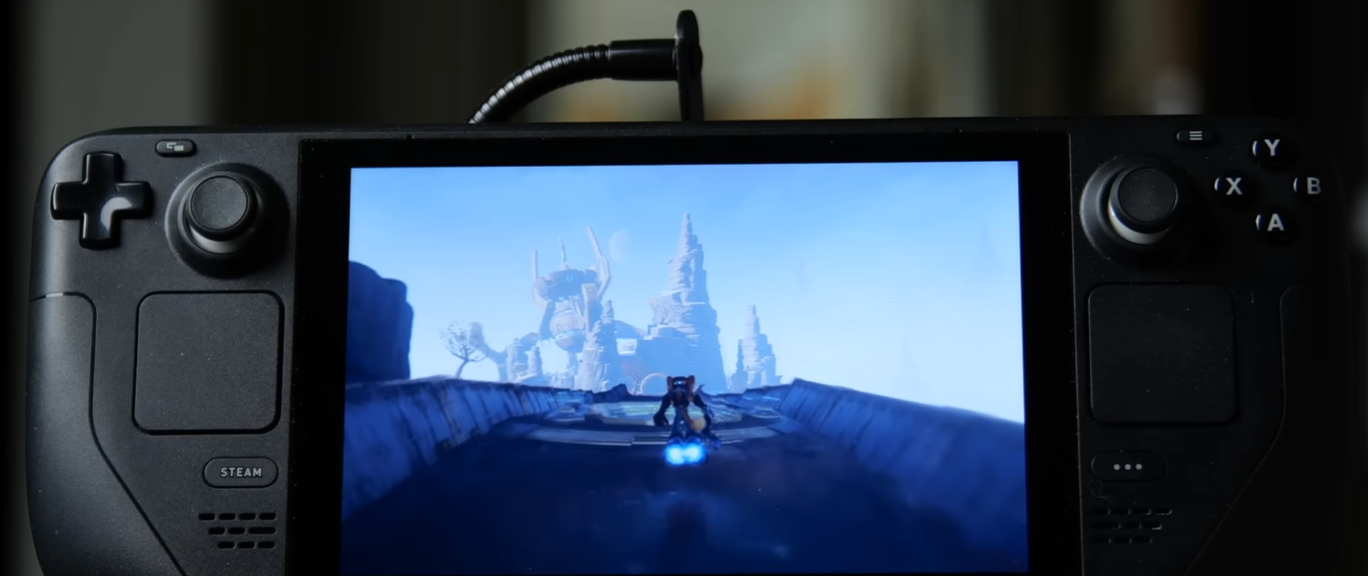
Technology does not stand still and continues to evolve. Games are becoming increasingly “heavier,” and even full-fledged gaming PCs cannot always handle them.
Digital Foundry specialists decided to test how the Steam Deck handles modern AAA releases. The tests began with Horizon Adventures — with high settings and TSR upscaling set to 50 percent, it was possible to achieve 30–40 FPS.
In the case of God of War Ragnarok, the settings were set to the “low” preset and AMD FSR 3.1 was enabled:
“The game’s performance level is solid and relatively stable, usually hitting or exceeding 40 FPS [...] Image quality suffers more than I would like [due to FSR], although on the actual Steam Deck display it doesn’t look too bad.”
Metaphor: ReFantazio was tested with standard settings at native 720p resolution:
“Metaphor has somewhat ‘lopsided’ performance, as 60 FPS is easily achievable in dungeons and combat, while more complex city scenes drop us into the 20s. This isn’t the most visually demanding game [...] we can get a fairly decent 30 FPS here.”
Black Myth: Wukong was tested on low settings with “medium shadows”:
“The visual result is less than satisfactory, with lower-quality indirect lighting, an odd appearance of enemy fur, and images plagued by artifacts [...] We are typically in the 30–50 FPS range, with occasional stutters, but without real sustained frame rate drops outside of the opening section, which remains very demanding. However, as reported, more serious stuttering issues emerge in later stages of the game on PC, so performance could drop in other areas.”
In Dragon Age: The Veilguard, an acceptable frame rate was also achieved after tweaking, thanks to low settings and AMD FSR.
However, as Digital Foundry notes, most recent AAA games run “extremely poorly” on the Steam Deck — these include: Final Fantasy 16, Horizon: Forbidden West, Warhammer 40,000: Space Marine 2, Dragon's Dogma 2, and Silent Hill 2. Sometimes, using low settings makes some of these titles playable, but heavy scenes suffer from significant performance issues.
In the case of Star Wars Outlaws and Indiana Jones and the Great Circle, it was impossible to get past the title screen, so they could not be evaluated:
“Overall, the Deck simply cannot handle a fairly wide range of current-generation software [games] [...] I think my main takeaway from this entire investigation is that more games than ever provide a ‘poor gaming experience’ on the Steam Deck.
You really have to pick and choose: last-gen ports should be mostly fine, while a limited group of current-gen [games] passes the test, often by a narrow margin. However, the reality is that ambitious current-generation games often run very poorly, if at all. It is no longer a reasonable assumption to think that the vast majority of games will at least ‘run okay’ on the Steam Deck, which was generally true early in the system’s lifecycle.”
Video: https://youtu.be/wKs415J5uhI
***
Cover art author: Digital Foundry. Image source: YouTube.com