Vitaly Kazunov
Blizzard leaves China
This is a landmark event. China is a huge market. Gaining a foothold there is the dream of almost every gaming company, especially when it comes to mobile and free-to-play games. The difficulty is that you can only operate in China through a local partner, and almost all the profits will go to them. Yet, for many Western studios, even the remaining percentage is plenty, because the total sum ends up being impressive.
Everyone wants to have a presence in China somehow, but at the end of 2022, Blizzard announced that it was leaving the Celestial Empire. This means that Chinese users will lose access to their games: Overwatch 2, World of Warcraft, Diablo 2, WarCraft 3, Starcraft, Hearthstone, and Heroes of the Storm. The situation is even worse than in Russia and Belarus, where Blizzard pulled out—meaning it stopped selling games, but users got to keep everything they had accumulated. You can keep playing; you just can't give Blizzard any more money.
In China's case, as soon as their partner, NetEase, sees its game license expire, it will simply shut down the servers, leaving users with nothing.
At this point, it doesn't matter who is to blame for the exodus from China: the management of Blizzard or NetEase, whether it was due to political or economic reasons. What matters is that users felt firsthand that they do not own their games. No matter how much money you pour into a company, no matter how hard you try to behave properly on social media, you can simply be cut off from your favorite game, from the community, from communication. In our digital age, for many people, that is precisely WHERE real life and friends are, rather than in the drab daily routine where you see nothing but work, commuting, and home. It's no wonder people are fuming.
Yet while millions of players in China dread the arrival of January 23, 2022, when the Blizzard game servers will be shut down, corporations couldn't care less. NetEase held onto the lucrative Diablo Immortal, which it co-developed itself, and is successfully launching new projects in the West. Activision Blizzard is losing massive markets, but those problems will soon be sorted out by Microsoft. The effective managers will keep their bonuses, while the people were simply milked like cattle and moved to a new stall—donate here now.
Prices for the new generation of graphics cards
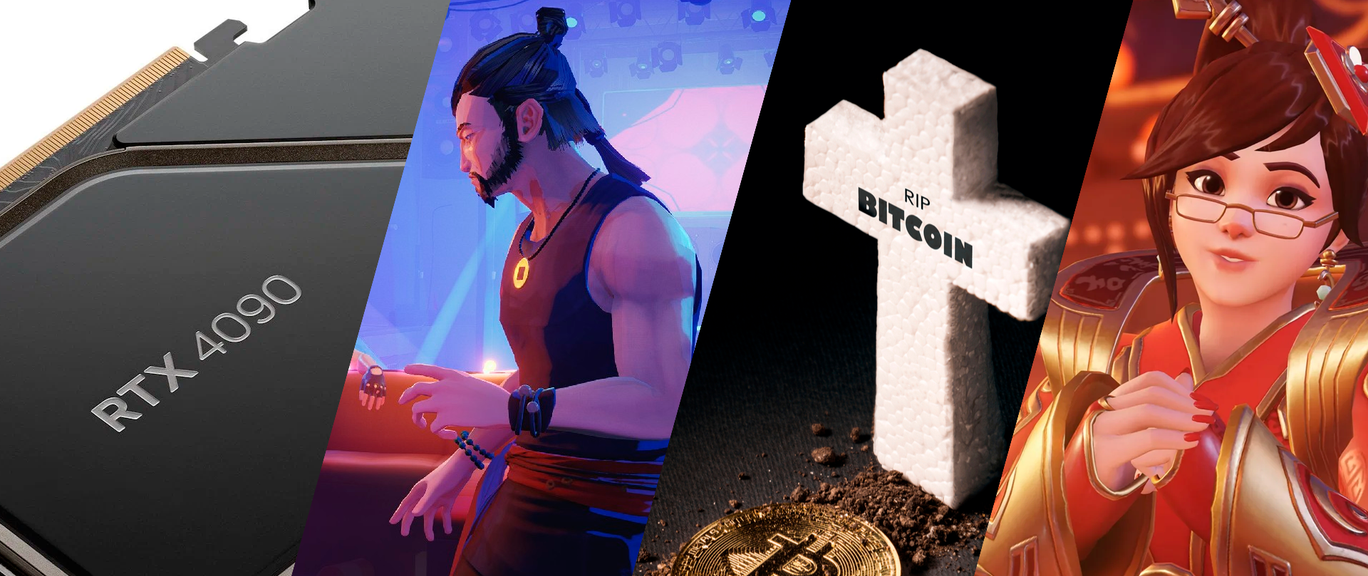
“Moore's law is dead,” is roughly how the head of Nvidia explained the radical price hike for new graphics cards. Want to play in style, with all graphical settings maxed out? Be ready to shell out $1,400–$2,000 for a GeForce RTX 4080 or RTX 4090, with offers varying wildly depending on the region. For the “broke,” there is the RTX 4070 Ti for $850–$1,000 or the Radeon RX 7900 XT and 7900 XTX for $900–$1,400. Absolute madness.
Nvidia promises to soon treat us to “budget” RTX 4060 and RTX 4070 graphics cards. How much will they ask for them? $600 and $700? An RTX 4050 for $500?! Is Nvidia even aware that the mining boom is over, and there are no longer lines out the door for graphics cards? Store shelves are packed with GeForce 30-series cards at sweet prices, and these cards will easily last for 5 years, since consoles continue to serve as the baseline for modern games as before. Whatever runs on a PS5 in 4K will simply fly on an RTX 3060 at 1080p.
Analysts claim that graphics card sales have hit a 20-year low. This doesn't mean people aren't buying them—not at all. It means flea markets and classifieds are overflowing with graphics cards from mining farms at throwaway prices. In the US, you can snag an RTX 3060 for $200 and an RTX 3080 for $400. How long they will last is a lottery, but many are willing to play it to avoid overpaying.
Now is not the best time for a new generation of graphics cards. Due to competition with stockpiles of the GeForce 30-series, prices have to be jacked up. Prices are such that only enthusiasts agree to pay them. Enthusiasts are few, so Nvidia and AMD are asking TSMC to cut chip production. In the end, we recommend buying a 30-series graphics card right now and calmly waiting two years for the launch of the GeForce RTX 50-series.
Mikhail Shkredov
A small number of new games from certain companies
The concept of a “major game publisher” has changed drastically in recent times. Today, it is not a company with a multitude of brands or franchises, but one that has one or two live-service games, or a couple of annual franchises. However, in 2022, select companies outdid themselves when it came to a low output of new games.
Electronic Arts confined itself to its sports lineup headlined by FIFA, a pair of racing games from Codemasters (owned by Electronic Arts) like F1 2022 and Grid Legends, and spat out the failed Need for Speed Unbound near the end of the year, which launched without any noticeable advertising campaign.
Ubisoft surprised audiences more often with disastrous announcements of free-to-play games than with new releases. Nevertheless, the French publisher managed to squeeze out not only the annual musical entertainment Just Dance, but also the flops Tom Clancy's Rainbow Six Extraction (yes, the game came out this year!) and Roller Champions. With the help of a magic kick from Nintendo, Mario + Rabbids Sparks of Hope saw the light of day. There was no new Assassin’s Creed, no reboot of The Settlers, no remake of Prince of Persia: The Sands of Time; even the release of the long-suffering, protracted Skull and Bones drifted off into 2023.
One of the platform holders also joined the “Why do you need many games?” campaign. Microsoft is trying to close its deal to acquire Activision Blizzard, and seems to have forgotten about games altogether. In 2022, Microsoft released version 1.0 of the survival simulator Grounded and the adventure game Pentiment, neither of which look like AAA games or projects designed to attract a massive influx of new Xbox Game Pass subscribers. And yet, at the beginning of the year, Microsoft fans were hoping for an action-packed autumn and the release of Starfield on November 11. Now, all they can do is wait.
Dmitry Krivov
The indie segment is getting bigger and better
While AAA games have sealed themselves under a dome impenetrable to original ideas and parasite on well-known genres and mechanics, indie developers are bursting with creative solutions and offering an expansive lineup of video games across various genres. Yes, these games won't be as visually stunning, but they too are capable of engaging millions of people and selling tens of millions of copies.
Platform holders recognize the strength of the segment and are willing to partially fund, publish original indie games, or include them in subscription services.
Moreover, the audience has a loyal attitude toward such studios—they are forgiven a lot. Small teams assemble, build a “dream game,” which, if it hits the right audience, turns into millions of dollars.
On Steam, the following model is practiced: in the absence of dozens of “effective” managers and a massive budget, indie creators launch games in Early Access, and then, under the close supervision and wise advice of fans, polish the project to version 1.0.
In 2022, a plethora of magnificent indie gems were released. We recommend checking out the following: Signalis, Stray, Neon White, Vampire Survivors, Cult of the Lamb, Symphony of War: The Nephilim Saga, V Rising, Songs of Conquest, Weird West, Tunic, Nobody Saves the World, Potion Craft: Alchemist Simulator, and Against the Storm.
Maxim Dragan
Consoles are machines for budget gaming
Having bought a PlayStation 5 this summer, I had no idea that upcoming Sony exclusives would come so cheap, deliver gorgeous graphics on a 4K TV, and delight with the comfortable DualSense gamepad. A PC is only useful for retro games, strategy titles, and exclusive indie releases.
As it turned out, building a personal computer for the 50,000 rubles that I spent on my purchased PlayStation 5 is simply not possible even today. Now that the mining boom has faded away and last-generation graphics cards can already be bought at more or less reasonable prices, the remaining PC components still cost quite a lot.
Let's do the math. In my case, to upgrade the graphics card at least to an RTX 3080 and spare no expense, I'd have to:
- swap the CPU from an i7-5960X to something newer to unlock the card's potential—add 20,000 rubles to the total piggy bank;
- upgrade the motherboard for the CPU, since the sockets are different—add another 10,000 rubles;
- naturally, pick up a new 850W power supply unit that can handle the new graphics card's voltage—add another 10,000 rubles;
- can't do without 32 gigabytes of high-speed RAM—10,000 rubles for a kit of two sticks;
- the case will also have to be replaced to fit all this gear—let's say it will run 5,000 rubles.
And that's not even counting a new 4K or at least 2K monitor to have, at the very least, a high refresh rate. Now, with a wave of the hand, let's tally up these rough figures and add the cost of an RTX 3080 graphics card, which starts at 80,000 rubles. We get… 135,000 rubles!
For that same money, you could buy both an Xbox Series X and a PlayStation 5—118,000 rubles for both consoles at December prices. You'd still have 17,000 rubles left over in reserve—more than enough for an annual subscription to Xbox Game Pass Ultimate and PlayStation Plus Deluxe in the Turkish region. There would even be money left for AAA games—for either platform.
PC gaming is an extra game of temperature readings, component loads, and frame rates. But how wonderful it is to sit on the couch, pick up a gamepad, and enjoy video games, rather than obsessively checking system readouts against the norm like you're in a spaceship and spending hours inside graphics menus tweaking and calibrating settings for your system.
Mikhail Kazachkin
The death of NFTs and mining
It was hard to resist gloating while watching the carnage across cryptocurrency markets in 2022. For several years, mining poisoned gamers' lives and stripped developers of the incentive to work on graphical enhancements. Unreasonable graphics card prices caused by the crypto boom led to gaming hardware freezing in five-year-old configurations. The Nvidia GTX 1060 and solutions of similar performance dominated players' system towers even 5 years after their release.
Hardware manufacturers, hiding behind words of devotion to gamers and the gaming industry, ramped up production of cards that went straight from warehouses to scalpers and mining farms. Blocking mining for new graphics cards at the driver level predictably failed.
At the end of 2021, an attempt was made to sneak NFTs—digital tokens “confirming” ownership of some asset—into games. Countless Ostap Benders and gaming industry also-rans who joined them, such as Ubisoft, tried to ride the hype. Somehow, they forgot to ask players whether they wanted such “happiness.” Practice proved the obvious: they didn't. People play for fun, not for money.
The rapid devaluation of Bitcoin and other cryptocurrencies in 2022 gave Nvidia a severe hangover. 30-series cards from mining farms, scalpers' warehouses, and manufacturers flooded the consumer market, causing prices to crash. Released at inflated prices, the new 40-series was forced to compete with the 30-series. AMD, which had been losing market share for a long time, promises to squeeze Nvidia out of the market with its new offerings.
There is plenty of conspiracy theorizing and mythmaking around the cryptocurrency market; the consequences of the collapse of one of the largest crypto exchanges remain to be seen, and traders don't always make rational decisions. Therefore, predicting cryptocurrency rates in the long term is impossible, but given events unfolding worldwide, another crypto craze shouldn't be expected anytime soon. Today, mining is partly dead, partly getting by without graphics cards. Mining fees do not cover the cost of graphics cards. NFTs in games died in infancy, holding zero interest for players. Buying and selling in-game items on Steam gets along fine without the blockchain.
It's a field day for gamers. For Russian players, even parallel imports haven't soured things much. New high-performance graphics cards can be purchased at attractive prices thanks to a stronger ruble exchange rate. For the first time in years, the opportunity has arisen to buy a new, capable PC tower at sensible prices. If only there were money. And favorite games worth spending it on.