Source of inspiration
The gameplay and animations of Arzette: The Jewel of Faramore are practically lifted from the dilogy Link: The Faces of Evil and Zelda: The Wand of Gamelon for the Philips CD-i, which today is not considered canon according to Nintendo itself.
The story behind the “cursed games of the series” begins with Nintendo’s attempt to create a peripheral CD-ROM device for the Super NES. The development task was handed over to Sony and Philips, but both contracts were terminated. As a consequence of Nintendo’s endeavors, Philips received the rights to use characters like Link and Princess Zelda on the CD-i console. And the company took advantage of that right.
Philips assigned the development of the games to independent studios, and the working conditions of the unfortunate developers could be described in a single word — limitations. Limitations related to budget, development time, and console capabilities: calling the CD-i a console is a stretch in itself — it was essentially a CD player. The result of their efforts perfectly embodies the phrase “so bad it’s good” — it also spawned memes well-known across the Western community. Although the fact that a playable game came out of it at all can be considered a true miracle!
A modern take
The story of Arzette: The Jewel of Faramore takes place in a standard fantasy kingdom inhabited by magical creatures and beastfolk. The peaceful life of the kingdom was disrupted by the villain Daimur, who escaped from timeless imprisonment. The villain quickly summoned minions, restricted the ability to teleport across the world, and unleashed monsters upon the peaceful inhabitants. Only Princess Arzette is capable of restoring peace and balance, and the player is free to help her in this noble endeavor.
The game world is divided into multiple locations: a forest, snowy peaks, a desert, a graveyard. Movement across locations is restricted by colored barriers – breaking through them requires finding a specific item. And occasionally, you can come across beacons that unlock access to new colorful worlds.
The primary way of interacting with the world is the smart sword. The weapon is used both to slay monsters and to make purchases in shops. And if you poke a friendly character, a conversation will start. When the player finds something important — the location where the item can be used is marked with an exclamation point. But this does not always happen, so it is better to keep in mind “who needs what.”
All characters encountered along the way are memorable:
- A bard parodying Link who actively avoids fighting the forces of darkness;
- A rat living inside a wall that loves to race;
- A very suspicious fairy;
- An exceptionally creepy cook;
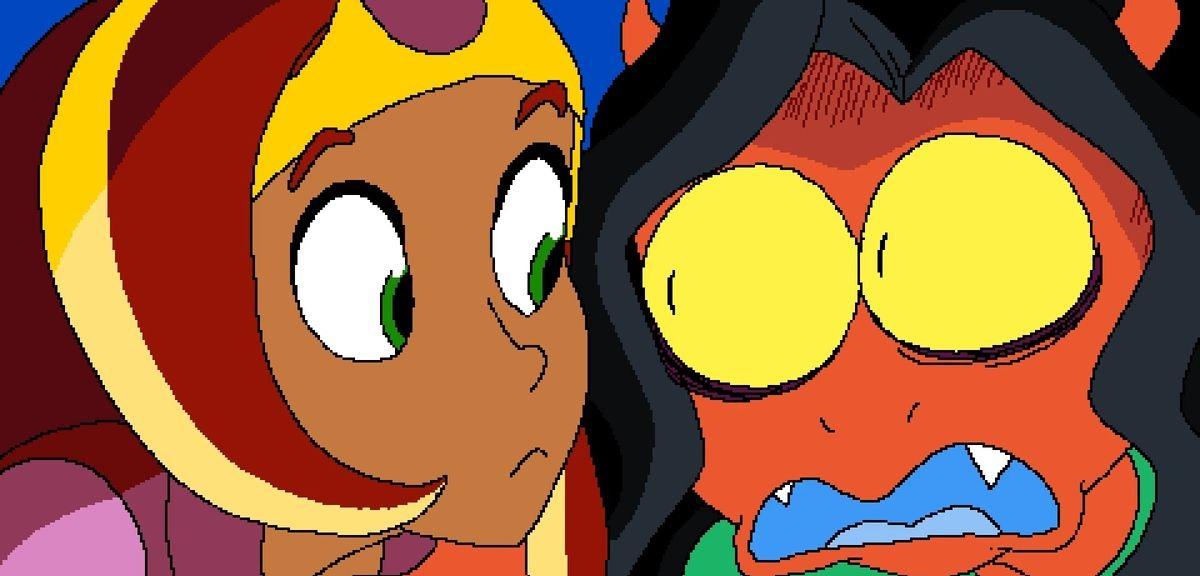
- The charming demoness Zazi, who dislikes the princess but does not know what she looks like.
The locations boast a large number of secrets. If you crouch-walk a lot and blow up cracked rocks, you can find upgrade items. Particularly attentive players will become so overpowered by the end of the game that combat with enemies turns into a joke.
Enemies feature unusual appearances and standard attacks — they are generously scattered across the terrain and pelt the princess with projectiles. Most of them die in a single hit, but the princess does not boast heroic health either — stay alert.
Bosses, on the other hand, can only boast about their looks and personality. Bosses that can only throw projectiles are completely defenseless against a shield that blocks/deflects projectiles. Against the rest, a flask that instantly restores health will do the trick.
In the time free from item hunting and slaying monsters, players can entertain themselves with minigames. Everything there is simple: close doors, find the way out in the dark, or smash pots within the time limit. The process is quick, fun, and awards resources.
On normal difficulty and without hints, the game can be fully completed in about 5 hours on average. After that, a “Boss Rush” mode and a hard difficulty level are unlocked.
Atmosphere
The game looks gorgeous! All locations in it are unusual, colorful, and memorable: a swamp, a beach, pyramids, or just a snowy area — they are full of small yet pleasant details. It is not just your eyes, but your brain that reacts to the giant cattails, beautiful lava lakes, or a submarine.
Cutscenes during dialogues copy the style of their Zelda CD-i counterparts. However, this time they are intentionally made janky. The developers carried over the awkward anatomy, volume, perspective, and the characters’ habit of leaning into the screen straight out of 1993. Only this time, all the flaws feel right and logical. As if it was meant to be that way — which is indeed true.
Complementing the atmosphere is classic-styled music that pleases the ears. The track heard in the forest is particularly memorable.
Diagnosis
Arzette: The Jewel of Faramore is the most impressive game of 2024! It does not just copy a 1993 game remembered for its jank and meme status, but does so skillfully and with an intimate understanding of the source material’s flaws. All the moments that amused players in Zelda CD-i are still there, but gamers also get an interesting world to explore, smooth controls, and great music.
And one should realize: making a good game is already hard, but deliberately making it bad so that it ends up being an engaging and entertaining project is even harder.
Pro:
- A successful parody of the “janky classic”
- Unique game world
- Smooth controls
- The player’s curiosity is generously rewarded
- Lots of side activities
- Charismatic characters
- Great music
Contra:
- Too easy on “normal” difficulty
- Lack of Russian localization
***
All images belong to Seedy Eye Software and Limited Run Games