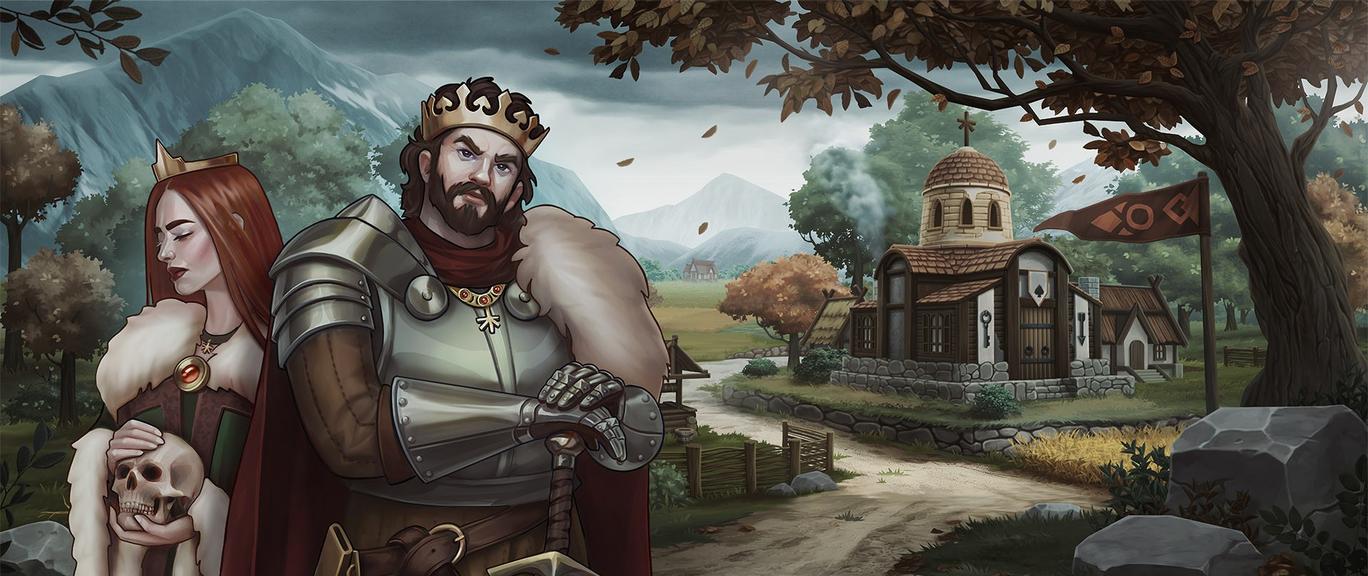
Before starting, the game offers a detailed system of initial parameters. The player is free to choose the difficulty; customize the king and his family; choose their people; and make life easier or harder using additional settings. Finally, the starting location is chosen – taking into account available resources and neighbors.
The choices made transport the player to the starting settlement. This is a small village that needs to be turned into a thriving kingdom. And here, fans of Knights and Merchants will be able to have a blast. After all, despite the visual style and mechanics reminiscent of RimWorld, the game feels like that famous strategy game from the past.
A variety of buildings are responsible for the economy of the future kingdom:
- Rutabaga grown in the field is used for food and to brew moonshine. Due to its low quality, neither peasants nor lords like it. But if you feed rutabaga to pigs, it lets you slaughter them for valuable meat;
- Rye is ground into flour, which simply remains flour – apparently, people devour it straight from the sacks... But if you mix rye with hops, you get beer;
- Wild herbs are turned by the alchemist into healing salves and nectar – a local tonic with mind-altering properties;
- The workshop produces tools and simple weapons.
All the heavy lifting falls onto the shoulders of the peasants, who arrive in the kingdom in a continuous stream. The hard workers chop wood, mine iron, and manufacture goods. At the end of the day, they receive wages, which they immediately spend on food and booze. In essence, it is free labor, if you don’t count the consumed food and alcohol.
For a comfortable life, peasants need housing, food, alcohol, and temples. Happy peasants become loyal servants of the crown – while unhappy ones stoop to crime. To combat bandits, you need to build a scaffold so that executioners can terrorize the populace. It is better to execute criminals, as public trials boost the general mood, though one of the spectators might get the idea: “Hmm. That guy was just executed for public amusement. Maybe I should follow in his footsteps.”
The only problem with this system is that peasants arrive in the realm in an endless stream. Accommodating all of them is impossible, and crime rates will inevitably rise. Which means this cycle of crime, executions, and crime again will never end.
Order is maintained by the king and his loyal lords. Lords must assign instructions, and assigning them to a building boosts its productivity. If peasants aren’t given instructions, they will just stand around with their mouths agape: “What should I do with an axe at the sawmill? Till the soil, probably!” Over time, administrative work can be delegated to the chancellery. This greatly streamlines the process, although running the chancellery still requires a lord’s presence.
Education allows lords to read books. Reading unlocks access to new buildings and technologies. Some books are written in an unfamiliar language, making it reasonable to hire a lord from another culture. Sounds great, but once a lord dies, the research disappears with them – you can no longer build or repair the buildings they researched, and bonuses are lost. As a result, you have to sit another lord down to study, even though they are already busy.
Lords, just like peasants, need housing, alcohol, and food. But they also need sex. A lord who abstains for too long will stoop to an affair with a peasant, which spoils their mood and leads to the birth of a bastard. Church-approved procreative interaction among royals yields future heirs. Children are useless in everyday chores, and the lord must tutor them every day. It is worth noting that all lords are lustful, and even at an advanced age, they behave like hormonal teenagers.
To protect the kingdom, an army is needed to patrol the streets and wipe out bandits. Soldiers are recruited from peasants and mercenaries, equipped with gear, and placed under the command of a lord. The resulting squad is sent into bandit camps or the lands of an undesirable neighbor.
Battles in the game do not stand out for epic scale or a variety of mechanics. Winning a battle rewards you with prisoners who are sent to the kingdom. The game hints that prisoners can be used as free labor – they work for food and stay on shift three hours longer. But my peasants also work for food, and they don’t need supervision. Therefore, it is simply more profitable to sell the captives.
Medieval folk are remarkably devout. To satisfy their spiritual needs, you need to build altars and temples. God-fearing lords should not get into brawls (which they love to do) or have affairs on the side. Having committed a sin, a lord suffers remorse until a bishop absolves their sins. Apparently, executing thugs is also frowned upon by the Church: after yet another execution, my lord sank into depression under the weight of committed sins.
Periodically, a holy caravan arrives in town – to trade and collect a military tax. At the caravan, you can buy and sell goods, prisoners, and books. The better the kingdom’s relations with the church, the richer the selection. But if you sell too much of one type of good, its unit price will drop.
The caravan is the only place where you can purchase holy rings. This is a rare and valuable resource used to hire lords, improve relations, bribe, and grant absolution. All lords crave receiving rings as gifts, and if you fail to give them any, their mood plummets. At one point, all four of my lords were overcome with a craving for rings and fell into depression.
The kingdom is surrounded by numerous neighbors. They constantly weave intrigues, wage war, make peace, and trade. An enemy king can either be captured and killed or befriended. To do this, you must send a lord there who will entertain the neighbor with conversation or a joint wolf hunt.
Good relations enable trade. Neighbors only buy and sell certain goods, but on the bright side, their prices do not collapse the way caravan prices do. If your army’s size permits, the neighbor’s lands can be annexed as a province or vassal state. Or you can burn the bastards to the ground...
I never managed to properly engage in global politics. The culprit was the never-ending stream of peasants, which absorbed all my attention and time. Furthermore, my lords were far too busy managing, training, and studying to build diplomatic relations on top of that.
What’s more, considering everything happening on screen, the game is surprisingly well optimized. The only downside is the long load times. Also, at one point, the UI system for tracking resources and desires broke for me – I had no idea how many rings and flour I actually had, and a lord was dying for a drink but couldn’t have one. And I had enough beer to drown in!
Diagnosis
Norland hooked me. It is an enjoyable game, with intriguing and diverse mechanics, and a distinctly Slavic visual style. It features solid sound design and music. But many mechanics need to be refined before the full release, otherwise their overall clunkiness will make you burn through your own chair!
One of the main issues is the uncontrollable flood of peasants, which is tough to manage. Holy rings are perpetually in short supply, and the developers should consider letting lords forge them on their own — they aren’t Nazgûl or something, but nobles! It would also be nice to ease the burden on lords, who, despite their high status, are expected to juggle administration, trade, tutoring, commanding troops, and politics. The mechanic of losing tech upon a lord’s death also feels superfluous.
The game releases into Early Access on July 18, and one can only hope that at least some of these issues will be resolved during the active polishing phase before the full release.
***
All images belong to Long Jaunt and Hooded Horse. Preview image taken from SteamDB