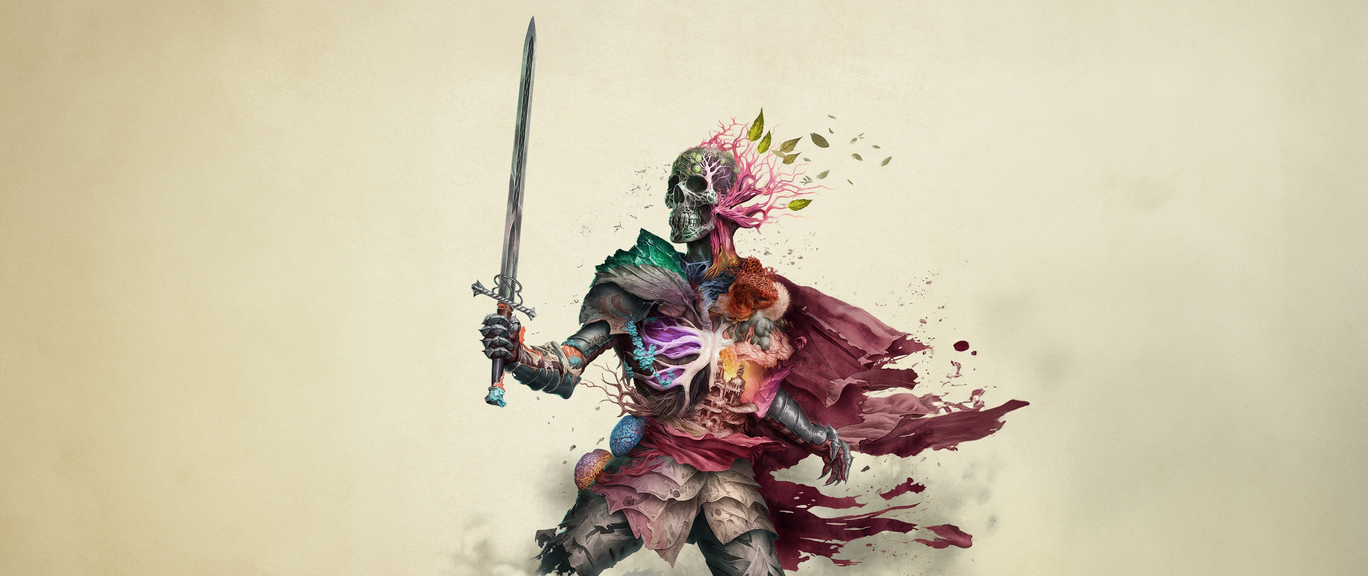
Storyline and role-playing component
The game is set in the Pillars of Eternity universe. The protagonist is a godlike — a human touched before birth by one of the gods, who became their patron. However, no one knows which god bestowed such an honor upon the protagonist. The story begins with the main character — an envoy of the Emperor of the Aedyr Empire himself — being sent to the Living Lands to deal with a plague known as the “Dreamscourge”.
Upon arrival, we find ourselves caught in several conflicts at once: the “Dreamscourge” is spreading rapidly, hatred toward the Aedyr invaders is growing among the locals, the elite Aedyr military organization “Steel Garrote” and its leader — Inquisitor Lödwyn — seek to resolve these issues radically, and the protagonist begins hearing a mystical voice in their head pleading for help.
The story in the game turned out to be straightforward, slightly dragged out, and somewhat predictable — it immediately becomes clear who the final antagonist will be.
Nevertheless, the role-playing aspect of the game is solid. Over the course of the playthrough, the player will have to make several crucial decisions: from how to handle a rebel killer to whether it is worth sacrificing a hundred to save thousands. Some of these decisions will be brought up all the way through the end of the game. In some cases merely through dialogue, while in others they carry direct consequences: you can rescue an NPC early on, and she will assist you in another side quest, while a choice in the main story leads to the death of a supporting character.
You can also be evil: refuse help, lie, kill, betray, destroy — do whatever your heart desires. You can even side with the antagonist at the end, which will cause your companions to turn their backs on you!
The writing is somewhat uneven. There is a lot of redundant chatter and terms unfamiliar to newcomers to the Pillars of Eternity universe, while talking to the voice in your head feels outright delusional with its nature allegories that would confuse anyone. You often feel like telling it to get lost — and you actually have that option! It will not really change anything, but it will feel satisfying and amusing.
Characters also occasionally blurt out things that will leave you baffled or in stitches. Obsidian’s signature humor is very much present! For instance, one of the side quests features the following dialogue:
Daiko: I promise a great reward to whoever helps me. I wink.
Protagonist: Did you seriously just say “I wink”?
Daiko: No! Wink again.
Adult themes also surface in dialogue from time to time, and their context varies widely — from serious to humorous, and even intimate.
A great deal in the game hinges on dialogue. The available choices are often influenced by attributes (more on this below) and your chosen background — they do not always drastically alter the outcome, but some of these options are genuinely interesting.
Side quests are varied. There are mundane “fetch-bring-kill-find” tasks, as well as genuinely well-crafted, branching quests with diverse approaches and moral dilemmas:
- A story where we encounter another godlike. In the end, we can either defeat them in battle, succumb to their persuasion and sacrifice ourselves for their experiment (triggering a Game Over), simply walk away, or convince them to sacrifice themselves instead;
- Or a quest where we can poison the quest-giver — all to save other characters;
- There is also an assignment where we act as a diplomat trying to broker a compromise between two conflicting factions — guards and those who broke away from them.
It is a shame there are so few such quests — you literally have to seek them out, sifting through heaps of “standard” chosen-one chores typical of many RPGs.
Companions and their stories
Throughout the game, we meet four primary companions:
- Male Aumaua Kai;
- Female animancer Giatta;
- Orlan wizard Yatzli;
- Dwarf ranger Marius.
Each possesses a personal storyline detailing the character’s tragic past: Kai will recall an old friend, Marius will dwell on his family and homeland, Giatta will contemplate how to move forward, while Yatzli will discover new possibilities and face a dilemma: her dream or the one she loves.
You can talk to them while resting at camp — they will gladly discuss your choices, both in the main plot and in side activities. You can only bring two of them along in your party at any given time.
During story dialogues, companions will occasionally chime in with their two cents, adding flavor with their opinions — sometimes it is helpful and helps you decide, while other times it only complicates matters. Furthermore, at key decision points, you can often directly ask your allies for their perspective. Companions can banter and sometimes bicker, and certain narrative decisions will delight some while baffling others — the characters truly feel alive.
While party members initially seem like useless fodder dying every other battle, their utility grows over time — they do not deal massive damage, but their support and healing skills are always needed. In combat, the player can issue commands to companions via a dedicated ability menu that pauses the game — much like in Dragon Age: The Veilguard.
In addition to the aforementioned quartet, there are also a couple of temporary companions available during the prologue.
Combat system and progression
The combat system is built on combining skills from three classes: Fighter — focused on direct damage, Ranger — oriented toward stealth and control, and Wizard — magic-focused.
You can stick to one of the three options, but there is little point: the player is not constrained by attribute requirements, essence (mana) is required to use abilities across any class anyway, and you can equip two weapon sets simultaneously, switching between them with a single button mid-fight.
The available arsenal is impressive: wands, swords, bows, axes, maces, shields, daggers, pistols, arquebuses, and spell grimoires. All of these can and should be combined — with the exception of two-handed weapons, you can dual-wield across hands.
Spells also cater to every taste: various elemental damage types, life leech, gravity anomalies, summoning weapons and creatures, vine entanglements, armor penetration, and so forth. However, to access most spells, you first need to find a grimoire containing them and only then learn them.
In battles, you constantly have to manage your stamina. It is spent on attacks and dodges, so it is best not to get greedy with strikes to avoid taking avoidable hits to the head. And if you do take a lethal blow, you can revive once every few minutes. All these combinations and the constant experimentation make Avowed’s combat dynamic and engaging, though several caveats exist.
Enemy variety is rather weak — you fight bears, xaurips (humanoid lizards), and skeletons in the opening area, and you will continue fighting them in the final one. With each new biome, the bestiary expands, but these three core categories haunt the player from start to finish. Particularly bears, whose numbers throughout the game reach absurd levels.
If you use magic frequently, by the second or third hour you will grow thoroughly tired of the vocal delivery — across a solid repertoire of spells, the character only has two or three voice lines for casting them. The player hears the exact same lines every single time! The only exceptions are skills from the godlike tree.
Battles themselves often follow a formulaic script: the player is swarmed by a pack of enemies, among whom there is almost always a priest without killing whom you cannot dispatch the rest. Or a summoner capable of conjuring an entire army of minions — wasting time on their lackeys is pointless. So you end up sprinting through crowds of enemies just to locate the priority targets.
Enemies have a stagger meter; once filled, the player gains the chance to perform an execution move dealing massive damage. Yet there is literally only one single animation for this move across the entire game.
You can play Avowed in either first-person or third-person perspective — just like Bethesda’s The Elder Scrolls series. However, third-person gameplay looks subpar: due to clunky animations, both combat and exploration look dull, lacking any sense of momentum. First-person battles, while nicely staged, can become very disorienting due to enemy rushes and a flurry of visual effects.
Character progression and leveling
Progression consists of three components.
The first aspect is classic attributes: Might, Dexterity, Constitution, Intellect, Resolve, and Perception. They grant various bonuses, from damage to health — for instance, Might increases all damage, both physical and magical, while Intellect only affects maximum essence — and unlock diverse dialogue options. All of this can be redistributed for in-game gold at any time, provided you are out of combat.
The second element is skills. There is a wide variety of combat talents across the three aforementioned classes, including active and passive ones. Each features multiple upgrade tiers that enhance their effectiveness. If desired, you can combine completely different skills, altering your combat playstyle.
There are also two supplementary skill trees:
- Godlike — ultimate abilities acquired as you progress through the game, offering exceptional utility;
- Companions — talents belonging to your allies, also featuring several upgrade ranks; these can be assigned to hotkeys and used both in and out of combat. For instance, Kai can burn webs to clear the path into a new area.
The third aspect shaping your build is gear. And it is the most critical, since equipment directly governs both the damage you take and deal to the greatest degree. Items can be upgraded at camp at a dedicated workbench. A compact crafting system is provided for dismantling unwanted junk and crafting higher-tier resources.
World exploration
One of the most contentious parts of Avowed that I must mention.
On one hand, the developers did a great job with level design. Not so much visually, but strictly in terms of game design. During your journey, you constantly want to delve into another ancient ruin or figure out a way into a building barred from the inside — it always presents a mini spatial puzzle you want to tackle, even if you told yourself: “I’m only sticking to the main quest!”.
Often enough, entering such structures can be achieved in multiple ways: climbing through a hole in the wall or roof, picking a lock or locating a key, bashing down a wall at a specific weak point, or entering from an entirely different direction via another building, a crawlspace, or a cave.
All of this feels rewarding to engage in because parkour is fluid and enjoyable. The character jumps far and easily mantles most ledges, while the ability to freeze water to walk across it or shatter grates with ice adds to the immersion.
The urge to “check out that cave over there” is further fueled by the fact that treasures always emit a distinct sound, as if calling: “I’m here, find me!”.
Yet the game rarely rewards the player with anything of genuine value for their efforts. Avowed is filled with chests of various sizes, but in 95% of cases their contents are identical — upgrade resources and random junk. After 10–15 hours of exploring like this, that chime begins to wear on your nerves.
Furthermore, the game world feels thoroughly lifeless: NPCs and fauna do not react to your actions and remain static. Splashing or shooting into water produces no ripples or splashes, and certain areas are unreachable despite having no barriers other than invisible walls.
The visual design of locations is also mixed. The developers attempted environmental storytelling but seemed to abandon the idea halfway through production, plastering the remaining spaces with an endless supply of notes that are hardly worth reading — there are so many that a single tiny spot can hold 3–5 at once! Will you find anything fascinating there? Most likely not.
Graphics and technical performance
The visual presentation of Avowed remains a subject of debate. Those who remember the 2020 announcement teaser with its grim tone will find it hard to embrace the style the final game adopted. The contrast is stark, even if such saturated color palettes are trendy nowadays (thank you, Fortnite!). On the other hand, it is classic colorful fantasy without modern frills. The quirks of the chosen engine can sometimes strain the eyes, but it is easy enough to get used to.
Moreover, the game world is split into several regions, each distinct from the last, sometimes dramatically so. While the original dark gritty aesthetic never made the cut, calling it an overly “candy-colored” game in the end would not be fair either.
During the first few days post-launch, many complained about crashes, severe stuttering, and other performance hitches — courtesy of Unreal Engine 5!
On my PC, I only encountered occasional framerate drops down to around 22–23 fps (mostly in towns and surrounding areas), and the game froze completely once. That is considering my graphics card — a GTX 1660 Super — is weaker than the GTX 1070 listed in the minimum system requirements.
On console — tested on Xbox Series S — there were no performance issues whatsoever, though the visuals were noticeably blurrier than on PC.
As for bugs, they were limited to side quests. Once, I came across an NPC marked with a quest icon who refused to give it to me, repeatedly muttering the same canned line. Another time, I discovered multiple locations marked with quest exclamation marks on the map that were completely empty. I may have arrived too late after triggering a story event, but in that case, the quest icons should no longer have been visible.
Diagnosis
Avowed is — by Obsidian’s own admission — an average game that does not attempt to be anything more. And that is exactly what it delivers: for every undeniable strength, there is a counterbalancing weakness.
The free and versatile combat system is undermined either by the game’s low budget or by haste in yet another attempt to overhaul the project and rush it to release: few enemies, few spellcasting variations, a single finisher animation, and the exact same combat tactic in most encounters. This same aspect has also hurt world exploration — the level game design is magnificent, but the world itself is completely dead. The repetitive loot starts to make you sick by the end of the first third of the playthrough.
The narrative is also a mixed bag: it constantly swings from genuinely important moral dilemmas to nonsensical gibberish and purple prose. The role-playing system is a success, but all the consequences a player might face are negligible — with a couple of exceptions, perhaps.
However, judging Avowed as a whole — it is a solid role-playing game that takes about 35–40 hours to complete. And most importantly — it doesn’t overstay its welcome. That is precisely what saves it.
Pro
- Versatile combat system and progression
- Well-developed role-playing component
- Great open-world game design that is exciting to explore
- Features some cool side quests
- Plenty of good humor
Contra
- Budget constraints and haste across the board
- Lots of purple prose in the writing
- Technical issues of Unreal Engine 5
***
All materials used belong to Obsidian Entertainment and Xbox Game Studios