The story of the Shroud
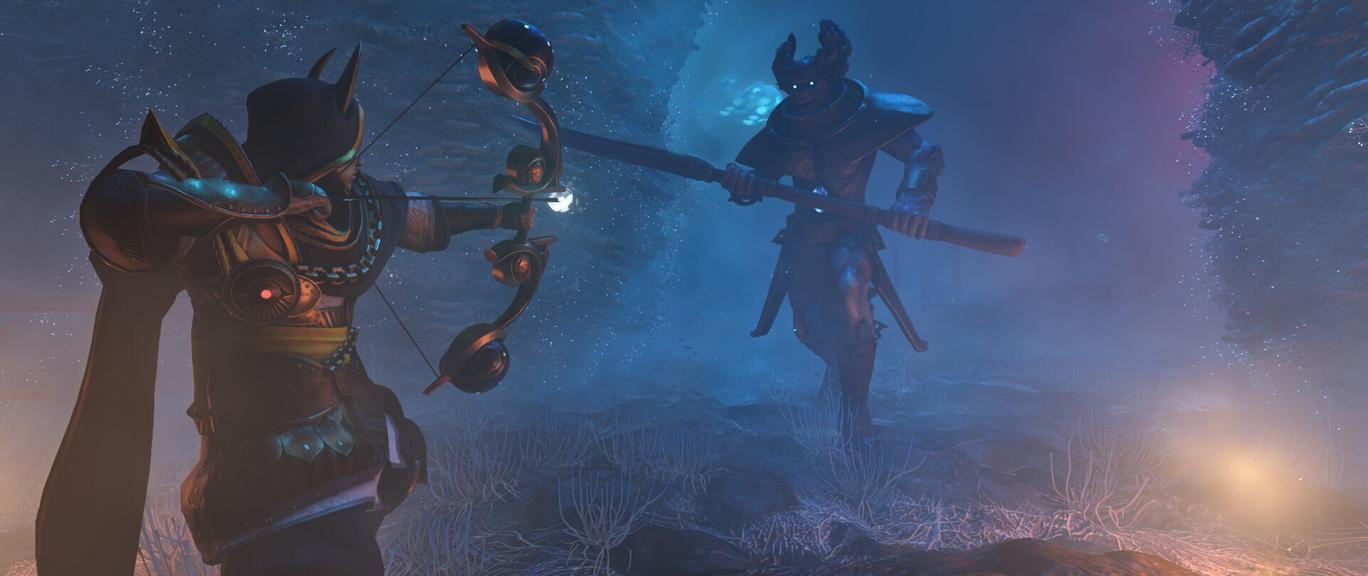
Once upon a time, all was well in the kingdom of Embervale, until a mysterious wanderer presented its inhabitants with a powerful elixir. The potion granted people tremendous power, but corrupted them: consumed by greed, they began mindlessly pumping the concoction from the depths of the earth, killing one another. Their insatiable thirst brought forth the ominous Shroud, turning the inhabitants into monsters. Civilization collapsed, and the survivors fell into a magical slumber.
The protagonist is the Flameborn, a chosen warrior created by the Ancients. Driven by a sacred source of life energy, they must restore peace, destroy the Shroud, and save Embervale.
The story is conveyed through dialogues and quests: the protagonist finds allies, summons them at the base, and talks to them, advancing the narrative. The rescued survivors gradually share their backstories, regularly giving the player tasks: find and return a valuable item, rescue another character, slay a dangerous monster, and so forth.
The environment in Enshrouded is also part of the storytelling. While exploring the world, you will often stumble upon locations where, with a quick glance around, it is easy to understand what happened: an attack by monsters, bandits, or the Shroud.
Notes scattered everywhere complete the picture—fortunately, they are highlighted with a bright glow and are hard to miss. The texts tell the stories of specific characters and locations, expanding the world’s overall lore. Moreover, they are all well-narrated in a voiceover that is pleasant to listen to, just like an audiobook. It is a pity that this voiceover is only in English.
However, the story here serves merely as a foundation for the gameplay. You should not expect major revelations or unexpected plot twists. There is also hardly any cinematic staging: just a voiceover narrative accompanied by still images. And for a project like this, that is perfectly fine.
Can you do... whatever you want?
Enshrouded’s gameplay revolves around survival in a vast open world. You will gather resources, set up your base, fight monsters, explore the world, eat, swap and repair gear, fish, hunt, breed livestock, tame pets, and so on.
Food can be cooked, such as roasting meat over a campfire, or scavenged across the game world as various berries, vegetables, and more. You can also cultivate your own vegetable garden, harvesting crops from time to time. Food provides buffs and restores health, while water and rest boost your maximum stamina.
Time also affects gameplay: more enemies appear at night, it gets pitch-black, and certain locations only open during these hours. But you can go to sleep, and while you are in bed, time speeds up 60 times, bringing morning very quickly.
Crafting is a whole rabbit hole you can easily get lost in for hours. You can craft gear, household items, tools, and more: basic necessities can be crafted anywhere via the menu, while bulkier and more crucial items require the help of allies at your base.
By freeing NPCs and helping them, you expand these opportunities. The carpenter, for example, will ask you to find parts and build a table saw, granting access to advanced woodworking. The more of these errands you complete, the more options become available.
The project allows you to make the most of survival game mechanics. I once ran into a small mountain on my way to a quest marker, and instead of searching for a detour, I pulled out a pickaxe and dug a tunnel straight through. I gathered plenty of resources and had a blast doing it!
You can go even further: hollow out an entire mountain and erect a whole settlement in its place, with bombs speeding up the process significantly. Slow and steady carves the whole map!
The developers deserve extra credit for the machinery. You can build large plumbing systems to bring water into your home or design custom dungeons packed with traps, then share them with other players for a challenge. Awesome!
The world in Enshrouded is vast: it features several biomes packed with intriguing locations to explore, such as dungeons, temples, towers, abandoned castles, and much more. They are filled with straightforward puzzles and traps, rewarding you with chests of valuable loot and fast-travel points.
Traversing these places feels seamless, thanks to a well-rounded mobility system: you can unlock a double jump skill, craft a glider to descend from great heights, or use a grappling hook to latch onto specific ledges.
The Shroud has become a standalone game mechanic. These are large, fog-filled zones where various monsters roam, unique resources spawn, and fast-traveling is disabled.
When entering the Shroud, a countdown timer starts, urging you to move swiftly and explore these areas while keeping an eye on the clock. If time runs out, your character dies, and you have to sprint back to your grave. At times, I accomplished everything I set out to do but failed to escape before the timer expired, forcing me to trudge a long way back in frustration to retrieve my gear. It is like a mini extraction shooter of our own.
Occasionally, you come across Shroud Roots, which harbor a boss or a mob of enemies guarding them. If you defeat them all and chop down the tree, a portion of the zone will be cleansed, and you will be rewarded with some excellent gear.
It is also crucial to manage your stamina, which is influenced by several factors ranging from your character’s exhaustion to the weather. For instance, when it rains, the bar decreases noticeably, which you must take into account. Miscalculating can easily cause you to plummet with your glider or lose a fight because you ran out of stamina to block or dodge an incoming blow at a critical moment.
How progression saves the entire combat system
In combat, you can perform light and heavy strikes, dodge, block, and parry. Both the player and monsters have a stun meter; once it fills up, the character is paralyzed for a few seconds, left open to attacks. By mastering the right skills, you can even use a grappling hook to pull enemies in or pull yourself toward them.
Yet combat feels overly simplistic: clunky animations fail to deliver solid feedback, and enemy movements are not always easy to read. As a result, fights feel stiff, leaving a sour taste on higher difficulties where the cost of a mistake spikes exponentially.
The enemy AI is also somewhat dim. You can easily outsmart opponents and turn the environment against them. Bandit camps, for example, are almost always scattered with traps that you can lure the bandits into.
Gear and character progression make up for the combat’s shortcomings.
You can use all weapon types simultaneously: one-handed and two-handed swords and axes, daggers, a magic staff, a wand, and a bow. You can hurl bombs, summon skulls that attack foes, and so forth.
Exploring the world yields plenty of consumables and powerful weapons, including legendary gear with great perks that dish out substantial damage to enemies. There is more than enough of this loot to go around.
The enemy variety is pleasing: standard bandits and forest beasts, skeletons, Shroud monsters, giant bosses, and many more. There are even Easter eggs like the Vukah race, which resembles the Wookiees from Star Wars: they also live in tree canopies in similar dwellings and look like yetis.
It is worth noting that the game cannot be paused, so you cannot freeze the action during a tough duel or while gliding downward.
Progression in Enshrouded allows you to upgrade multiple aspects at once, requiring a massive amount of varied resources. Consequently, your inventory fills up fast (thankfully, it can be expanded), and your base ends up with rows of chests to stash all that “useful junk.”
Players have access to an extensive skill tree that includes both simple stat boosts and new combat and crafting capabilities. For instance, you can learn a special finisher against stunned foes or increase resource gathering efficiency.
By the way, the game allows unlimited respecs. Don’t like your current build? You can easily try another one!
Gear can also be upgraded: each level raises attack power and provides welcome bonuses. This requires special runes, which drop from slain enemies and can be acquired by salvaging unwanted equipment.
Some weapons can be socketed with gems that grant various effects, such as inflicting bleed on melee hits. However, you must first track down both the gems and the workbench hidden inside the Shroud.
You will also need to upgrade your base by strengthening the Flame in two distinct ways: one expands the overall building area, while the other grants player perks, such as increasing your time limit inside the Shroud.
Flexible difficulty for everyone
Thanks to the difficulty settings, the game can turn into either a brutal challenge or a walk in the park, as difficulty alters not just incoming and outgoing damage, but also several core gameplay mechanics.
For instance, on the standard difficulty, dying makes you drop your gathered resources (except food and equipment), which you must retrieve from your death marker. Luckily, dying again on the way does not make your loot disappear, and while monsters do respawn, they do not do so immediately.
However, switching to the easiest preset—“Relaxed”—means you won’t drop anything upon death, and weapons will no longer degrade. The game turns into a pleasant grindathon where you can sink dozens of hours while putting on a podcast or music playlist in the background. Admittedly, it can get dull at times, since dying is nearly impossible unless you get distracted in combat or plunge into a chasm.
Starting from “Hard,” the game mounts a serious challenge, to say nothing of “Survivalist.” These difficulties are largely tailored for co-op, with up to six players sharing a server at once.
It might seem like a false choice: either play with no challenge at all or perish in two hits while constantly starving. Yet you can fine-tune numerous parameters to your liking—which is unquestionably a huge plus.
Verdict
Enshrouded is a game that can be finely tailored to your taste: transform it into an engaging grindfest or a brutal challenge, play solo or adventure with friends, pore over every lore note or breeze past the story entirely.
At your disposal is a solid, if imperfect, combat system, deep progression across every front, the ability to build and decorate an impressive personal castle, and a massive world ripe for exploration.
At the same time, the game rarely feels tedious: the gameplay pulls you in and makes you lose track of time. All systems are remarkably well-balanced, granting players a genuine sense of freedom. And if you dislike the presets crafted by the developers, nothing stops you from tinkering with the settings.
Still, boredom can creep in occasionally. While exploring the world, it is easy to feel a sense of loneliness. The world is so vast that certain areas seem to demand that you find your own fun. Yet you can always switch tasks: instead of another attempt to conquer a dungeon, you can focus on sprucing up your homestead into something truly magnificent. Time will fly by before you know it!