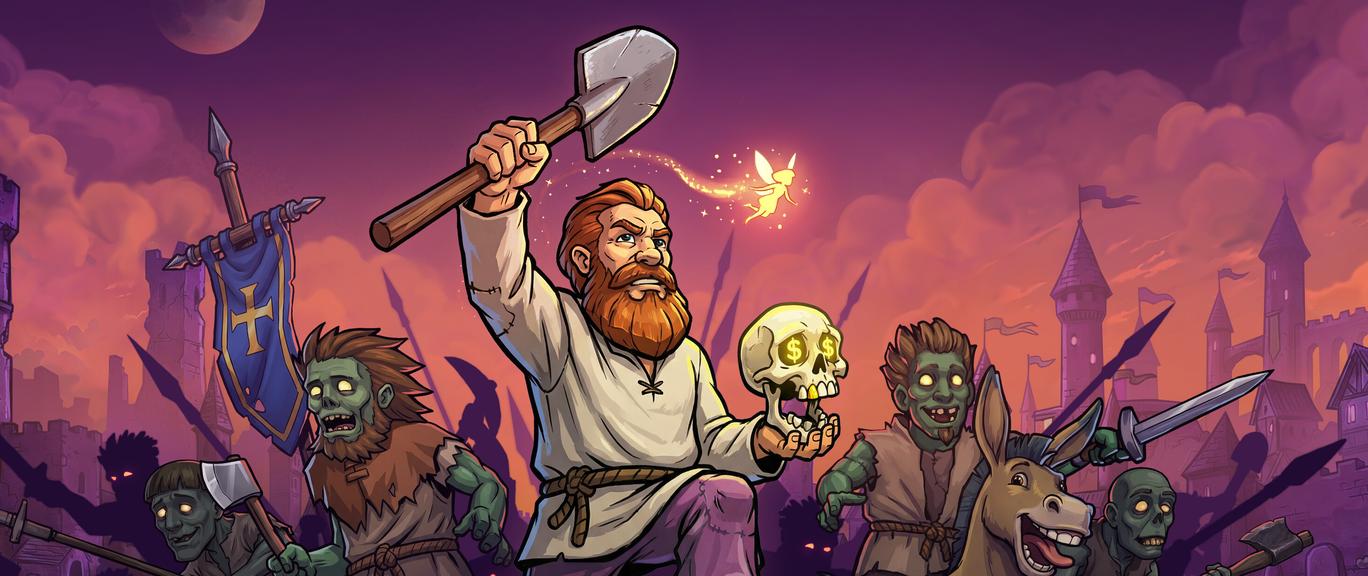
The story of an offshoot isekai traveler in another world
Right from the start, the game pleasantly surprises with high-quality voice acting: all characters sound lively and expressive, including the protagonist. It gives the impression of playing a solid point-and-click adventure on par with Monkey Island or Deponia. Alas, Graveyard Keeper 2 did not continue down this path.
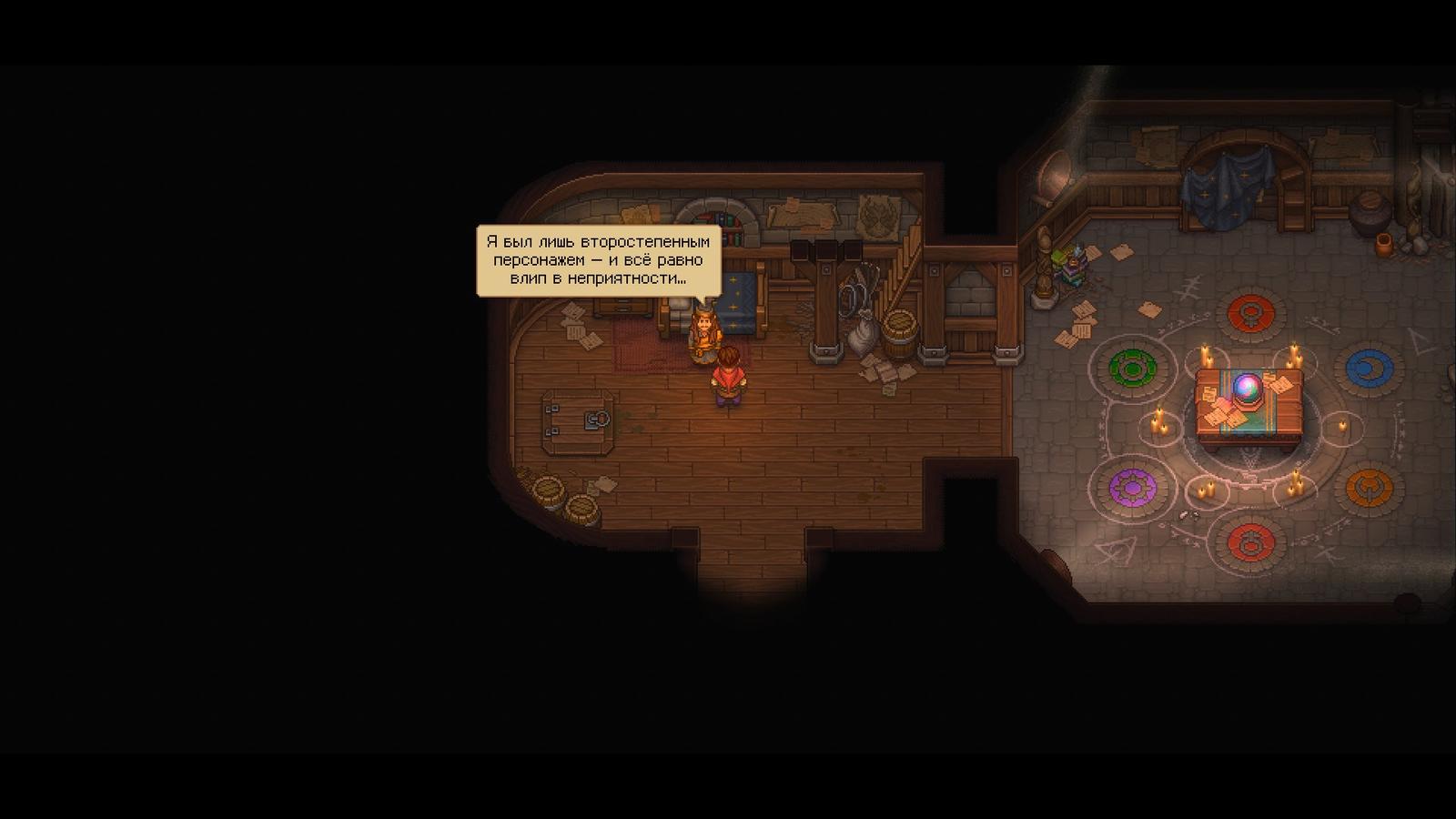
The protagonist is a classic isekai character who got into an accident. A certain deity split his essence into two halves and sent him to a fantasy world to oversee a cemetery. As the opening quickly explains, the dark half from the first installment turned out to be greedy and despicable, committing pure atrocities at the player’s instigation.
Now the good Keeper must deal with the consequences of his doppelgänger’s sabotage: devastation and an accompanying zombie apocalypse. The hero will have to restore the churchyard, rebuild the ruined estate, and reclaim the town streets from hordes of aggressive undead.
The Keeper’s direct duties
A talking communist donkey regularly delivers fresh corpses whose traits are determined by white and red skulls:
- A body with white skulls is suitable for burial;
- Red skulls are needed to upgrade zombies that will assist the Keeper with daily chores.
You must bury the deceased properly: dig a grave, lower the body, erect a tombstone and a fence. As technologies are unlocked, conditions for the churchyard’s residents improve, and a well-tended cemetery pleases the eye while directly boosting church services.
The Keeper here fills every civic office, including the role of preacher. During the service, you can pray for wealth, luck in combat, or success in crafting. Personally, I used nothing but the prayer for faith: this resource is vital for upgrades and complex production, and needed in huge quantities.
Over time, the game imposes a penalty: the more undead under the hero’s command, the weaker the effect of the prayers. The restriction is lifted using hypnotic devices. This is a frankly immoral step that completely shatters the image of someone redeeming others’ sins. Furthermore, the devices require constant feeding with that same faith, and the hypnosis effect wears off far too quickly. The mechanic feels unpolished and becomes irritating after just a couple of cycles.
Helping the town of slackers
The basic duties of a graveyard keeper quickly fade into the background and turn into a hobby. Most of the time is spent setting up stone, wood, and metal workshops where raw materials are processed into components and finished goods. The base is divided into aboveground and underground levels for different types of manufacturing. However, due to the sparse interface and lack of hints, you constantly have to run in circles and check schematics just to remember where and what building can be erected.
Finished goods are needed by town residents, who require a handkerchief for every single sneeze. There are many quests, all generic and one-off. What makes them especially tedious is the townsfolk’s constant mocking of the hero’s altruism, along the lines of: “You’re going to do everything for us anyway, so why should I bother?”
A colossal amount of materials is required to repair the base, the churchyard, and city districts. In the town itself, you have to restore residential houses and market stalls: the more buildings brought back into service, the more people move into the streets and the more generously churchgoers share faith during services.
You can purchase missing resources from merchants, but I limited myself to starter seeds for the garden, the supply of which replenishes itself after each harvest. All other items are much easier to craft yourself as you unlock skills in the tech tree.
Undead, but hardworking labor
The game’s key concept is automating routine tasks using the raised dead:
- Zombies can be assigned to a workbench or sent to dig in the garden;
- You can assign a zombie as a runner to bring raw materials and collect finished goods;
- If you assign a zombie to resource extraction, you will never lack raw materials;
- Armed undead will help clear aggressive zombies out of the town.
In theory, the player gets the ideal workforce without wages, fatigue, or lunch breaks: hand out the tasks and watch the process unfold.
In practice, though, you have to transplant high-grade organs into your minions for the right skills, wait ages for experience to accumulate, manually equip each one with tools, and haul them between the barracks, church choir, and workshops. Servants are not displayed on the world map, so you constantly have to guess where a specific batch of workers was left.
The game features a great concept for an underground automated factory: zombies crank mechanisms and send resources down conveyors, where they are assembled into finished goods. However, there is little practical use in this:
- Townsfolk place orders that are too modest to warrant mass production;
- Storage fills up instantly, and spending resources on new chests makes no sense at all;
- The factory branch in the tech tree requires an unreasonably high amount of experience points.
By the time you finally manage to get the conveyor running at full capacity, your own workshop is already built and fine-tuned. It is simpler and faster to fulfill an order by hand, and send the undead with a clear conscience to tend garden beds, chop timber, or deal with enemies in town.
Bugs and flaws
Alas, the game is full of them, and here are just a few encountered during the playthrough:
- Despite modest visuals and a small install footprint, the game manages to stutter noticeably for no apparent reason.
- An attempt to increase a corpse’s white skull count via alchemy had zero effect on the graveyard’s final rating after burial, even though according to the system rules it should have worked.
- A zombie porter persistently shuttled back and forth empty-handed from a worker mining sand.
- Minions only agree to collect resources from workstations if other zombies are involved in production, ignoring the hero’s manual labor.
- Melee combat in the town feels lively, but archery against groups of enemies turns into pure agony due to the arrows’ overly narrow hitbox.
If you decide to play, be prepared to run into these or other rough edges.
Verdict
Despite a mountain of technical and balancing complaints, Graveyard Keeper 2 cannot be called a failure. It wins you over with an appealing visual style, memorable dark humor, and superb voice acting. The production routine pulls you in for dozens of hours, and the time spent building and crafting does not feel wasted at all.
Nonetheless, the game leaves a distinct impression of an Early Access title: it sorely lacks polish, optimization, and fine-tuned balance, while core systems occasionally get in each other’s way. One hopes the developers will ultimately shape the project up with patches.