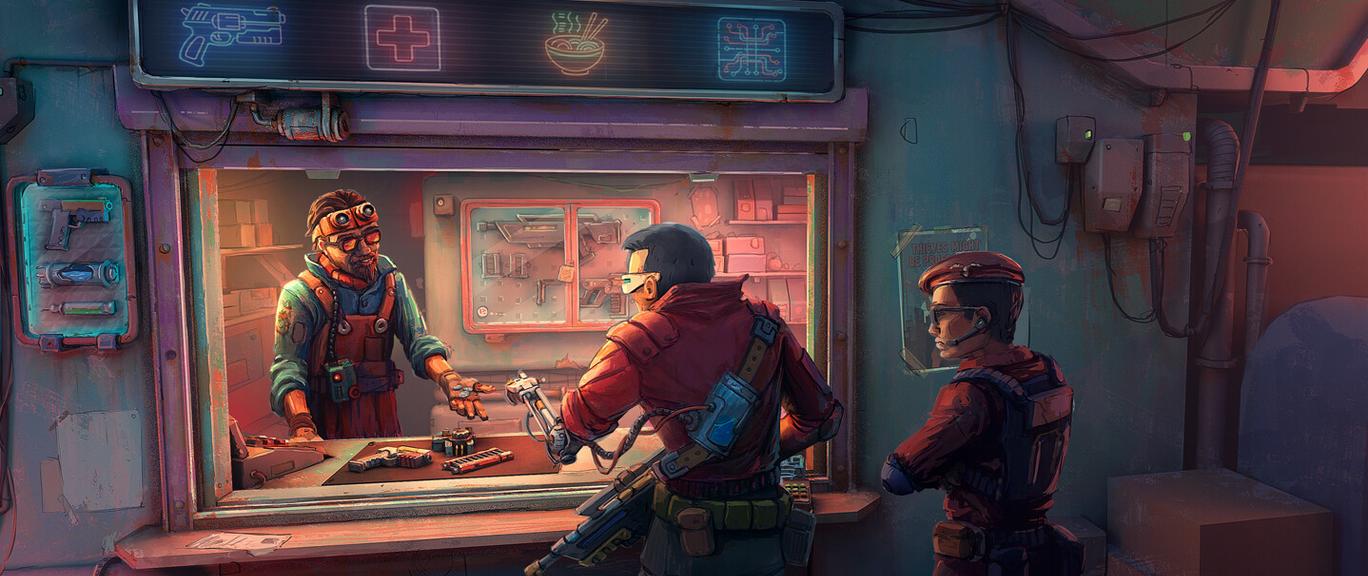
The main character is a former scavenger who was helped into acquiring a small space on the station’s lower levels. Local society is divided into the poor and the wealthy residents of the upper floors. Operating between them are security forces, underground traders, and revolutionaries. Everyone has their own agenda, and the shop is convenient both for shopping and for making useful connections.
The goal is simple: earn enough money to buy out the premises. Until then, you have to pay rising rent and cover business maintenance expenses. Money is needed simultaneously for purchasing goods, equipment, and mandatory payments. And revenue from a good day doesn’t mean you can spend it entirely on expanding the business.
Nuances of supply and demand
Goods in circulation include food, household supplies, materials, electronics, and items of questionable origin. Customers have different interests and limited budgets, so you still have to find the right buyer for an expensive item.
Core gameplay revolves around visitors. Some are interested in the shop’s inventory, while others offer to sell something. Buying an entire batch yields a wholesale discount. Haggling helps increase profit or offer favorable terms to a client to build good relations. Pushing too hard can ruin a deal and damage your reputation among members of their faction.
Although the merchant spends most of their time behind the counter, events on the station constantly shift market conditions. Daily newspapers help track changes. Occasionally, informants visit the shop, willing to share intel on upcoming shifts. Thanks to this information, you can prepare in advance for price hikes or drops.
The storefront helps attract the right buyers. Signs and items displayed there increase foot traffic and drive interest in specific inventory categories. This allows you to tailor your trade to existing stock and your chosen specialization.
Some goods need to be inspected before purchasing. A pack of cigarettes can be examined under a magnifying glass, matching the seal, font, and logo with a reference sample in the guide. Water is tested for purity, and the value of a cybernetic limb depends on its specs and installed components. Carelessness during procurement can result in losses.
You can also make extra money by appraising items, offering appraisal services to visitors. Mistakes here hurt your reputation. Selling substandard goods doesn’t always go without consequences either: a buyer may file a complaint, demand a discount, and lower their opinion of the shop.
Dealing in contraband and stolen goods is far more dangerous. Station security responds to calls if a wanted person stops by the shop and conducts inspections for illicit merchandise. The chance that an inspector will recognize a stolen item decreases over time. Such goods can be stashed in a hidden compartment. Contraband doesn’t become legal just by sitting in storage: depending on the severity of the violation, you risk confiscation, a fine, or arrest.
Expanding the business
You can restock beyond the shop’s walls. At night, the game invites you to head to the scrapheap and look for valuable items to resell. However, an outing might yield worthless junk or result in an injury. Saving on procurement here comes with health risks.
Food and water are also sold at a store that accepts ration cards. Random visitors bring them in, offering to trade them for regular cash. Cards bought at a good price help save on restocking. However, they can also be forged: a counterfeit won’t be accepted, and the money spent on it is gone for good.
You can develop the shop in several directions. Even before starting a game, you are prompted to choose a specialization, such as dealing in water or weapons. The choice determines starting resources and equipment, but doesn’t prevent you from expanding your activities later on. You can also explore any desired direction as you play.
Joe Wild and Dr. Jackson can help with this. The broker in the crimson jacket introduces the merchant to the right people. Through his connections, you can expand your assortment, attract more customers, and get help when facing legal trouble.
Jackson sells useful hardware: a furnace to produce valuable ingots, stash spots for contraband, and an advertising projector to draw customers. Step by step, the shop gains its own manufacturing and extra safeguards against inspections.
Equipment requires energy and repairs, and manufacturing demands raw materials. Buying a new machine increases expenses before any finished goods are sold. As a result, expanding the shop forces you to choose between investing in future profits and keeping cash on hand for the next rent payment.
Trading reputation
Buying out the shop sets the overarching goal, but the narrative unfolds through relationships with regulars. They have their own backstories, goals, and reasons to seek help. The merchant’s choices affect their fates and can cause trouble for the shopkeeper themselves. For instance, Eleonora is trying to get her mother out of prison and return to high society. At one point, you can frame her by handing over a package from ‘relatives.’ Cadet Serpico investigates corruption in the security service, which puts him on the wanted list with a bounty on his head. And Giorgio the scavenger tries various ways to make money, hoping to find a lucrative venture; without your support, he will go missing.
Their stories are engaging to follow. They come asking for food, donations, purchases, and other forms of help. Gradually, familiar faces emerge—people you want to assist and whose story arcs reach resolutions. Yet, they affect the growth of the business itself less than one might hope.
The rich cast of characters also includes wanted criminals. Station security provides a list of nine individuals with bounties on their heads. You have to spot them among regular customers, but turning them in can ruin your standing with certain factions. Besides, the criminals don’t seem all that villainous at first glance. Moreover, the list doesn’t explain their offenses. Personal impressions suggest that only one person from the wanted posters is an outright monster. If you report him to the authorities, he will later stake out the shop and hunt its owner.
A special threat comes from the “augs”—implant carriers taken over by artificial intelligence. They attempt to chip other station residents. You need to identify such visitors by their visual cues and shoot them yourself without waiting for security. However, spotting the chipped poses no difficulty even after 40 in-game days: the AI does a very poor job of concealing its pawns.
Core relations are built with five factions: the lower-level and upper-level residents, station security, the black market, and the revolutionaries. Reputation affects access to customers, goods, information, and protection. Backing one group can complicate relations with another. Starting as a chemist adds the Sector 13 Cartel and its production quotas to the mix, shifting the nature of your work from ordinary retail to trafficking illicit substances.
However, your impact on station events is confined to the shop’s operations and individual storylines. Selling weapons, armor, and ammunition to the revolutionaries doesn’t unlock a victorious coup ending on the station. The only winning outcome is buying out the shop. All other endings mark failure: bankruptcy, prison, or the merchant’s death.
Endless mode allows you to skip story visits and focus purely on trading. But without those stories, the game grows stale much faster. The buying and selling continue, yet the familiar faces that made you want to open the shop the next day are gone. In the late game, repetition becomes noticeable even in a normal playthrough: routine item checks, restocks, and customer service increasingly rarely call for fresh decisions.
Verdict
Probably Stolen successfully connects trading with customer backstories and faction relations. Earnings depend on your ability to appraise goods, time deals properly, and weigh the consequences for your reputation. Extra services and equipment help the business grow, while regular patrons keep things interesting on the station.
Different starting conditions and specializations provide good reason to return to the game with a new strategy. Its main flaw surfaces closer to the endgame, when familiar activities turn into routine. It is a solid simulator of a small shop that is especially captivating while learning and expanding, but gradually loses momentum over time.