On the dangers of lynching
In a remote mountain village, people worshiped the great serpent Yamatagi Madara for centuries and offered him sacrifices. This continued until two powerful priestess sisters defeated the monster and split its essence into two halves. Such an ancient creature cannot be destroyed without a trace, so the priestesses remained in the village to keep both parts in check.
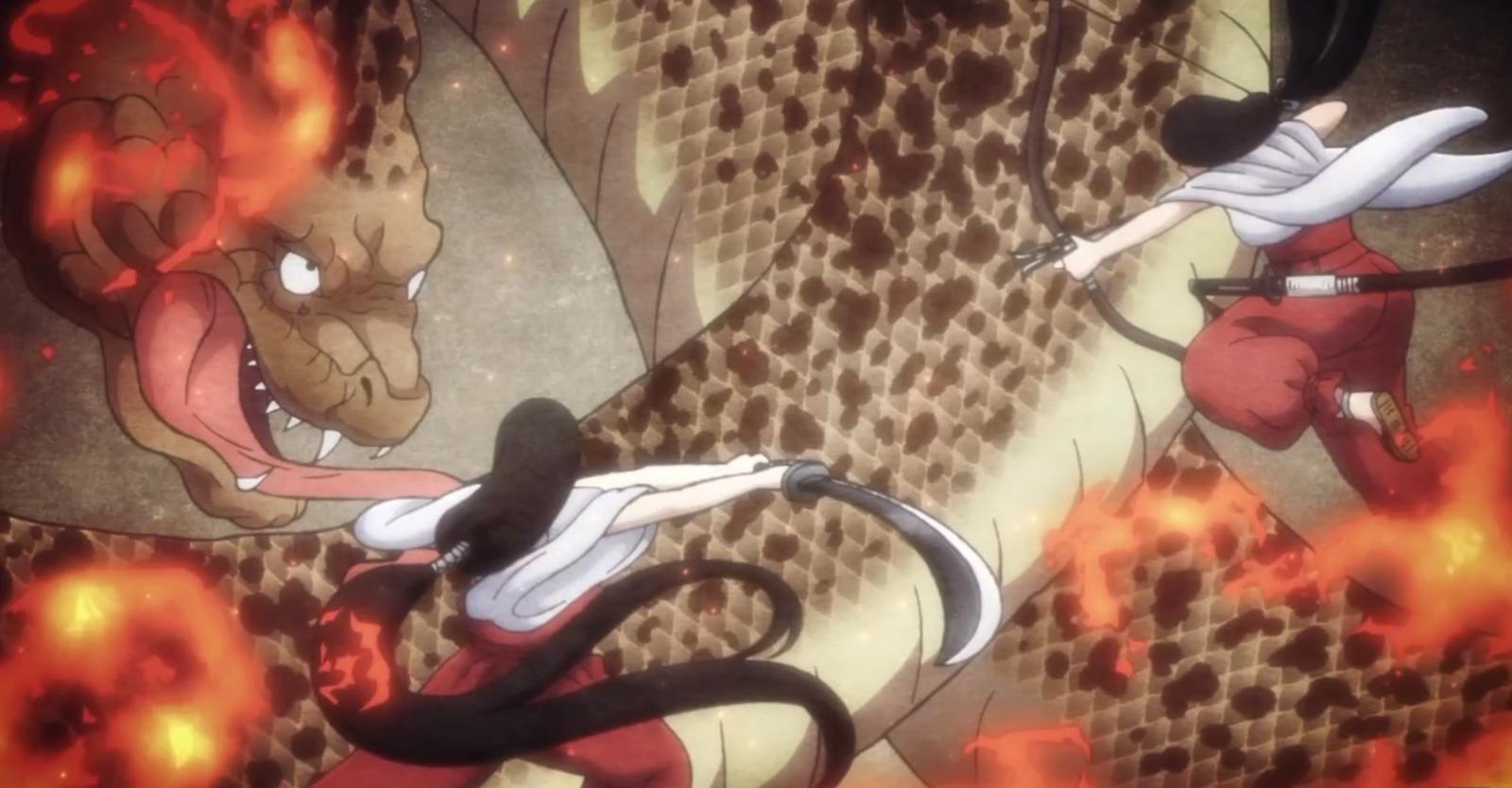
The serpent's body continued to poison the surrounding area with misfortune, and the elder sister incited the desperate peasants against the younger one. Waiting until the girl was weakened in a rigged battle, the villagers mobbed her. The betrayal might have gone unpunished for the elder priestess, but she overlooked one thing: the betrayed relative found common ground with the hated Yamatagi Madara—they were united by a thirst for revenge. Merging together, they spawned a vengeful snake woman who wiped out everyone she deemed guilty.
Human cowardice and stupidity created a monster that absorbed the demon's ferocity and the priestess's spiritual power. Should such a creature descend from the mountains, not only the village, but a good half of the country would have come under attack. To avert catastrophe, the survivors deified the newly emerged Yamatagi Madara and ritually bound her spirit to the place of her death. After that, for generations, the villagers guarded the sanctuary's borders from stray travelers.
Slice of life and horror
The series skillfully shuffles everyday comedy with dark mysticism, evoking pleasant associations with “xxxHOLiC”, “Ghost Hound”, and “Dekin no Mogura”.
For a long time, Yamatagi Madara remained a ruthless calamity. Over centuries of isolation, however, her blind rage subsided, and the caring priestess awoke within the monster once more. The change came just in time: two uninvited guests accidentally wandered into her domain:
- Hinata Misogiya—a good-natured and straightforward girl who prefers a boyish style of clothing.
- Kaoru Misogiya—her younger brother, who is dressed in female clothes according to a family tradition to protect against evil spirits. This unusual look does not prevent the boy from charming people around him and skillfully manipulating them, and sometimes even helps.
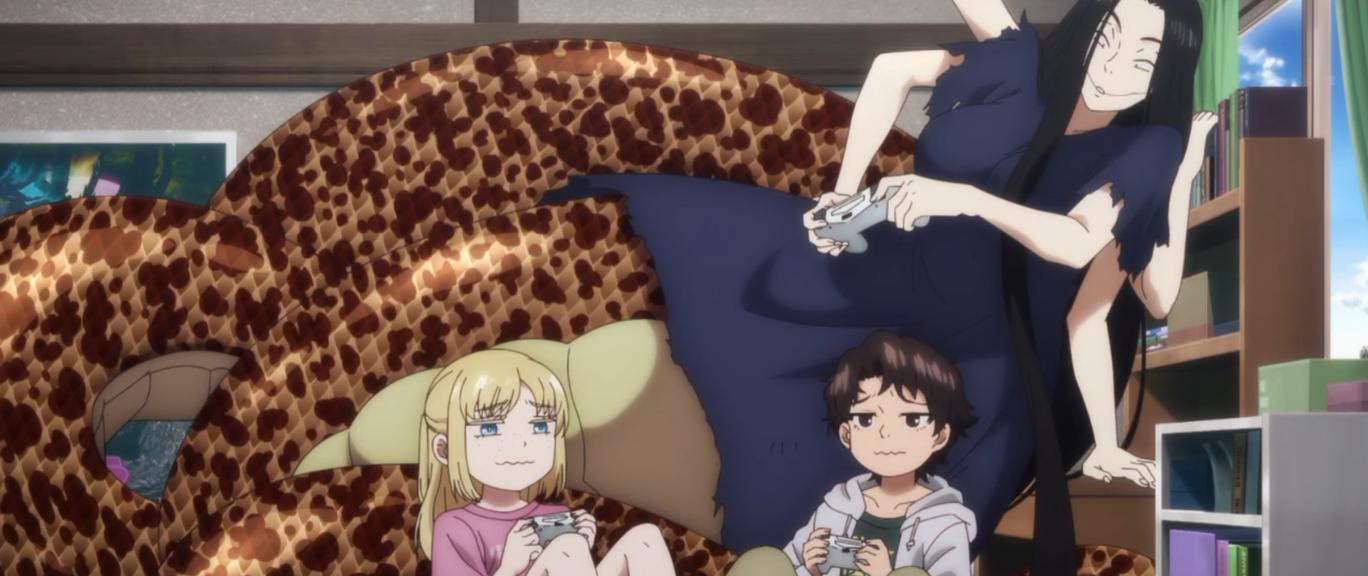
For modern teenagers, the ancient monster is little different from characters in familiar video games. Moreover, both protagonists have their own quirks. Instead of fleeing in panic, the brother and sister quickly found an approach to Yamatagi Madara and casually dubbed her Dara. In their eyes, the formidable spirit turned into a quick-tempered auntie and an involuntary model for trying on modern outfits.
In life, her fellow villagers despised the heroine for her unusual appearance, which led her to judge others superficially as well. Throughout the season, Dara gradually learns to see the bright side in people, genuinely enjoy company, and, most importantly, accept herself.
Scenes of a bloody past and the dark underbelly of the spirit world serve as a contrast to the comedy. Malevolent entities dwell alongside mortals. They are inferior to Dara in strength, but any careless bystander risks becoming easy prey for them. The anime does not shy away from showing brutal retribution for idle curiosity.
The serpent's dark half hasn't disappeared either. While Dara's human side sees evil and resists it, Madara has thoroughly studied good and cynically uses that knowledge to cause harm. Over a long life, the serpent grew so calculating that his schemes became overly convoluted. As a result, the monster's habit of outsmarting itself saves people just as often as the direct intercession of the kind priestess.
A classic monster girl
Japanese pop culture has long reinterpreted mythical creatures. The wave of popularity surrounding “Monster Girl Quest” and “Monster Musume” turned monster girls into formulaic fanservice—hypersexualized creatures with horns or animal ears. This phenomenon is harmless in itself, but the trope quickly grew stale. One longs to see such beings in their classic, folkloric interpretation—as dangerous and alluring monsters in the vein of the harpies and nagas from “Heroes of Might and Magic III”, rather than a faceless addition to yet another isekai protagonist's harem.
Dara fits squarely into the traditional mythological canon. Yes, a compassionate soul lives inside her. But first and foremost, she remains an unholy creature and a natural disaster. Dozens of ruined lives weigh on her conscience, and her ancestral curse continues to reap a bloody harvest even today.
There is no point in ignoring the obvious: Dara hardly wears human clothing, flaunting a bare torso (hence the 18+ rating on this article). Yet there is no cheap lust in this. She is an otherworldly creature, and the direction underscores this status: the heroine's nudity looks natural and monumental, like an ancient statue. Paradoxically, during the moments when the teenagers dress her up in regular clothes as a joke, Dara looks far more seductive.
Human virtues
One of the laziest clichés in screenwriting is the trope of an enraged mob bereft of reason and compassion. The tragedies of many protagonists are built entirely on the fact that a blind mob of townspeople once destroyed their normal life (one need only recall the crowd in “Akudama Drive”).
“Dara of Reiwa” formally employs the same device: the villagers treated the younger sister monstrously. However, the script does not reduce the people to caricature villains. The surviving villagers paid an exorbitant price for their ancestors' sins, attempting to atone for their guilt. They did so not merely out of panic-stricken terror of retribution: the descendants of the traitors genuinely bore the burden of repentance, and many truly sympathized with the girl's tragic fate, protecting her peace out of love and pity.
Verdict
“Dara of Reiwa” is a rare example of a meaningful and original anime whose creators know restraint and understand the laws of drama. The series proves that time-tested tropes do not necessarily need to be uprooted: in capable hands, even old clichés can sound fresh.
Yet the story's main virtue lies elsewhere—it restores faith in humanity. Yes, humans are capable of monstrous baseness and betrayal. But to an equal degree, they are capable of self-sacrifice, genuine compassion, and the willingness to right past wrongs. It is precisely because of this uplifting aftertaste that the series lingers in the memory.