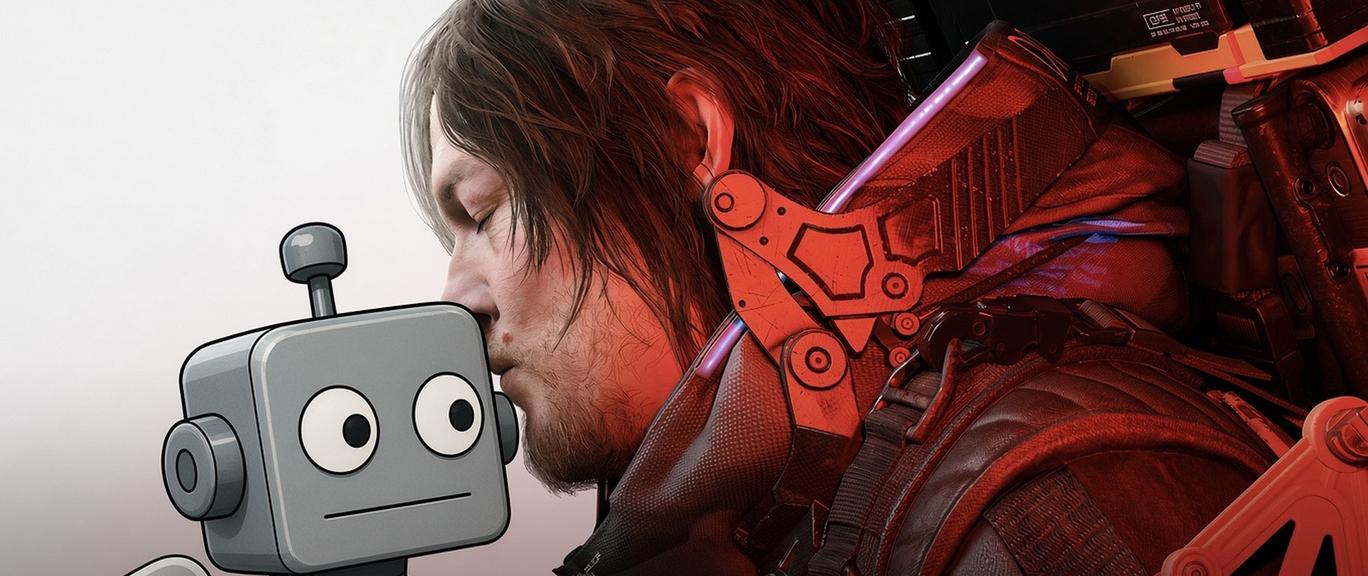
Hideo Kojima believes that neural networks can significantly speed up production processes, but at the same time, there is a serious risk of losing the joy derived from the very process of creating something.
In an interview with the Japanese publication Game*Spark, the game designer noted that over the past 40 years, the gaming industry has made a huge technological leap. Modern tools provide developers with far more capabilities, and the emergence of AI continues this trend, allowing tasks to be accomplished faster and more efficiently.
Kojima compared the current situation to the advent of Photoshop and word processors. When these tools first appeared, they significantly simplified the work of professionals. Now, artificial intelligence is beginning to play a similar role, helping people handle tasks faster and meet deadlines.
At the same time, the game designer does not believe that maximum efficiency should necessarily become the primary goal of development. As an example, he cited drawing: the pleasure lies not so much in obtaining a finished painting as in the very process of creating it. The same, according to him, applies to scale models, jigsaw puzzles, and LEGO sets. The end result might be the same, but it is precisely the work that goes into it that brings joy.
Kojima admitted that he is worried about the potential disappearance of this creative component. He believes that assigning tasks to a computer on the principle of “do this,” “here is the result,” “redo it like that” is not the most exciting way to engage in creative activity.
The developer also drew attention to the fact that the traditional game development process involves constant interaction between people: one specialist proposes ideas and formulates tasks, while others bring them to life. Replacing this chain with computers does indeed increase productivity, but such an approach is more suited to manufacturing a finished product than to a full-fledged creative process.
It is precisely the trial-and-error process between setting a task and getting the result that gives me an adrenaline rush and makes the work exciting. I don't want a future where this component disappears.
According to his forecasts, the situation is unlikely to become critical in the next five to ten years. However, if the development of AI remains unrestricted, artificial intelligence may one day take center stage even in creative professions. Kojima himself, as he humorously noted, probably won't be around to see that era, so it will be up to the younger generation to decide what the future of the industry should look like.