Lords of the Fallen greets the player on the threshold of a grim world where the minions of the rampant god Adyr and unhinged church clerics enforce their rule. The story itself, as the genre dictates, is conveyed through non-intrusive dialogues with characters and item descriptions. You can easily sprint through the game from beginning to end without ever understanding for whose sake or why we were swinging our sword so diligently all this time.
While the overall plot is not as deep and multifaceted as in the Souls series games, the world of Lords of the Fallen is intriguing to explore, uncovering more about how it ended up on the brink.
The main feature of “soulslikes” is high difficulty, which in Lords of the Fallen becomes unfair at a certain point. Moreover, this is sometimes done in the most unsophisticated way — the game turns certain bosses into regular enemies. Their health does not decrease after this, and all their annoying abilities, such as healing and summoning clones, remain intact.
Overall, Lords of the Fallen suffers from enemy variety issues. The developers boasted that around 40 types of enemies were created for the game. But the studio didn't clarify that some of them share the same models and behavior patterns — they are merely wrapped in different rags or wearing different armor. It feels sad when one enemy tries to hit the hero with a cross in the first location, and then you encounter its exact clone 9 hours later, at the opposite end of the game world. How can one believe in this world after that?
The criminally low enemy variety also negatively impacts the feel of the locations. Gloomy castles and dark dungeons, abandoned hamlets in terrifying forests and leper colonies, and of course, swamps — the world of Lords of the Fallen is vast! The levels feature solid design, alternative routes, and hidden passages — all following the genre’s best traditions. Beneath the material world lies the terrifying Umbral realm: covered with organic matter and unblinking eye-walls, giant skeletons in the sky, and the screams of martyrs. The hero ends up in this purgatory either after death or by using a magic lamp.
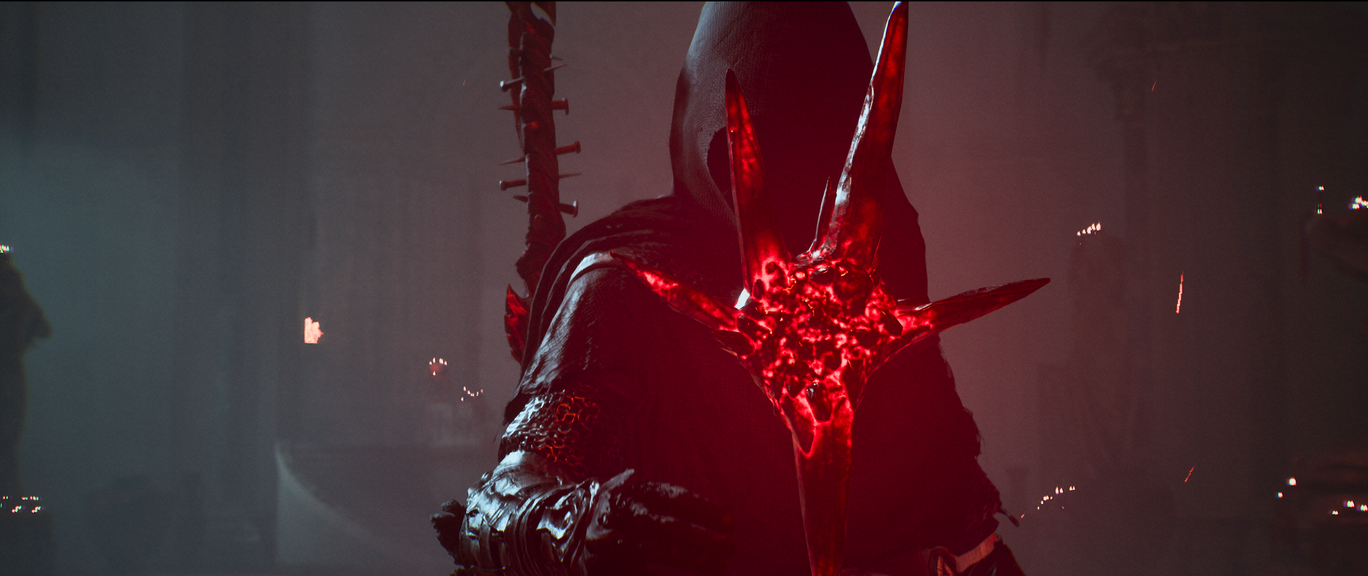
Thin, naked zombies wander around Umbral, hideous women fly on insect wings, gargoyles leap and cackle. Venturing into this otherworldly fold of reality opens up new pathways and allows access to previously unreachable places. However, you cannot linger in Umbral for long — the presence of a living soul draws the attention of the Red Reaper. This is a formidable foe with an immense health pool, capable of dispatching almost any hero to the afterlife in two hits.
The lack of enemy variety is more than offset by their sheer numbers, which is not ideal for a “soulslike” — no matter how strong an enemy is, if there is only one, the encounter is manageable. But when weak foes are numerous and attack from every angle, dodging or parrying all of them in time becomes nearly impossible.
The situation worsens drastically in Umbral, where enemies can sneakily materialize out of thin air behind the hero’s back. The target-lock system, governed by laws known only to itself, exacerbates the issue — snapping onto archers 20–30 meters away behind their allies or harmless pieces of scenery instead of the nearest threat.
Sadly, exploring the world of Lords of the Fallen is undermined by an outright idiotic checkpoint system, with checkpoints placed way too far apart. Yes, much like in early showcases of Dark Souls 3, the player is allowed to create temporary “bonfires” using a rare resource. But the game offers no guarantee that after spending resources on a temporary “bonfire” in a designated spot, a permanent vestige isn't waiting right around the corner — and that does happen.
The aforementioned difficulty spikes are especially noticeable during boss fights, which are sometimes separated by a corridor of merely twenty paces. While the first few main antagonists are easy to take down once you learn their predictable attacks, by the first third of the game, every successive boss fight turns into a genuine trial. Take the Saint of the swamp, who spends 80% of the first phase riding around on horseback and hurling spears, then dives into the muck the moment you start striking back. Or the archer who sics fierce, armored hounds on the protagonist. Many encounters are dragged out far too long by staging, making replaying them pure agony.
A strong point of Lords of the Fallen is its combat system — it captivates with dynamics and variety. The game allows you to build: a mighty warrior wielding a colossal sword that sends enemies flying with a single swing; a battle mage with near-infinite mana raining devastating spells on enemy heads; or a steadfast paladin healing allies and afflicting enemies with potent curses. The diversity in build crafting is delightful.
A key element of combat is the wither mechanic — blocking and parrying enemy attacks causes the hero’s health to wither, which can be regained by going on the offensive. But taking direct damage causes that health to be lost permanently. By the way, this system is taken straight from Bloodborne — where it similarly pushed players toward aggressive encounters.
The lamp can also be utilized in combat to rip out an enemy’s soul — rendering it vulnerable to damage. However, due to the limited number of charges even on an upgraded lamp, constantly relying on it is hardly feasible.
The primary issue of Lords of the Fallen, however, is its technical state. At a certain point in development, Hexworks had to switch from Unreal Engine 4 to Unreal Engine 5. The studio was not prepared to handle the engine, resulting not only in cut content but also in severe optimization issues.
The game runs terribly on consoles even after several patches — frame rate drops, freezes, and pop-in textures right before your eyes are common occurrences. A memory leak on Xbox makes Lords of the Fallen unplayable after an hour and a half to two hours due to dreadful stuttering. And that is how the game behaves in performance mode! To this day, the memory leak issue has remained unaddressed by the developers.
Optimization issues in Lords of the Fallen hit even harder when you realize that visually, it is the best non-FromSoftware “soulslike” available today.
The netcode of Lords of the Fallen also hardly deserves flattering words, at times turning co-op runs and player invasions into a slideshow.
Diagnosis
The potential of Lords of the Fallen is so massive that it is easily noticeable behind the terrible netcode, abominable optimization, repetitive enemies, and other flaws. The developers will certainly be able to unlock it, but over time — by fixing what went wrong with the launch version.
The trouble is that the game made such a wretched first impression on the audience that many may never give it a second chance. Although they probably should — half a dozen patches and performance updates later, one might discover the best successor to Dark Souls’ ideas today.
Pro
- Vast world
- Gorgeous visual design
- Umbral adds even more opportunities for exploration and finding secrets
- Stunning visuals and sound design
- Dynamic gameplay
- Solid combat system
Contra
- Excessive number of “trash” mobs in locations
- Atrocious checkpoint system
- Certain boss battles are frustrating due to scripting and staging
- Optimization and technical issues even on consoles