A heartwarming fairy tale rarely seen these days, even if a bit simplistic. Review of the adventure The Plucky Squire
Translated with AI from the Russian original.
“The Plucky Squire” is a naive children’s fairy tale capable of becoming a bridge to a serene childhood. It is a classic tale of a chosen one saving his community from evil, a story about friendship, mutual aid, honor, and valor. Devolver Digital possesses a natural magic: finding distinctive projects to help bring them to life. This time, we are presented with a love letter to The Legend of Zelda, though written in very uneven handwriting. We invite you to dive into this tale of lost time that you won’t regret spending at all.
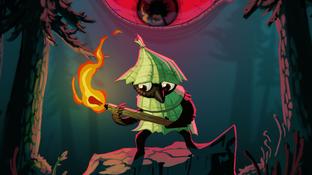
In the far-off kingdom of Mojo, where creativity and inspiration reigned, there lived a plucky squire named Jot. It was an amazing place where each day was filled with magic, and each night with fairy-tale silence under a canopy of stars. The kingdom was ruled by the wise and gentle Queen Light, and Jot served her faithfully, protecting Mojo from the evil sorcerer Humgrump.
This squire was not only skilled with a sword, defending the kingdom, but was also a talented writer! His thrilling tales of heroism inspired all the inhabitants; they were read everywhere—from humble cottages to majestic castles.

One morning, as the first rays of sunlight sparkled through the windows, Jot awoke to remarkably upbeat music. He leaped out of bed, got dressed, and headed toward the sound. The music was coming from the home of his old friend and mentor Moonbeard, who, despite his advanced years, had decided to master a DJ turntable.
Moonbeard asked Jot for a little help—he needed wax to press records. But no sooner had Jot set off on this adventure than darkness fell across Mojo: the wicked sorcerer Humgrump had unleashed an unknown magic, and now Jot had to head to the Tome Tower to find out what had happened.
In the tower, a terrible secret was revealed to Jot: Humgrump had discovered that their reality was merely a figment of someone’s imagination, and they were characters in a book! But most importantly, the sorcerer realized that he was destined to always lose to the plucky squire, because Jot was the protagonist, while Humgrump was just a pathetic parody of a certain infamous Austrian painter.

Seeking to alter his destiny, Humgrump decided to cast Jot out of the book to write a new story himself. Thus, our plucky squire found himself in a mysterious and frightening 3D world, where Mojo was merely a hardcover storybook lying on a desk in a child’s room belonging to a rather messy boy. Soon, however, this creative clutter would serve both our brave Jot and another character sitting on the other side of the screen well.
All this time, while Jot challenged fate itself, the Player watched his misadventures with rapt attention. He enjoyed following Jot’s journey: the bright drawn world in pastel tones and the abundance of lovingly crafted details gave the feeling of a magical fairy tale, in which the Player himself was gradually becoming a participant.

Sitting on the other side of the screen, the Player was fully immersed in this world, feeling like a part of Mojo. He smiled as he watched Jot and his friends enjoy life, solve puzzles, and overcome obstacles. And Jot, though unaware of the Player’s existence, sensed that his misadventures were taking on another, special meaning—as if someone invisible were supporting him in difficult moments and rejoicing with him in times of triumph.
Jot and his friends traveled to the most diverse corners of Mojo. Here was a cliff where mountain trolls resided. These were not frightening creatures from Scandinavian tales, but good-natured heavy metal fans who hosted open-air heavy music festivals.

And here was the town of Artia, a true Mecca for all creative souls. In its streets, you could meet Leonardo da Vinci crafting his great inventions, Kazimir Malevich promoting his avant-garde ideas, or Andy Warhol organizing unusual exhibitions.
There were many other wonderful places, but what the Player liked most was when Jot ventured to explore the world outside the book to find a way out of unusual situations: the combination of 2D and 3D settings gave a sense of novelty. However, while the player was enjoying Jot’s adventures, a terrible threat loomed over him—Monotony.

The Wasteland of Monotony
Time and again, Jot had to overcome obstacles, solve puzzles, and fight monsters, but it all seemed to lack depth. It felt as if the very essence of “The Plucky Squire” suggested that boundaries are an illusion, yet its creators could not quite realize their ideas to the fullest.
Platform jumping was merely a minor hurdle for Jot on the way to his goal, as were the battles, added to the narrative only to keep the Player from getting too bored while watching events unfold: monsters posed no danger to Jot even on the highest difficulty setting.

At first, Jot could only perform simple slashes with his sword shaped like a fountain pen, and dodge attacks with rolls. Later, Jot learned to throw this sword and catch it like a boomerang, and then spin like a top and strike after jumping. So many abilities… Yet Jot could never find worthy opponents.
Only battles with the most powerful adversaries, like a badger or a mega-eagle, could give Jot any trouble. But none of them required sword skills—the fight with the badger took place with bare fists, while Jot’s friends took on the other foes: the mountain troll Thrash and the young artist Violet. Thrash deftly handled all of the Eagle’s rhythm attacks with his drumsticks, while Violet enthusiastically defeated her opponent by shooting colored orbs in a match-3 game.

What the Player enjoyed most was the battle in which Jot had to become a real flying mecha robot to fend off enemies in an encounter called “Reso-chan,” reminiscent of a bullet hell. The final battle combined elements of all the previous ones, and only this very last fight brought the Player genuine delight.
In those rare moments when Jot suffered defeat, the Player was not discouraged, for our squire was the chosen one and death held no power over him. Jot would get up, dust himself off, and set out on the road again, fortunately never having far to go—Jot always reappeared close to his objective.

Jot: A Source of Inspiration
The somewhat out-of-place additional sword attacks were also dampened by the way they were acquired: Jot could unlock new abilities by collecting enough “inspiration,” represented by glowing light bulbs. However, the Player grew weary of the fact that Jot had to smack every little tree, bush, and barrel with his quill-sword in search of “inspiration.” This monotonous process, in the Player’s view, had absolutely nothing to do with inspiration.
Yet Jot could use inspiration differently—a merchant he occasionally met on his travels offered to trade it for amazing scrolls, in which the creators of “The Plucky Squire” share early sketches and ideas that did not make it into the game. Although these scrolls could also be found during exploration, the merchant offered unique ones not available anywhere else.

Puzzles and brain teasers that Jot encountered were diverse, but like the battles, they lacked depth. During his adventure, the plucky squire learned to step beyond the pages of his own story to flip pages, tilt them to move objects, blow them up, freeze them, or even transport them from one dimension to another. Jot only had to use many of these abilities a few times, and they presented no real challenge, which occasionally left the Player feeling bored.

Furthermore, being a skilled writer, Jot could affect the surrounding world by altering the narrative text. He could turn a dense forest blocking the path into ruins by changing just one word. It seemed as though this power gave Jot strength his father could never have dreamed of. But the naive plucky squire did not know what was apparent to the Player: Jot could only alter the story in places where the creators of this wonderful tale allowed him to.

At times, Jot was stripped of all his combat abilities. Then our squire had to use stealth to avoid being spotted by enemies. The Player appreciates it when heroes use stealth, but in this tale, it felt out of place—Jot had previously defeated a huge badger in hand-to-hand combat, yet for some reason was afraid to engage in open confrontation with ordinary beetles.
After ten hours, Jot’s adventure came to an end. Make no mistake: Jot and the Player did everything they could to write a happy ending to this story—it couldn’t have ended any other way. The Player even felt a little sorry for Humgrump. Although an evil sorcerer, his desire to break free of the script and avoid being trapped in this “matrix” was understandable. However, a true hero, as good old uncle Campbell taught, “always embraces his destiny rather than resists it.” And such was our plucky squire, Jot.

This fairy tale of friendship and the heroic deeds of Jot and his friends inspired the Player, who had now become the Reviewer. He wanted to tell all readers of the iXBT Games website about Jot’s adventures, so he opened a text editor and began to write:
Diagnosis
Gameplay combining 2D and 3D elements simultaneously is nothing new to the gaming industry, and in my view, the developers fell victim to their own ambitions. A game in which the protagonist can step outside the narrative and his own confined world offers broad room for experimenting with mechanics, but they hardly evolve as the game progresses.
Obviously, the project is better suited for younger players rather than adults. But if you have long been craving a bright, good-natured adventure, give it a try—just don’t expect the depth of The Legend of Zelda from it. The game is available on all current platforms: PlayStation, Nintendo Switch, Xbox Series S/X, and PC. PlayStation Plus Extra subscribers can try the game for free.
If you want to introduce a young child to good games, “The Plucky Squire” will be a great entry point. For this, the game provides additional settings such as invincibility, platforming assistance, and the option to skip the toughest battles. Outside Nintendo’s console, games so well-suited for this aren’t exactly plentiful. You could count them on the fingers of one hand, and this is one of them.
“The Plucky Squire” is a solid debut from the studio All Possible Futures, which will likely get lost among releases like Astro Bot and The Legend of Zelda: Echoes of Wisdom. I hope the game meets the expectations of the developer and publisher, and that a sequel with deepened mechanics won’t keep us waiting long. Then we will return to the pages of “The Plucky Squire” once more to witness Jot’s new adventures across the lands of Mojo.
***
The Reviewer did not want to scold the game for being overly simple—the creators of “The Plucky Squire” likely didn’t want it to be too difficult. After all, for those seeking to overcome challenges, there are plenty of other adventures. I’ve heard there are stories in this world about dark souls, a hollow knight, and many others. We don’t need any of that in Mojo! As for me, the Narrator, it’s time to head home.
Thank you for the adventure, and until next time!
Yours always, the plucky squire, Jot.

Pro
- The game was made with heart
- Pleasant visual style
- Great Russian voice acting that creates a fairy-tale atmosphere (special thanks to Aleksandr Khorlin)
- Variety of mechanics
- Difficulty settings available for kids
Contra
- There are many mechanics, but they don't evolve
- Maximum difficulty setting is easy
***
All images used in this material belong to All Possible Futures // Devolver Digital. Cover source: SteamDB — The Plucky Squire
Never miss our newsAdd this site to your preferred sources to see us more oftenAdd on Google