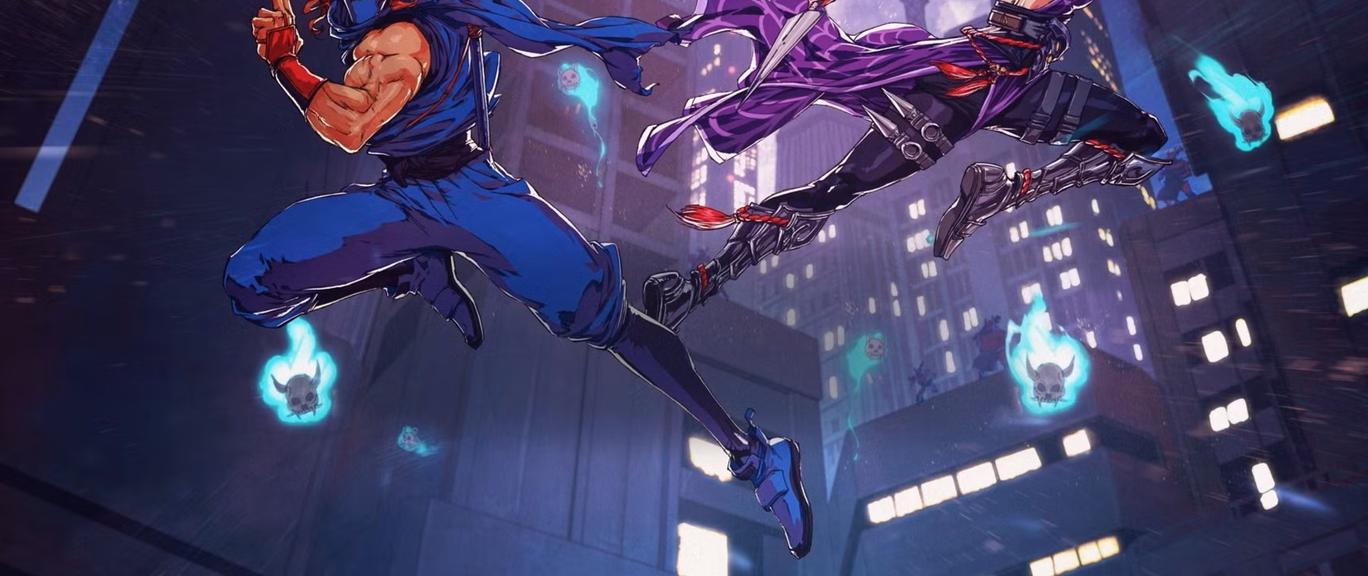
A nostalgic ninja
Ragebound begins with a tutorial prologue in which Joe Hayabusa heads off to a deadly duel—and right off the bat tugs at an older gamer’s heartstrings with a remake of the Determination: Father's Message theme. But it does not do so to recount Ryu Hayabusa’s misadventures in America: the events of Ragebound unfold parallel to the original 1988 game and tell the story of a young ninja named Kenji Mozu, who stays behind to defend the Hayabusa village from a demon invasion.
The plot’s premise is as simple and straightforward as a 90s action flick, but it works without fail: it motivates the hero to grab his sword and rush headlong into danger. Kenji’s journey, which begins as a vengeful quest to stop the Demon Lord’s invasion of our world, takes him across Mount Fuji, secret laboratories, ancient pirate caves, catacombs, and military bases. Along the way, he faces demons, ninjas, mutants, and even CIA soldiers. But most intriguingly—he does not walk this path alone.
Events soon take an unexpected turn, and Kenji teams up with a girl from the hostile Black Spider clan. Under orders from her leader, she was supposed to subdue the demons using the Tamashi kunai, but ended up trapped instead. To survive, she had to ask Kenji to wield the sacred weapon and... let her soul enter his body. Thus, two sworn enemies—Kenji and Kumori—become a single entity, gain shared abilities, and are forced to work together to survive and save their clans.
Deadly simplicity
The entire combat system is built on this dynamic: Kenji is in charge of close-quarters combat and physical attacks, while Kumori handles ranged and magical attacks, which consume Ki energy.
Kenji’s repertoire is limited to basic straight sword strikes and the “guillotine boost”—a spin attack executed by pressing the jump button again upon colliding with an enemy or an enemy projectile. This move not only inflicts damage, but also serves as the primary acrobatic tool for traversing hazards and chasms.
Ordinary foes drop from a single blade slash, but elite adversaries require substantially more punishment: they may be shielded by steel barriers or possess abilities that prevent you from closing in. Here, the distinction between physical and magical attacks stops being merely an element of variety and turns into a tactical foundation of the combat system.
Certain enemies are surrounded by a blue or pink aura—physical or magical, respectively. By taking them down with the matching attack type, the hero earns a “hypercharge” capable of taking out even an elite foe in one hit. This forces you to react swiftly and make split-second decisions: what sequence of targets to prioritize to maximize efficiency while minimizing health risks.
The combat mechanics do not feel overly simplified, nor are they burdened with extraneous elements—striking an admirable balance between conciseness and efficiency. However, the “hypercharge” mechanic negatively impacts enemy perception: foes end up feeling repetitive, differing largely by their textures and the weapons in their hands. Furthermore, one specific aspect left me disappointed, even though I probably should have expected it: contact damage from enemies.
Yes, I realize it has been a staple of 2D platformers for decades. But within the framework of a whirlwind ninja action game capable of chaining extended aerial combos through basic strikes and the “guillotine boost,” the unforgiving collision radius and damage frequency feel excessively harsh and disruptive to the game's flow.
In Ragebound, up to a dozen enemies can crowd the screen at once (especially in New Game+), and instead of slicing through them like a hot knife through butter while sprinting across the stage, you constantly have to watch your distance to avoid stepping too close. This frequently halts your momentum and, in my case, served as the primary cause of defeats during boss fights: almost every encounter demanded at least ten attempts.
The bosses themselves, for that matter, turned out decent—yet similarly one-dimensional, a direct consequence of the combat system’s constraints. We face all manner of demons and lab experiments, and there are even helicopter and battleship bosses, although fights against them essentially boil down to clearing waves of minions.
Otherwise, everything follows a single script: dodge whatever the boss throws your way, strike aura-infused projectiles to gain a hypercharge, stun the boss, unleash a barrage of “free” damage—and rinse and repeat until victory. There are essentially no boss fights that stand out distinctly in terms of complexity or design—with the exception of the finale, where you alternate playing as Kenji and Kumori.
An unpretentious thrill ride
The campaign in Ragebound does not feature the labyrinthine exploration seen in past titles by The Game Kitchen—this is by no means a Metroidvania. What we have here is a rapid-fire sprint through several dozen linear levels crafted in gorgeous pixel art filled with rich details, smooth animations, and clear environmental readability. Nobody expected anything less from the creators of Blasphemous, a pixel art masterpiece—even though Ragebound feels from the outset like a straightforward, contracted endeavor with no grand artistic pretenses.
Traditional combat sections culminating in boss battles alternate with staged auto-scrolling set pieces: the protagonist battles atop a motorcycle, hops across moving cars, or escapes a blazing inferno—all set to a mix of original and remastered classic tracks, leaving mountains of corpses in his wake. However, do not expect the variety of scenarios and platforming sections found in games like The Messenger.
At the same time, the platforming feels delightfully responsive—there is no pixel-hunting involved, and only occasionally is precise timing required. The most challenging acrobatic feats remain entirely optional, tied to tracking down collectibles scattered throughout the stages.
Reaching some of these collectibles requires navigating level sections within the “demon realm.” During these sequences, Kumori takes full control, and the surrounding environment transforms, unveiling fresh platforms and pathways previously inaccessible to Kenji.
The gameplay turns into a race against the clock: Kumori’s presence in the demon realm is strictly limited, and even a moment’s hesitation can lead to failure.
What’s in a ninja’s pockets?
Collectibles scattered across the levels include golden scarabs, crystal skulls, and secret scrolls. Crystal skulls serve as typical milestones for completionists, whereas golden scarabs are essential for purchasing talismans and secret arts at Muramasa’s shop.
You can equip up to two talismans simultaneously. These range from basic perks—such as regenerating health during combat or at checkpoints—to more intriguing bonuses, like rewarding the execution of the “guillotine boost” or extending the invulnerability window after receiving damage. The latter is particularly beneficial for mitigating the frustrations of contact damage.
Secret arts encompass both offensive and defensive abilities for Kumori, along with the “rage art”—devastating ultimate moves that unleash crushing damage upon foes.
Discovering secret scrolls unlocks optional campaign stages termed “secret operations.” There are eight in total, and they are generally far more demanding than the core stages, though admittedly, the definition of “difficulty” here is somewhat arbitrary.
An accessible classic
Most stages can be conquered without excessive frustration or hassle, particularly because enemy spawns almost never trap the player inside an arena. With rare exceptions, skirmishes can simply be bypassed or handled selectively on the run. However, beating a level and meeting specific criteria—such as defeating specific foes, finding all collectibles, or finishing deathless—yields an end-of-stage rank. Beyond flattering a player’s ego, it grants access to new wares in Muramasa’s shop.
In fairness, unlocking items does not demand superhuman skill—rewards are not locked behind the very highest rank, so striving for perfection remains entirely up to the player. Furthermore, hardcore enthusiasts can pick up talismans in Muramasa’s shop that increase incoming damage, disable checkpoints, or strip levels of healing pickups. This not only amps up the challenge, but also automatically boosts your final grade. Consequently, you can crank the difficulty up right from the beginning—without having to wait for New Game+, where enemies become considerably more numerous, elite variants emerge, and stages are loaded with extra hazards.
Regrettably, the only meaningful reward for beating the campaign on higher difficulty settings is a bonus boss rush level, where Kenji takes on familiar adversaries back-to-back. The downside is that bosses in New Game+ remain unchanged: they feature no new moves, merely attacking with greater frequency, which hardly changes the overall flow of battle.
That said, if even the standard difficulty proves too steep on your first playthrough, you can always head into Settings and toggle on “Assist Mode,” which lets you tweak game speed, incoming damage, and more. Ragebound therefore offers a remarkably flexible difficulty setup, welcoming newcomers and diehard purists alike into the storied franchise.
And so it would seem that Ragebound has few major shortcomings. Yet everything changed with a single event: July 31 marked not only the arrival of Ninja Gaiden, but also the demo release of the new SHINOBI by Lizardcube—the team behind Streets of Rage 4. Frankly, that demo was what influenced my ultimate impressions the most. It sweeps away the nostalgia and illustrates how drastically different two approaches to a “comeback” can be.
The art of vengeance
Historically, Ninja Gaiden and SHINOBI have always run parallel to one another—even having launched on different platforms, they were legendary rivals of the late 80s. Now, in 2025, they cross paths side by side once again.
Art of Vengeance, much like Ragebound, is a side-scrolling action platformer, but swaps pixel art for a hand-drawn visual style with a vibrant palette. It feels less grim, yet every bit as stylish. The only detail that caught my eye compared to Ragebound was the excessive abundance of glowing drops: coins, health kits, and assorted loot bursting out of defeated enemies. After all, I’m not playing modern Doom. But that is pretty much where my complaints end.
From the opening seconds, SHINOBI makes it clear that it bets heavily on tactile depth in combat. Here, the hero does not sustain damage simply by standing too close to an enemy—harm occurs solely upon a genuine hit. This fundamentally transforms how combat feels: Shinobi’s gameplay comes across as fluid, aggressive, and instantly captivating. That single alteration lets you dive into adversaries with confidence, stringing together creative combos aided by a substantially broader moveset. It includes light and heavy strikes, aerial maneuvers, flashy finishers, magical attacks, and ultimate techniques triggered from a shinobi stance.
What’s more, all unlocked maneuvers and combo segments are perpetually at your disposal: there is no need to equip them—simply buy, memorize, and execute them with the proper inputs. Ninpo magical arts are the sole exception, but you can carry several at once—up to eight active skills. As a result, within a single hour in the SHINOBI demo, I discovered and tried out far more combat options than during the entirety of Ragebound. And this is clearly just a fraction of what the full release has in store.
In addition to an expanded arsenal, SHINOBI delivers a completely different tactile experience in battle. Not every enemy drops in a single hit, but the key difference lies in the weight of the combat. The grace and dynamism of a shinobi blend with heavy, impactful strikes that carve into opponents. Every sword stroke carries tangible weight and momentum, yet the hero floats gracefully across the arena like a butterfly. In Ragebound, by contrast, strikes seem weightless—and to be fair, you hardly notice that while playing. Yet that distinction is precisely why this article is more than a simple review of Ragebound.
Enemy variety was another welcome surprise. Granted, evaluating a full game based on a demo is tricky, but I have to highlight it: beyond regular grunt enemies that fall in one or two hits, there are distinct combat classes. For example, healers perch on high platforms buffing their allies. And among elite ranks, you encounter not just stationary damage sponges guarding spawn points, but agile combatants darting across the battlefield and engaging in the fight actively.
Finally, a few thoughts on level design. It remains too early to pass definitive judgment, but all signs point to a full-fledged hybrid of a Metroidvania and a linear platformer—akin to a semi-open world structure. The player lands in an expansive maze-like area packed with branching paths, secrets, and platforming trials. Yet each area is self-contained and followed by the next—and the demo gives us access to explore the very first one.
Core platforming could be described as accessible: the protagonist conveniently pulls himself up onto ledges when required. Still, I encountered several genuinely taxing segments leading to secrets. These require tight timing and skilled mastery of abilities—from wall-running to a newly acquired grappling hook, double jumps, and mid-air dashes, none of which existed in Ragebound.
It is too soon to judge beyond that. While Ragebound faithfully honors the legacy of original Ninja Gaiden—complete with gritty action, Eastern mysticism, and B-movie charm—the new installment of SHINOBI aims to find its place with modern audiences. Surprisingly, it resembles a fusion of 3D Ninja Gaiden and Prince of Persia: The Lost Crown far more than its 8-bit predecessor—which, in my book, is quite high praise. How these impressions will hold up upon release remains to be seen. For now, Art of Vengeance announces itself with its very subtitle as a stylish action showcase of the “art of killing”—and looks fully equipped to deliver on that promise.
Diagnosis
Ninja Gaiden: Ragebound is a remarkably faithful and respectful revival of a classic that will surely delight fans of its 8-bit progenitor. Nostalgic chords will resonate through familiar soundtrack melodies, frenetic pacing, and an old-school aura refined with modern polish. The Game Kitchen has captured the essence of the franchise flawlessly: you dash across levels, cutting down enemies against stylish pixel art backdrops backed by a pulse-pounding soundtrack—never doubting for a second that this is genuine Ninja Gaiden.
Its execution is virtually beyond reproach: visual presentation delights with meticulous pixel animations, the music gets the adrenaline pumping, and the platforming feels precise and intuitive. It is clear that the project was crafted with genuine affection for the original and reverence for players: the difficulty is steep yet fair, and each death serves as a learning experience rather than a cause for frustration.
On the other hand — was it really worth being so faithful to the original? Maybe they should have trimmed the vestiges a bit, deepened the mechanics, and made the game even more hardcore? After all, many design elements of the past were dictated not by creative vision, but by technical, financial, or other limitations. Meanwhile, a competitor is already hot on its heels, and comparisons with it are inevitable — alas, not always in favor of Ragebound.
Ragebound looks too faithful to the original to truly surprise, whereas Shinobi feels more like an attempt to take a step forward. Before buying, I would recommend checking out the demos of both games. Though, to be honest, I personally wouldn’t skip either of them. After all, 2025 is clearly the year of the ninja: we haven’t seen so many decent action games about “katanas and throwing stars” in years.
***
Rights to all images in this material belong to their respective copyright holders. IXBT Games uses them exclusively for informational and analytical purposes and claims no ownership over them.