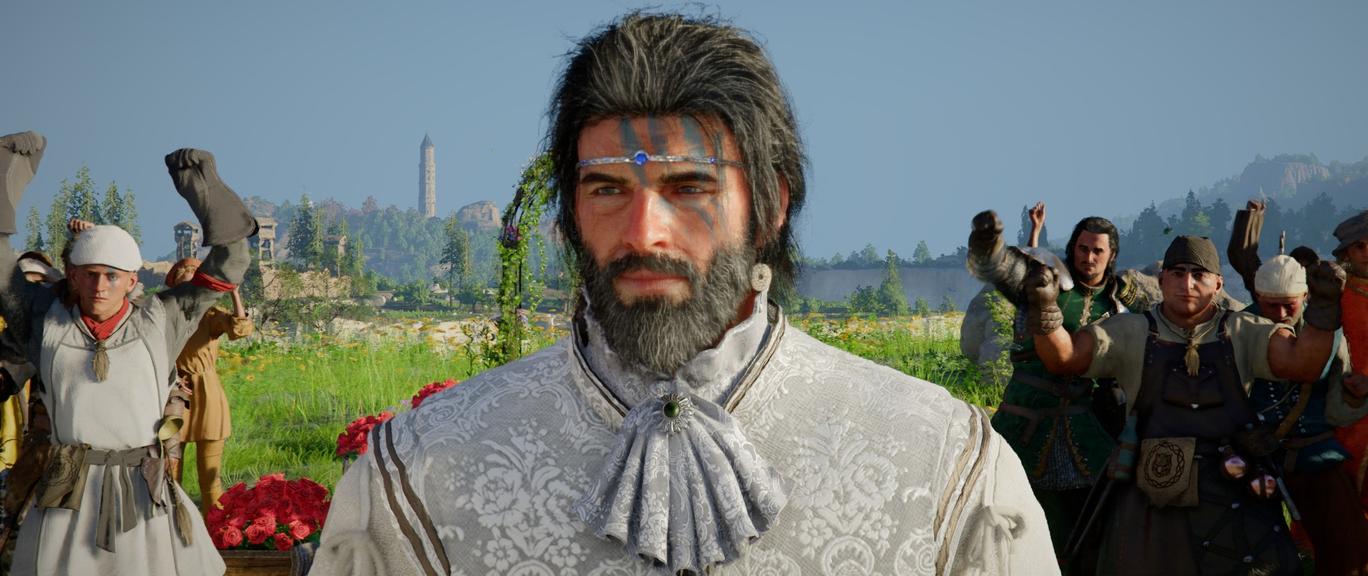
When I wrote my first pre-release review of Crimson Desert, I had just over 50 hours under my belt, with a good two-thirds of the adventure still ahead of me. During that time, I managed to appreciate the scale of Pearl Abyss's ambitions, admire certain moments, and uncover so many issues that I wanted to send the game straight back to the drawing board. In some ways, it felt like an early access title, where intriguing ideas coexisted with clunky controls, ill-conceived systems, and frankly unpolished mechanics.
After publication, I spent more than a hundred additional hours in Pywel, completed the main storyline, explored the remaining regions, and unlocked most of the available activities. Yet my opinion of the game never really changed. Crimson Desert remained a single-player game built by MMORPG rules. A vast world, a heap of activities, and dozens of interconnected systems created the illusion of boundless possibilities. But behind every small dose of enjoyment lurked hours of routine and artificial hurdles standing between you and your reward.
Over the following eight months, Pearl Abyss rolled out more than 50 updates and hotfixes, reworked specific game systems, and even tackled the storytelling. The August Enhanced update introduced new cutscenes, Kliff's internal monologues, dialogues, and memories. All of this made the narrative more coherent — at least judging by comparisons published online. Alas, I could not verify these changes firsthand. I happened to be one of those stubborn “lucky ones” who had already dragged themselves through the main plot all the way to the finale. Starting a fresh playthrough was out of the question: Pearl Abyss doesn't pay me a salary for that, and sinking another 150 hours into a “second chance” was the last thing I wanted to do.
On the other hand, October saw the release of the first major paid expansion — Charting the Unknown. It introduced seafaring, new storylines, business ventures, and romantic relationships. It was for this expansion that I decided to dust off my old save file and see whether the studio had learned to respect the player's time or simply invented new ways to burn through someone else's life.
Shiver me timbers
Diving into the expansion naturally began with the maritime content — after all, exploring the ocean and uncharted islands was positioned as its marquee feature. It all kicks off when Kliff's companions from the Greymane camp decide to take up maritime trade. To do so, you must first secure your own vessel and then deal with the pirates blockading the sea routes.
After running a few errands, we construct our first ship and proceed to assemble a crew. Setting sail strictly requires a first mate, a lookout, and a topman, while cannoneers, repairmen, and deckhands can be recruited at your discretion. At first glance, every crew member appears to have a role, but it quickly becomes apparent that most companions serve a purely decorative purpose. They take their posts, sway in rhythm with the ship's movement, and barely interact with it at all.
The exceptions are the first mate, who can take the helm in Kliff's place, as well as the lookout, the topman, and the repairmen, who at least cycle through a handful of canned animations. The rest of the time, the sailors fish, and whenever enemies appear, they grab their rifles and glare menacingly toward the foe.
The cannoneers are especially disappointing. Despite their job title, they take no part in operating the cannons; their presence merely unlocks the ability for you to fire them. My encounter with the named ship “The Drunken Catfish” — one of the few vessels with an accessible hold — drove this point home completely. After spending several hours hunting down the blueprint and gathering resources, I finally built the ship, only to find a completely vacant interior. No cannons, no supplies, and, of course, no cannoneers in sight. Up to that moment, I had still clung to the illusion that a crew was manning the broadsides and firing at my command.
Perhaps someone might say that I am nitpicking and demanding too much from the game. But after experiencing Assassin's Creed IV: Black Flag Resynced, such oversimplifications are particularly glaring. At first glance, the naval gameplay in both titles seems similar: you steer the ship, account for wind direction, and aim the broadside cannons. However, the true gulf between them is laid bare during boarding actions.
While in Black Flag the entire crew leaps onto the enemy vessel and helps Edward capture it, in Crimson Desert it is a bona fide one-man show. Kliff leaps across to the enemy ship entirely alone and slaughters the adversaries, all while his own ship continues circling the enemy and pounding it with cannon fire — occasionally managing to hit Kliff himself. What is more, the ship does not cease shelling even after the enemy crew has been wiped out, turning the return on board into a harrowing ordeal.
You can return to the ship quickly using a special teleport. The catch is that its blueprint is hidden in a treasure chest whose location is marked on a map. Kliff receives this map during the expansion's opening quests, but treasure hunting is an optional activity that is not tracked in the quest log. I blithely overlooked this opportunity and spent the next ten hours without a teleport until I stumbled upon mention of it online quite by accident.
Formally, it was my own fault, but isn't it bizarre to tuck away such an essential quality-of-life feature behind a side activity instead of introducing it during mandatory tutorials? And this is far from the only instance where Pearl Abyss manages to construct needless obstacles completely out of thin air.
There is no shortage of nautical pursuits in the expansion: you can scour underwater depths, harvest resources, search for shipwrecks, and unearth hidden ruins brimming with treasure. On the surface, uninhabited islands await with puzzles and caches. Pirate-held territories must be cleared out to cement Greymane influence. Finally, you can hunt legendary pirate vessels and engage in commerce. Yet even island colonization manages to become a colossal headache.
Dispatching mercenaries requires unassigned sailors. As a result, if most of your crew is already tied up developing one territory, you cannot launch the next expedition. The process itself takes anywhere from 60 to 90 minutes. While the mercenaries work, the player can roam the island, but there is simply not enough engaging content there, leaving you to pass the downtime elsewhere.
Once colonization is complete, you must return to the island and pick up your crew; otherwise, they will abandon it on their own. If you fail to do so, you will have to sail back to port and hire sailors all over again for your next voyage. You could use teleportation, but then you would have to pay a fee to recall your ship, restock the crew, and set sail for the target island once more. You can, of course, take a shortcut by teleporting to the nearest anchorage — closer to the next island — but summoning your ship along with its crew will cost you an additional fee. It all sounds terribly cumbersome, and indeed it is.
Even traversing the ocean can hardly be called an enthralling pastime. Even with a tailwind, ships crawl along at a snail's pace, the distances between points of interest are colossal, and there is no auto-navigation along a charted route. At times, you find yourself staring at the horizon for ten or even twenty minutes while the vessel chugs toward the desired island. At some point, you just start browsing your phone because what is happening on screen requires absolutely no input on your part.
The situation is improved somewhat by special pirate ships, such as the aforementioned “The Drunken Catfish.” It comes equipped with bow chasers and naval mines, and boasts superior speed and agility. However, I managed to acquire it so late in the game that most of the maritime content was already behind me.
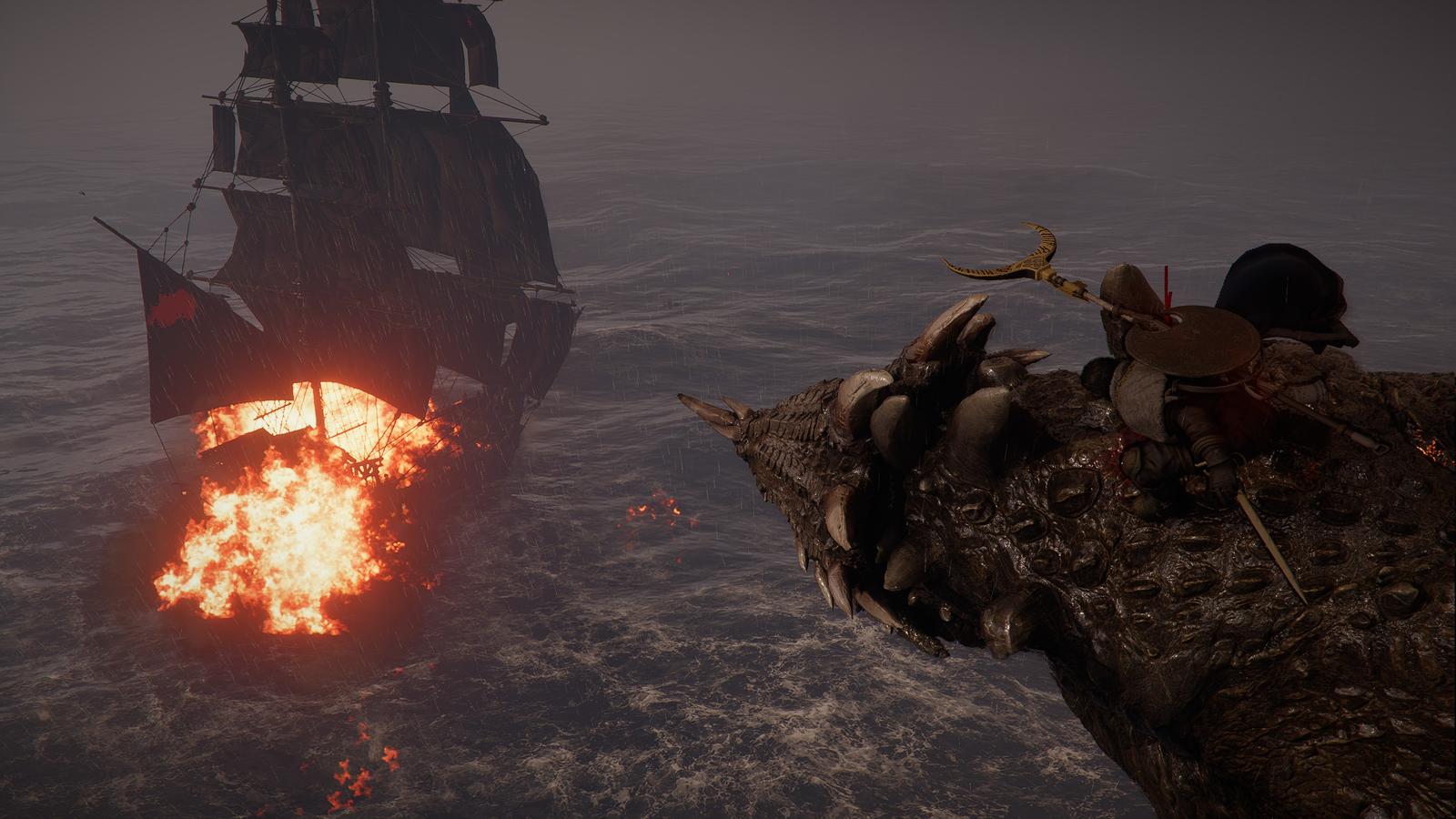
In the end, the only truly memorable highlight of the naval campaign was the boss battles. The confrontation with the Leviacan stands out in particular — a gargantuan mechanical serpent whose body you must scale, clinging to wings dipping into the brine and activating the mechanisms mounted upon it. Yet even this encounter was not spared from gratuitous friction and technical hiccups.
At that stage, I still lacked the ship teleport, so following my first demise, I had to hike back to the boss from the nearest island while my ship remained stranded far out at sea. Reaching the Leviacan quickly aboard a dragon was not an option either: the autosave had triggered right before the fight while the dragon was on cooldown, and saving manually was prohibited because the boss's sheer size caused the game to consider Kliff in combat even after respawning.
Consequently, before each new attempt, I was forced to wait out the dragon's cooldown, which stretched the entire battle to roughly an hour and a half. But no sooner had I finally reached the second phase, in which the clash moves underwater, than the game simply crashed! I had to start all over again from scratch, though this time I managed to conquer it on my first try.
Regrettable as it is to admit, the seafaring content in Crimson Desert turned out to be terribly bland. It reminded me of the state of the game at launch, when the developers provided a wealth of options but never figured out how to make engaging with them convenient or enjoyable. Instead, they simply dumped everything onto the player with a shrug: “Go entertain yourself.” It is obvious that Pearl Abyss will continue tuning the expansion in the coming months (the first patches have already landed), but for now, the nautical escapades leave a rather sour impression.
I can only hope the developers sit down, play through Assassin's Creed IV: Black Flag Resynced, and unabashedly borrow a few essential QoL features from it — if only an auto-sail function along a set course. For now, though, let us leave the ship in port and head off to inspect the landlocked portion of Charting the Unknown.
Land-based rehabilitation
Alongside the naval campaign, the developers crafted three standalone questlines for Kliff, Damiana, and Oonka. These serve as epilogues set after the conclusion of the main campaign.
Kliff was handed a storyline reminiscent of Death Stranding on a budget. After everything he lived through, the protagonist grew so accustomed to resolving dilemmas with his blade that he simply has no idea what to do with himself anymore. Together with the cartographer Sebastian, he sets out to chart the unknown lands lying beyond the sandstorm barrier. There, the explorers discover small settlements whose inhabitants have virtually lost contact with one another: old roads lie smothered beneath sand, and someone has even begun defacing the waystones.
To get to the bottom of the mystery, Kliff must do plenty of trekking across the desert. Unrelenting dust storms impair visibility and, coupled with the monotonous landscape, make navigation a chore. You have to restore damaged waymarkers using the hero's abilities and leave glowing seeds along your path so as not to wander off course and plunge into quicksand or a vortex. Along the way, Kliff discovers new villages and assists the local populace: finding stray livestock, escorting children home, and gradually reestablishing ties between the scattered communities.
The gameplay here does not boast much variety. All the more astonishing, then, that the developers of one of the most bloated games in recent memory managed to deliver an engaging, concise adventure that genuinely makes you feel like a pioneer. Exploring a desert where virtually nothing happens at first glance proved far more compelling than wrestling with an ocean crammed to the gills with resources.
Following a bitter loss in the main campaign, Oonka refuses to feel powerless ever again and resolves to grow stronger to protect his loved ones in the future. To that end, he heads to the Scholastone Institute, hoping to master engineering, learn to harness power sources, and upgrade his arm cannon.
Before long, experiments with an enigmatic apparatus pull Oonka into a full-fledged sci-fi romp featuring interdimensional travel, an investigation of the peculiar Marni Estate (which we had already visited during the main campaign), and an encounter with an alternate reality.
The premise of this story arc is intriguing, but the developers lacked a bit of imagination when it came to fleshing it out. The puzzles turn out to be overly basic and scarce, and the adventure itself concludes before it can truly realize its potential. Even so, it never gets dull: the unusual change of scenery and a pair of unexpected plot twists make the tale an enjoyable companion to the other heroes' journeys.
Damiana's epilogue strikes an entirely different tone. Here, we are treated to a political mystery with distinct Game of Thrones overtones. Following Caliburn's defeat, a fresh crisis brews in Deminiss: the king is bedridden, the populace is revolting, conspiracies fester behind the scenes, and soon Countess Colette Azerian vanishes without a trace. Damiana must unravel this web of intrigue, uncover the truth behind the countess's disappearance, and restore order to the realm.
Along the way, you will not only be swinging swords and piecing together clues, but also pitching tents, hauling supplies, and even sweeping streets (after all, we are playing as a woman). All of this is necessary to aid those in dire straits and earn the backing of ordinary townsfolk.
Such mundane domestic chores hardly spark much thrill, but they are broken up by skirmishes with rioters, who must be subdued strictly with hand-to-hand combat. To my surprise, Damiana's brawling mechanics proved so much smoother, punchier, and more spirited than Kliff's that after the very first scuffle, I found myself craving more.
The story itself gradually gathers steam, eventually culminating in a complete regime change. As a reward, Damiana is granted an entire castle — or rather, reclaims her family's ancestral seat, which had previously been seized by rebels. The fortress can be renovated, decorated to your liking, and even populated with Greymanes. And that comes in especially handy given what comes next.
Business, bosses, and family life
The developers apparently decided that Crimson Desert still didn't feel enough like a single-player MMO and embedded yet another game within the game. You can now establish your own enterprise: a sawmill, a restaurant, a forge, or a tailor shop. Doing so requires hiring laborers, arranging machinery, beautifying the premises, managing your inventory, and satisfying special criteria to boost your rating. It sounds like the elevator pitch for yet another indie business sim on Steam, but in practice it is far more straightforward.
Setting up a business initially takes just a few minutes, after which all that is left is monitoring your rating and dropping by periodically to install new workstations (unlocked as your rating climbs), refresh your stock — specific combinations of which yield perks — and attend to other minor chores.
The only hitch that might cause a headache is the erratic behavior of AI workers when interacting with lathes, workbenches, and other equipment. The in-game HUD dutifully hints at where and how to place objects, but that is no guarantee that NPCs will figure out how to operate them. Workers may simply loaf around or get stuck in place, causing order fulfillment to grind to a halt and tanking the enterprise's rating. Consequently, you have to ensure that ample walkway clearance remains around structures from multiple angles. Otherwise, you just configure everything once, make sure the staff is handling their duties, and get back to adventuring.
For instance, you can check out the “Garden of Trials” — another addition introduced in the expansion. It consists of a gauntlet of ten challenges, each requiring you to take down three bosses in succession. Consuming food to replenish health is prohibited here, so you will need to thoroughly master parries and dodges while leveling up all three protagonists. The twist is that the entire trio can participate in every challenge: once one character falls, the next steps into the fray, and so on until all three perish. Conquering each trial awards a permanent upgrade to an already learned ability. For example, you can reduce the spirit cost of dodging or the stamina drain while gliding.
Should you wish to take a brief breather from the relentless combat, you can always turn your attention to matters of the heart. Crimson Desert now lets you pursue romantic relationships with the inhabitants of Pywel — with courtship open to each of the three protagonists. The system itself is fairly basic: first, you max out friendship, then bestow gifts, chat via dialogue menus, and raise affection levels. Otherwise, it is just like real life: ordinary maidens can be won over with meat and beer, whereas highborn witches demand a far more refined touch.
I, for one, sparked a romance with the witch Elowen. Courting her forced me to scurry across virtually the whole of Pywel pilfering flowerpots, seeing as Kliff, an aspiring entrepreneur, unfortunately lacked the funds for gold ingots. Beyond gifts, deepening the relationship requires completing short loyalty quests that essentially play out as a string of dates. Once affection peaks, you can confess your feelings, propose, and tie the knot.
Afterward, your spouse moves into Kliff's residence. You can take strolls together, ride horseback, sit in an embrace, admire the scenery, and even file for divorce. That, however, is where the depth of married life effectively ends. Your wife remains perpetually silent (any downsides?), does zero housework, and during skirmishes simply drops to the dirt and curls up in terror. In short, romance is just another amusing diversion in case you suddenly feel lonely in the game's sprawling world. Yet here, as in so many other facets of Crimson Desert, one wishes for greater polish and purpose.
Verdict
Returning to Crimson Desert nearly eight months later feels like catching up with an old acquaintance you haven't seen in ages. During your time apart, they managed to shed some pounds, dress sharper, and even kick a few nasty habits. For the first few hours, you are genuinely glad to see them, but gradually it dawns on you: their personality hasn't changed one bit. They still adore squandering your time on utter nonsense and can rarely explain what the point of it all was in the first place.
The terrestrial journeys of Kliff, Damiana, and Oonka demonstrate that Pearl Abyss has finally managed to bring the ground-based portion of the game into a much more respectable state. The naval campaign, by contrast, feels like a regression to launch day: a dizzying array of features rubs shoulders with half-baked systems, and extracting any fun out of charting the ocean too often feels like pulling teeth. After a play session, you feel as though you've just clocked out of a grueling factory shift.
On top of that, technical hiccups remain aplenty. During my playthrough, I ran into crashes, muddy textures, visual artifacts, cutscene flickering, localization blunders, and misaligned quest markers. Given how relentlessly Pearl Abyss continues to push updates even eight months post-launch, there is little doubt that many of these flaws will be ironed out in upcoming patches. But for now, it is what it is.
If you have already lived one full life in Crimson Desert and are ready to embark on a second, Charting the Unknown will certainly find ways to keep you occupied. But if the game initially struck you as hopelessly bloated and overloaded with mechanics, this expansion is unlikely to sway your verdict. It merely piles on another layer of systems and demands that you be prepared to settle into Pywel for days, weeks, or even months on end.