Throughout its existence, the Ace Combat aviation series has constantly evolved. Everything revolutionary and innovative was stifled at the idea-embryo stage, but once caught, the best features were honed and polished, like an ancient family blade. If you compare the first Ace Combat game with the latest Fires of Liberation, the differences will be quite insignificant. The Japanese, proudly carrying the banner of the Only Console Simulator, cannot afford to disgrace themselves by introducing anything unusual and innovative into the game. For example, kawaii schoolgirls on flying brooms. Whether this is good or bad is up to you.
Traditionally, the story takes place in fictional states on imaginary continents during a conflict pulled out of thin air. Or so it seems. The conditionally European Emmeria and the collectively socialist Estovakia diligently, but hopelessly, hide their protruding roots. And while the names of settlements might still mislead, the aircraft fleet reveals the authors' intention completely. It seems so many years have passed, the world situation has changed, political poles have shifted, but things remain the same. The valiant air forces of Emmeria prefer American, German, and French-made aircraft, while the invaders from Estovakia give their hearts to products from AKB Sukhoi and Mikoyan with Gurevich. The red and black coloring of the elite 'Strigoi' unit puts the final touches. It's a good thing they didn't think of drawing red stars...
However, it's hard to fault the plot. Not every shooter or even adventure game can boast such a thing. Despite all the aforementioned tinsel with the Red Threat, there are no unambiguous villains and good guys in the game. It's easy to believe that the characters are alive. It's easy to empathize with them and understand their motivation. A woman who lost her husband and only daughter in the chaos of the offensive; a former first-class pilot, now disabled, spending his days until retirement doing paperwork; an unsurpassed ace and ladies' man, who turns out to be an unexpectedly tragic character. Homeless children, wingmen, enraged partisans – if Namco decided to make a movie based on the game, they would do it easily and effortlessly. Success in the USA, at least, is guaranteed. Of all the Ace Combat series, only the third part had a better plot, and even then, only the Japanese version – the English-language one came out with a truncated story and one ending instead of five. Yes, there are many clichés, plenty of pathos, and the ending is predictable. But... hey, it's an air combat simulator, not a Pedro Almodóvar film.
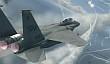
The second strong point of Ace Combat 6 is its visual aspect. We won't give a standing ovation, but if we meet the person responsible for the graphics engine, buying them a good beer in a cozy cafe will be a matter of honor. Everyone who collected and glued models as a child, all lovers of airshows and aviation magazines – these people will get indescribable pleasure from the game. The smallest details, radars and sensors, seams and dents – one of the games that encourages you to throw a thousand or two green papers at a new TV, preferably a bigger one. Wall-to-wall. Flaps and ailerons move during turns, landing gear extends, shadows fall geometrically correctly, hot air and sun reflections... Mmm... It is because of all these features that the murky mess below and the cardboard brick houses look completely dead. By the way, traditionally in Ace Combat there is a replay. After completing a mission, you can watch your own stunts and the smoky trails of irresistibly falling enemy aces to your heart's content.
Alas, nothing outstanding can be said about the music. It's present, occasionally creates atmosphere, plays in the menu. And honestly, it's not really needed. With constant negotiations between friendly and enemy pilots, through the engine noise and the roar of explosions, you don't pay much attention to the background chirping.
And then, quite unexpectedly, the harmless prefix 'arcade' is added to the word 'air combat simulator'. Almost harmless. Detailed and polygon-flaunting steel birds, a rather gloomy plot, a minimalistic menu – that's it, we believed it was a simulator. As it turned out, too soon. The authors at this point in the narrative exhibit a split personality syndrome.
Simulator: maneuverability, speed – everything more or less corresponds to real-life counterparts. Some models are good against ground targets, others are equally bad at shooting at air and sea objects.
Arcade: ease of control, maneuvers impossible from a practical and theoretical point of view are performed with 'Hurrah'. And how, for heaven's sake, to explain that a pilot fighting against invaders calmly, as if in a supermarket, buys new models of equipment, and probably even bargains, thumping his medal-covered chest? There are suspiciously few planes. Only 16 compared to 30-40 in previous games. And the fact that on the day of the game's release, 6 new models immediately appeared for sale on the Xbox Live Marketplace leads to bad thoughts. Very bad ones.
Simulator: equipment is a fragile thing. Three accurate hits – and the pride of the air fleet turns into prey for scrap metal hunters. In addition to the traditionally useless machine gun and basic projectiles, a dozen types of weapons are added – from monstrous torpedoes to homing missiles.
Arcade: a normal number of missiles on board – 100-140 basic and another fifty units of special weapons. Flying hordes of enemies are wiped out by a single Messenger of Death to the shouts of allies: 'Boss, there are so many of them, we're doomed!'. Often, arcade shooters, like Jets'n'Guns or Gradius, simply pale in comparison to the showdowns in Fires of Liberation.
Simulator: despite an impressive supply of weapons of mass destruction on board, most missions offer the opportunity to leave the combat zone and 'refuel' by landing on a landing pad. Ammunition and armor durability are fully restored, and you are ready again to tear the throats of foreign vultures for the good of the Motherland.
Arcade: the boss on the penultimate level goes to pilot heaven only after consuming 30+ missiles. At the same time, he constantly releases up to a dozen unmanned aerial vehicles with a 'kamikaze' function, completely ignores the laws of physics, and destroys your aircraft with two volleys. But, fortunately, nearby, right on the battlefield, a tiny, friendly base is lurking. Yes, you understood correctly – a tedious half-hour of takeoff and landing, and the boss is defeated. A sleepy 'Hurrah!'.
Simulator: in each mission, you have up to six objectives that you can complete in any order, depending on the aircraft/special weapon configuration chosen before takeoff. Your preparation and knowledge of the map determine whether the mission will be hell or a Sunday stroll with children in the park.
Arcade: 'Kill them all, and more!' Somewhere there are ships, somewhere there are anti-aircraft guns, somewhere time is also running. The authors' desire to transfer part of the plot into negotiations leads to confusion. Try to understand when they scream in your ear 'Get the [censored] out of here!' – is it an order, or will the pilot send the operator away after five minutes and croak: 'We're staying and fighting!'.
Continuing notes on arcade-ness. In the best traditions of role-playing games and fighting games, you have a super move bar. Excuse me, support gauges. If you destroy flying and ground enemy equipment for a long time and beautifully, the bar fills up, and all the fury of your wingmen sitting in the rear falls upon the enemy. After that, the fighting spirit of our friends cools down, and they again retreat behind the front line to drink beer and cheer for you on screen. Many missions are almost impossible to complete without the support of cowardly friends. For example, taking down a colossal mothership and five accompanying giants.
Diagnosis
An excellent continuation of the famous Ace Combat series. Not without flaws (the game is quite short, and they could have made twice as many means of destruction), but hellishly exciting. An almost perfect balance between arcade and simulator will allow newcomers to easily get into it and will delight experienced pilots with the furious dynamics of air battles.
Pro:
- Pleasant balance between arcade and simulator
- Ease of learning
- Detailed models of winged creatures
- Excellent graphics and spectacular effects
- Engaging plot
- Multiplayer allows you to test your skills against real people
- Short game duration
- Modest set of aircraft
- Some bosses are killed using a tedious, long scheme