10 iconic games released in 1996 [Gaming Archive]
Translated with AI from the Russian original.
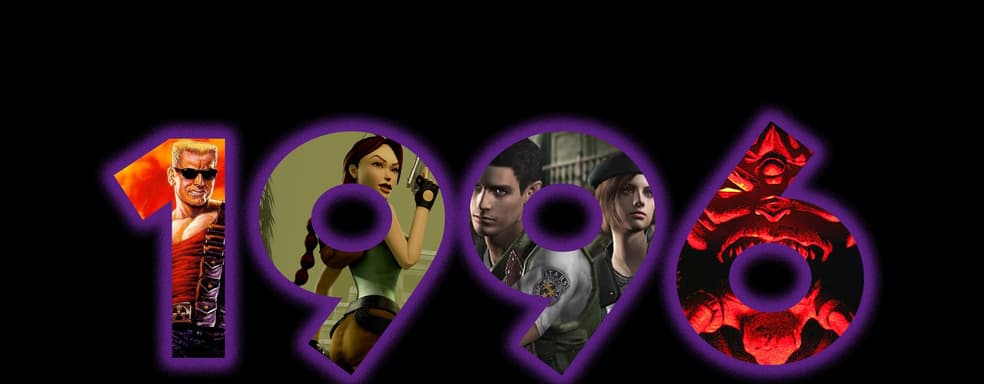
1996 was a real watershed year in the gaming industry: that's when sprites finally gave way to polygons. And even after so many years, this "golden age" offers concentrated gameplay and charisma that modern AAA blockbusters often lack. We recall ten of the best iconic games that were released 30 years ago.
Duke Nukem 3D. Release — January 29, 1996
It's hard to explain to a younger generation of gamers who Duke Nukem is and why he's a true must-have. The first Duke games had little in common with the hero he became when he transitioned to 3D. And Duke Nukem Forever, a game that was supposed to solidify Duke's reputation as a true action hero, unfortunately turned into a scandalous long-term development. But today we remember Duke Nukem 3D, which turned 30 on January 29, 2026.
What did this game give to the generation of gamers in the 1990s? The 3D shooter genre was on the rise, and id Software and its DOOM were already widely acclaimed. And the title of best shooter developers and leadership in technology would be confirmed by Quake in the same year, 1996, six months after the release of Duke Nukem 3D.
But Duke was loved for something else entirely. The gaming industry had probably never seen such a charismatic hero before. Today, this image has become canonical. It was Duke Nukem, approaching strippers in a nightclub, offering them money with the words "Shake it, baby!". It was he who was delighted by his own reflection in the mirror. And it was to him that enemies dedicated the inscription on a huge scoreboard: "Duke Nukem must die!". Why? Because no one before him knew how to deal with enemies so bloodily and dashingly.
A huge arsenal of diverse weapons helped him in this difficult task: from an automatic pistol to fantastic shrinkers and freezers; anti-personnel mines that reacted to passing enemies were something unusual; and most importantly — a kick with one or even two feet at once (a bug that turned into a feature).
Is it worth playing now? Definitely yes! And not just for nostalgic reasons. If you love crazy shooters, which are almost not made anymore, and want to know what a real "boomer shooter" is in its natural habitat, then feel free to launch the original 1996 version. And then go through all the official add-ons. Believe me, despite the sprites, you won't lose much.
However, if you want a more modern picture, pay attention to Duke Nukem 3D: 20th Anniversary World Tour. As Mikhail Shkredov noted, the anniversary edition (which turned 10 this year) allows you to "fully experience all the features of a 90s shooter."
Resident Evil. Release — March 22, 1996
Surprisingly, but true: 30 years after the release of the very first game, Capcom not only retained the audience's love for the Resident Evil series but also multiplied it. How many truly iconic franchises have managed to keep their fans and original essence over decades, while continuing to regularly, almost without interruption, release new hits?
Yes, much of the current success is based on updated gameplay, which is very different from what we saw in 1996. Honestly, a modern gamer would find the controls and level design of the 90s extremely inconvenient. But if you love Resident Evil, the 1996 original is worth playing at least once.
Why? To understand — this is not an action game with horror elements, like modern representatives of the genre, but a horror with action elements. Moreover, some mechanics here deliberately constrain your actions. You won't be able to aim properly, you won't be able to turn the camera yourself to see what's around the corner, and you'll always be limited in resources. And this is really scary, despite the fact that the local zombies are quite slow.
This kind of game design is characteristic of the early parts of the franchise. On the one hand, the PlayStation hardware of the 90s did not allow developers to fully expand into 3D. But the ability to create a truly frightening experience even within such tight constraints is a sure sign of talent. Many fans appreciated this approach: even while acknowledging the undeniable merits of modern remakes, they occasionally feel nostalgic for that very "old-school" Resident Evil.
Fortunately, there are also modern spiritual successors to this approach. For example, check out the early version review of The Killing Antidote — Vitaly Kazunov highly recommends it.
But also take a look at the 1996 original, or at least the classic remake Resident Evil HD Remaster, about which Mikhail Shkredov wrote 11 years ago that "the game still remains one of the best survival horrors." Little has changed since then. Yes, it will be a specific experience now, but perhaps it's exactly what you need.
Civilization II. Release — February 29, 1996
Sid Meier has probably forever inscribed his name in the history of the gaming industry. Games released in the 80s and 90s under the Sid Meier's brand were synonymous with quality and thoughtful game design. But even if Sid Meier had only worked on one game — Civilization — that alone would have ensured his entry into the pantheon of the greatest game designers.
Although Meier himself had a rather indirect relationship with Civilization II (the main designer was Brian Reynolds), it was the second part that remained, perhaps, the most faithful follower of the ideas laid down in the original. The basic "turn-by-turn" formula migrated from the first part to the second, but with important additions.
If Civ2 were released today, it could safely be called Civilization Remake or HD Remaster — that's how much the graphics have improved! After the CGA/VGA modes of the first part, the high resolution of SuperVGA (up to 1024×768 pixels!) looked fantastic. And the videos dedicated to the wonders of the world looked simply stunning in the 90s (and still look good today).
Yes, compared to modern installments (Civilization VII doesn't count — even the developers partially admitted their game design mistakes), Civilization II slightly lacks strategic depth. But the beauty of the Civilization series is that it doesn't really matter what number the latest installment has. You can always go back to any previous one, where you'll have to build your strategy anew, choose a civilization to your liking, and spend dozens of hours in front of the monitor. And Civilization II is no exception here.
On the contrary, if you want the "pure" gameplay that was in the original Civilization (which Sid Meier himself worked on), but are not ready for the hardcore pixelated VGA graphics — the second part is exactly what you need.
Quake. Release — June 22, 1996
The legendary "Quake" is 30 years old? Looking at screenshots of games from that time, you wouldn't say so. At most, you'd give it 28 years. And why? Because the aforementioned id Software in the 1990s was so technologically advanced that others simply couldn't keep up with John Carmack, id's lead engine developer.
Quake is the first full-fledged 3D shooter in the context of classic FPS. Not "2.5D", with pseudo-3D environments and sprite enemies, but fully polygonal, with full 3D environments and dynamic lighting effects!
Now, when playing Quake, you notice the enclosed spaces, short labyrinthine levels, and a limited number of enemies in one location. And given the intense gameplay and skillfully built suspense — rustles, scary sounds, rapidly attacking enemies — there's every chance you won't notice these features of past game design.
Unfortunately, Quake has aged poorly in one aspect. And it aged so quickly, in just 4 years. The beloved multiplayer modes rapidly became outdated, especially after the release of Quake III Arena and Unreal Tournament, which dominated the internet at the turn of the century. And now it's impossible to recapture the thrill that players experienced. Unless you gather a company of old-timers or young retro enthusiasts.
So you have to play alone and smash 3D monsters with a nailgun — it's still fun.
And you know what else is good about old id games? Thanks to the open source of their engines, there are many modern mods for their games, including the first Quake. So if you have a good video card, believe me: Quake RTX with ray tracing can still create a wow effect today. It doesn't matter if you played the first Quake before or not. Now there's definitely a reason to play it.
Crash Bandicoot. Release — September 9, 1996
Early 3D graphics of the mid-1990s look archaic today. And, recalling that time, you realize that it didn't always look appropriate: the characters on the screen seemed too angular compared to sprite characters — albeit flat, but detailed — of the 2D era. But there were characters whose angular shapes made the whole world fall in love with them. We'll talk about one tomb raider in a tight blue top a little later, but for now, let's remember the angular and strange bandicoot. Crash.
In general, a whole book could be written about the birth of this iconic character. About how Sony was looking for its mascot, who was supposed to compete on equal terms with Mario and Sonic. About how his appearance was born and how the developers from Naughty Dog almost individually counted polygons for his rendering so that the modest hardware of the first PlayStation could handle it. And they had to do this because the specifics of the genre required high dynamics. Want dynamics? Do hard optimization!
The result was a cool, dynamic, and exciting platformer. And even though Crash didn't become the official and eternal mascot of PlayStation, he forever cemented his status as the most beloved and recognizable symbol of Sony's first console. Naughty Dog, then a little-known studio, performed a small miracle, showing how a living world with stunning level design for its time could be created on limited hardware.
Is it worth returning to the 1996 original today? Honestly, probably not — unless you want to touch history and understand where the golden age of 3D platformers began. The specific features of the controls and design of that time are noticeable.
For a more comfortable introduction, the Crash Bandicoot N. Sane Trilogy collection is ideal. It carefully preserved the spirit, difficulty, and humor of the original, but freed the player from technical limitations, "blur," and the angular graphics of the 90s. Mikhail Shkredov wrote about this collection in 2017: "Such a gift cannot be missed."
Tomb Raider. Release — October 25, 1996
If you are only familiar with modern Tomb Raider games, then I'm afraid you've missed a lot. No, of course, after the franchise reboot there were good and popular releases, but the vibe is not the same. In the first games about Lara Croft, the main thing was not the gameplay. Just as in the "old" films about the tomb raider, the main thing was not the plot.
The game and films were made by her — the heroine of the narrative, Lara Croft. A style icon and the dream of millions, despite her angular, literally triangular forms in the first part (which eventually evolved into more pleasant roundness, and in the cinema were embodied by Angelina Jolie).
Don't get me wrong, the game itself was excellently made. 3D spaces, acrobatics, a decent combat system for its time, diverse weapons, and interesting puzzles. But in a direct comparison with modern AAA hits, the original Tomb Raider, of course, loses. In the genre of action-adventure games, it's incredibly difficult to surpass Sony exclusives with their Uncharted, God of War, or The Last of Us. And modern Tomb Raider games, to be honest, also don't reach that high bar.
But the irony is that old Tomb Raider still has something to answer modern blockbusters with. Lara Croft from the 90s is simply captivating: following the adventures of this character is still interesting and aesthetically pleasing. Yes, the original won't give you the same cinematic density of events as games from Naughty Dog or Santa Monica. Yes, the controls will seem specific, the physics strange, and the graphics hopelessly outdated. And the approach to storytelling has also changed a lot since then. But this game will give you a very special, incomparable pleasure.
The recently released Tomb Raider I-III Remastered collection does an excellent job of bringing that classic Lara Croft back to your PC or console. And this time, they've added significantly more polygons for her rendering.
Heroes of Might and Magic II. Release — November 16, 1996 (note: according to some sources, the game was released on October 1, 1996)
The second "Heroes" was unlucky: the immortal HoMM III simply overshadowed this part with its grandeur. And this is unfair, because it was HoMM II that paved the way for the third part.
If you compare the mechanics of the first, second, and third parts, it becomes obvious: almost everything we love about the "Three" migrated precisely from the "Two," which was truly revolutionary. Yes, in the "Three," parts of this system were refined and polished to a shine, but it was the "Two" that laid the foundation of the legend.
Compared to the darker or more epic sequels, the second part feels truly fairytale-like — this applies not only to the bright graphic design but also to the musical accompaniment. The original CD with the game contained full symphonic and choral compositions for each castle. Played directly from the disc, in high quality, these melodies captivated and instantly immersed players in the magical universe of Might & Magic.
By the way, for many, their introduction to Might & Magic began with this strategy game, despite the fact that several parts of the classic role-playing "Swords and Magic" had already appeared by the time the "Two" was released.
The gameplay masterfully combined global strategic and detailed tactical elements. On the adventure map, you explored the fog of war, developed cities, and searched for artifacts, while in battle, you decided on the proper positioning of units on a hex field and the timely use of hero spells.
Is it worth returning to HoMM II today, when there's the "Three" with all its modern mods and add-ons? Definitely give it a try. Perhaps the atmosphere of the early "Heroes" will appeal to you more. The first part is still outdated in terms of gameplay, but the second one still plays great.
Command & Conquer: Red Alert. Release — November 22, 1996
"Our Soviet Union conquers the whole world from Europe to the Neva to the east..." — sings in broken Russian in the famous "Soviet March," written for the third part of Red Alert in 2008. By the way, many players in the CIS deliberately sang this march with the word "punishes" to further intensify the heat of the "Red Threat." It's a pity, of course, that this masterpiece would appear somewhat later than 1996, because it perfectly fits the atmosphere of the very first Red Alert.
Red Alert was essentially, in modern terms, a reskin of C&C: Tiberian Dawn on the same engine, but with new units and mechanics. And, attention, spoiler: according to the plot, it was a prequel to the original — in one of the endings, we learn exactly how history changed. An unusual feature for that time. But it so happened that in terms of popularity in the CIS, Red Alert eventually surpassed the original, giving the industry iconic characters, especially in the second and third parts. Although in terms of charisma, the leader of the Brotherhood of Nod, Kane, still remained unsurpassed.
But Red Alert was loved on both sides of the already collapsed Iron Curtain not only for this. The fear of World War III, which terrified humanity in the 1980s, receded by the mid-1990s. Now it was possible, in a light, almost arcade form, abundantly seasoned with thick cranberry syrup, to work out one's past fears and laugh at the absurdity of global confrontation.
Frenzied dynamics and the legendary Tanya Adams, clearing bases alone, buzzing Tesla coils of Soviet bases and insane experiments with the chronosphere, the genre of alternative history and cinematic inserts with live actors — all this created a unique atmosphere of the game.
Which you can and should immerse yourself in now, thanks to Command & Conquer Remastered Collection (2020). And then "Everywhere on Earth they will sing: 'Capital, vodka, Soviet bear!'"
Super Mario 64. Release — November 22, 1996 (in Japan, the game was released earlier, on June 23, 1996)
Looking at Super Mario 64 from 2026, it's hard to immediately grasp the scale of the revolution this game brought about. Some might think: well, an "old platformer" from Nintendo, how many of them were there? And if you think this is just another part of the franchise, you are deeply mistaken.
When you launch hits like The Legend of Zelda: Breath of the Wild, Super Mario Odyssey, or even modern open-world action games like Elden Ring and Genshin Impact today, know this: they all stand on the shoulders of a giant named Super Mario 64. This was the first game in the 3D platformer genre that successfully solved the problem of a free camera. The player decided where to look, rather than following a rigidly "fixed" screen. Critics and developers are unanimous: it was the camera and control system in SM64 that paved the way for the entire genre into a true 3D world.
It was a revolution in everything.
- The game became a system-seller for the Nintendo 64 — a console that initially lost to the first PlayStation due to the lack of a CD drive. The new "Mario" literally boosted hardware sales.
- It was a shock for players who for the first time had the opportunity to freely explore a volumetric space, rather than running from left to right — this gave them a sense of true discovery.
- It was a lesson for the entire industry. Before SM64, no one really understood how to work with 3D platforming, but after its release, it became clear how to work with space and why ignoring the lessons of "Mario" was no longer an option.
But the most important innovation was not even the graphics engine, but the analog stick of the gamepad. It was Super Mario 64 that showed why it was needed: the speed of the hero's run depended on the angle of the stick's deflection. Today this is obvious, but in the mid-90s, such a level of control was a revelation. Mario the plumber taught developers how to create worlds.
Is it worth playing now? Absolutely. Yes, the polygons are angular, and the textures are blurry. But the level of game design remains exemplary even after 30 years. Every corner here is designed to encourage exploration. This is Nintendo, after all.
If the original N64 console is a thing of the past, check out the Nintendo 64 Expansion Pack on Switch — it includes many hits from the console, including Super Mario 64.
If you don't have a Nintendo console at all, you'll have to use software that the company doesn't really like (it starts with the letter "e"). But it's still better to buy a Nintendo console. It has many great games — and not just about Mario.
Diablo. Release — December 31, 1996
Formally, Diablo was released in the last hours of 1996, although it gained widespread fame in 1997. But in 2026, the game turns 30, so it rightfully earned its honorable place in the list of top releases of the last century. An undisputed hit, the progenitor and standard of the "Diablo-like" genre, defining its appearance for decades to come.
If you look at modern Path of Exile, Diablo IV, Titan Quest, and other projects, you'll find that the game mechanics laid down in the very first Diablo have remained practically unchanged. Development trees and skills have become larger and more branched, but the foundation has remained the same.
However, there is one nuance that distinguishes the first part from all sequels. Modern "Diablo-likes" are combat RPGs with classes, leveling, and dungeons, but their essence is different. They followed the path set by Diablo II: they offer an endless pursuit of the ideal build and set of artifacts. And starting with Diablo III, this pursuit became truly endless, turning character improvement in the hope of great random drops into a second job.
That's why the first Diablo might seem too simple to genre fans today. Judge for yourself: only four classes — Warrior, Rogue, and Sorcerer, to which the Monk was added in the Hellfire add-on — a small number of characteristics, one giant dungeon generated with each playthrough, four main biomes, and a handful of artifacts. Blizzard would complicate this formula later, but in 1996, it was exactly like this.
But this is what makes the first Diablo special. The main thing here is not the mechanics, but the oppressive gothic atmosphere, which is so difficult to recreate. Gloomy sound design, echoing footsteps in stone corridors, a sense of complete isolation, and Matt Uelmen's legendary music. It changes in the town of Tristram to that very melody, to which Deckard Cain greets the hero with the phrase "Hello, my friend. Stay awhile and listen...", which has become one of the most recognizable in gaming history.
The first Diablo can simply be played through to the final credits as a complete game and get concentrated pleasure from it. Isn't that great?
If you want to experience the classic today, don't torture yourself by launching the old exe-file through DOS emulators. Turn to the DevilutionX project. This is a free, open-source fan port that carefully transfers the original to modern systems: it adds support for widescreen monitors, gamepads, and an improved interface, while preserving 100% of the original gameplay and atmosphere.
Important: for the port to work, you will need a legally purchased copy of the game.
Read more on the topic:


Never miss our newsAdd this site to your preferred sources to see us more oftenAdd on Google