Silent Hill “at home”. Post Trauma horror review
Translated with AI from the Russian original.
While Polish Bloober Team was forging the long-awaited Silent Hill 2 remake, somewhere in Spain, the newly minted indie studio Red Soul Games was preparing its own answer to 2000s horror nostalgia. Post Trauma invites us into a world of personal nightmares, puzzles, and oppressive silence. In this review, we figure out whether it's worth diving into this Gloom.
The conductor doesn’t understand
A flooded prison. A defenseless man. A gunshot. The opening scene of Post Trauma casts the first hook into the lake of our interest and then transports us to the protagonist — Roman, a conductor battered by life and animators, who, as a result of a sudden panic attack, finds himself in another, terrifying reality known as the Gloom.
The developers don’t hide this, so don’t consider it a spoiler: our clumsy conductor hit the brakes — and ended up in a personal hell. Now the player is tasked with escaping this dark abode by solving puzzles and occasionally fighting monsters.
Sounds familiar, doesn’t it? And indeed — the influence of the Silent Hill series is felt everywhere here. Only far from always do these parallels turn out in Post Trauma’s favor.
You begin to doubt the screenwriter’s competence from the very first minute. Roman comes to his senses in a subway car that still looks quite ordinary and immediately blurts out an awkward: “Where am I?” — as if he forgot where he spent the last thirty years. This seemingly insignificant example, which might seem like nitpicking on my part, actually illustrates the authors’ approach to the story and the world perfectly. Soon you’ll understand why.

During the playthrough, we visit a number of locations “mandatory” for the genre: an abandoned subway, a police station, a hospital, and a school. In these places, we encounter strange characters who hint at Roman’s “great guilt” — the very one that brought him to the Gloom.
The dialogues are full of omissions and half-hints, but in reality they are devoid of meaning and merely serve as an attempt to spook the player. Moreover, between acts, the player gets to take control of other story characters: Carlos and a mute girl named Freya. Theoretically, this was supposed to clarify certain points, but in practice, it doesn’t work.
There are enough intriguing details in the story — the characters’ past, strange experiments with a monster, the desire to explore the depths of the Gloom — to keep interest alive until the finale. But there are a number of nuances.
The thing is, Carlos’s story is fully revealed through four cassettes scattered across locations, and understanding Freya takes just one abstract scene in the school. Meanwhile, all hints at internal drama and traumatic events are worked out so superficially that even the most ardent fans of Silent Hill symbolism won’t find any hidden depth here.
As for Roman’s story, of course, some understanding of what is happening emerges toward the finale, but it can hardly be called satisfying. The developers built their world by ripping elements from classic horror franchises, but forgot to lay the foundation, shifting that responsibility onto the player.
Until the very end, the main character remains an empty, suffering dummy, needed only to carry the player from one puzzle to another, while his personal drama, having arisen out of nowhere, vanishes into nothingness.

Pixel hunting
The core gameplay of Post Trauma consists of exploring gloomy, empty spaces and solving puzzles that require not so much logic as patience and skills in mashing the action button on the gamepad.
The puzzles themselves are classic for the genre: carefully examine the surroundings, match found symbols, guess passwords, or collect parts to start some mechanism.
Often, puzzles line up in a coherent chain where one task unlocks another, like: “find a piece of ice — melt it — get a fuse — start the generator — solve the cipher on the generator...” and so forth. But here, too, there is an interesting nuance.
Have you ever played adventure games where you have to meticulously search the screen for a tiny item without which progression is impossible? Here, the developers took that formula to the absolute.

How are we used to finding items in Silent Hill and Resident Evil? We wander through a location, suddenly spot an alluring glint, head toward it — and discover the required object that can be picked up for future use.
In Post Trauma, there is no glint. What’s more, often there is no object at all — and that’s not even a joke. For example, in the flooded prison, there is a key lying in the cell on the right — but you will never see it because it simply has no physical model. I discovered it by accident, poking into corners and frantically pressing X on my DualSense. And most of the game plays out in this mode: interactive objects do not stand out from the scenery in any way, and some have no visible model at all, just like that key.
This is certainly an outrageous design choice for a 2025 game. But against the backdrop of the combat system, the puzzles are more pleasing than disappointing.

The combat system in Post Trauma is frankly nominal. Battles with monsters are rare — and big thanks to the developers for that. As the saying goes: “If you don’t know how, don’t bother.” Although you’ll still have to face a dozen enemies over six hours, it’s almost always easier to just run away from them.
There is no aiming when using firearms, so you have to “aim” by shifting the character’s position in space — which is simply awful under fixed camera angles. Meanwhile, the developers for some reason added stamina, which is depleted by dodging and melee attacks.
The fights themselves are simple and resemble a circus performance of two clumsily twitching models, so there isn’t really any need to manage stamina. But its presence is quite annoying when you just want plain and simple “running from point A to point B” — since even outside of combat, running consumes stamina. Well, forgive and forget — after all, Roman is already 57 years old.
I’d like to say that the bosses are an exception and pose a real challenge to the player, but three shotgun blasts are enough to end any battle. The final encounter takes place without firing a single shot at all. And there’s no one else to waste ammo on — after unloading an entire magazine into nowhere (thanks to the lack of an aiming reticle), you realize that it’s easiest to beat regular enemies to death with some pipe. Fortunately, melee weapons don’t break here at least.

Nostalgia for budgets
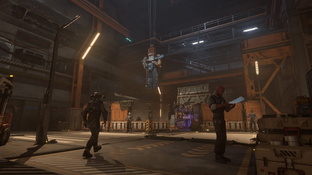
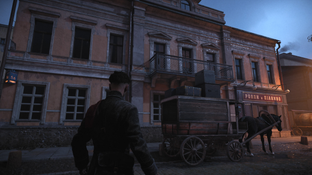
In terms of atmosphere, Post Trauma truly tries to probe the fragile boundary between reality and nightmare, just like Silent Hill does. And, admittedly, the developers succeed at this in several moments. The locations oppress with their emptiness, and even the gym in the abandoned school induces inexplicable anxiety. Moreover, creating the atmosphere of horror is aided not by cheap jump scares, but by a competently built visual and audio environment.
The fixed camera is used according to all genre conventions: sometimes it catches frightening details, and sometimes it deliberately conceals the source of rustles and creaks outside the field of view, forcing the imagination to flare up in vivid colors.
The sound design deserves a separate mention. A palpable tension reigns in the game even in complete silence, broken only by the crackle of electrical appliances, the hollow echo of footsteps, and oppressive ambient drones. The musical score, composed by Nicolas Gasparini (Myuu), echoes the works of Akira Yamaoka — which is certainly another deliberate nod toward Silent Hill.
Yet against the backdrop of the carefully crafted atmosphere, technical flaws that can spoil it become glaringly obvious.

There are just as many problems with the animations in the game as with the combat: the characters’ movements, especially Roman’s, are jerky — as if his main goal isn’t to escape the Gloom, but to urgently make it to the restroom. Facial animation is either completely absent, as in the case of the mute girl, or so primitive that it doesn’t even reach the level of projects from that very PlayStation 2 era.
I understand everything — a young indie studio, debut project, limited budgets, the game costs 500 rubles. I’m even willing to make allowances for that. But just recently I wrote a review of the thriller KARMA: The Dark World, which also had no whiff of big budgets and pulled lots of elements from various works — from Orwell to Twin Peaks — yet the developers there laid down a world foundation with clear rules.
Despite the abundance of surrealism, this allowed them to offer players a decent finale, as well as take an inventive approach to the few battles so as not to weary players with a dreadful implementation of the combat system.
With all the caveats, KARMA seems to have an identity of its own. Regrettably, the same cannot be said about Post Trauma.

Diagnosis
Post Trauma is an attempt to convey the spirit of classic survival horror, where sincerity of intent clashes with limitations of execution. The game is clearly crafted with love and respect for the genre, focusing on atmosphere, exploration, puzzles, and anxious loneliness. However, the execution of these elements suffers from a lack of depth, smoothness, dynamics, and basic gameplay tuning, making the combat system feel superfluous and causing even the brightest moments to quickly fade.
When the Spanish studio Red Soul Games says they draw inspiration from PlayStation 2 era horrors, it seems high time to dust off the classics, spice them up with new tech, and bring players back to the golden era of fear. But Post Trauma was out of luck — it arrived not only between Oblivion Remastered and Clair Obscur: Expedition 33, but also in a world where the Silent Hill 2 remake already exists, which means expectations are now entirely different.
Nevertheless, Post Trauma cannot be called a failure. It is a debut work showcasing potential — even if not fully realized. In its best moments, the game truly reminds of the genre’s golden age and can provide several hours of atmospheric old-school horror. But you certainly shouldn’t expect anything more from it.
***
All image rights in this article belong to RED SOUL GAMES // Raw Fury. IXBT Games uses them for informational and research purposes and does not claim ownership of them.
Never miss our newsAdd this site to your preferred sources to see us more oftenAdd on Google