A hunter the world has never seen before. Review of the animated film “Predator: Killer of Killers”
Translated with AI from the Russian original.
A Viking, a ninja, and a pilot walk into a bar... No, this isn’t the beginning of a tired joke, but the key protagonists of a new animated film in the Predator universe directed by Dan Trachtenberg, who previously reimagined the franchise in Prey (2022). Killer of Killers has already become the highest-rated entry in the series, but how justified is that? Let’s find out in this review.
“Walk among the stars and seek only the strongest prey. It shall become your trophy. Become a killer of killers.” Yautja Code 0522/74
Shield
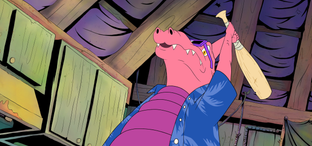
Structurally, the film resembles an anthology: three stories unfold before the viewer, formally unconnected to one another. Each shows a clash between the Yautja predators and human warriors in different historical eras. However, thanks to a common framing device and a unified visual and stylistic approach, the film feels more like a triptych.
The first story takes the viewer to the harsh icy fjords and rocky shores of 841 AD. Here, the Predator faces Ursa—the daughter of the Jarl of Ladoga and a valkyrie of the northern seas, in whose heart a monster with claws of fire and steel has long taken up residence. The name of this monster is vengeance. Ursa sets out on a campaign to find and destroy the one responsible for her father’s death. But this is merely a prelude to a far more sinister nightmare.
The creators skillfully build tension by showing how the Predator observes the unfolding events from the shadows. Time and again, he could have slaughtered everyone under the cover of night, yet he bides his time—waiting until a worthy opponent emerges. Only the audience is aware of his presence, and this knowledge adds a necessary dose of suspense to the proceedings.

The combat choreography and gory dynamics justify the film’s R rating from the opening minutes. The camera tracks the heroine as she charges with shield raised into enemy ranks, lopping off heads and crushing bones. The animation deliberately slows down here, at times shifting into stop-motion, so that every strike, every splash of blood on the pristine snow gains the necessary weight. At times, blows fly straight at the camera—as if these scenes were crafted for 3D glasses. Yet even on a flat screen, this produces an impressive effect.
We are shown a Predator who seeks not merely to destroy a worthy adversary, but also partly mimics them—making the clash, from the standpoint of the Yautja code, more “fair.” Since Ursa is a ferocious northern warrior ready for open, face-to-face combat, the Predator responds in kind. This also emphasizes his portrayal as a muscular brawler who does not rely on agility, speed, or cloaking in battle.
In my opinion, this is a successful choice that preserves the internal logic of the conflict without cheap tricks like a deus ex machina, sudden bouts of stupidity, or inexplicable luck. The first episode establishes the directorial vision and sets a template along which the subsequent stories are built. Trachtenberg tested this formula back in Prey—and now adheres to it almost religiously, making it easier for the audience to believe what is happening.

Sword
The second story transports us to the other side of the world and time—to 1609, in feudal Japan during the Edo period. Here, among pagodas and autumn foliage, a samurai drama unfolds about two brothers vying for the right to lead their clan. Their rivalry leads to a rift: one stays with their father, while the other goes into exile and becomes a ninja.
Along with the setting, the mood shifts as well—the pacing quickens, and the points of emphasis change. Throughout the entire episode, not a single word is spoken, except for one phrase repeated twice that acts as a refrain. Words give way to visual storytelling—the tale is told through the language of sounds, gestures, emotions, combat choreography, and falling leaves. The animation becomes smoother, the movements swift and measured, and the combat acrobatics balance on the edge of what is possible.

The Predator changes too. While in the first episode the Vikings called him Grendel—referencing the monster from Beowulf—here he appears as an invisible demon from Japanese folklore. An agile hunter wielding multiple types of weaponry, actively employing gadgets, and acting like a true ninja—just like his opponent.
The gory dynamics blossom in full force: the vivid accents of the first episode are replaced by uncompromising dismemberment. By this point, it becomes evident that the background extras exist solely to literally lose their heads, let out piercing screams, and get torn to pieces.
Without spoilers: emotionally, this is the strongest part of the entire film. However, its impact might feel somewhat diminished due to the abundance of familiar tropes from works about medieval Japan. And now—we ascend higher. Straight into the sky.

Bullet
The third story moves the action to the World War II era and follows Torres, a young mechanic who dreams of conquering the skies but is stuck on the ground—along with his broken plane.
Here, Trachtenberg, let’s say, indulges in a bit of showing off—delivering something we haven’t seen before: a full-fledged dogfight against a Predator. And perhaps you, like me while watching, will wonder: what kind of Predator would you even get if he had to fight a pilot?
The creators present a veteran resembling a one-eyed sky pirate who indiscriminately obliterates anyone daring to take to the skies in his ship. The only issue is that the feeling of still watching Predator, let alone Trachtenberg’s Predator, gradually slips away.

Throughout the entire episode, narrative logic stumbles noticeably. Torres, who initially couldn’t even fix his own car, suddenly starts tinkering with radial engines, pulling off unthinkable aerial stunts, climbing out of the cockpit mid-flight—and doing all this with enthusiasm and endless Nathan Drake-style luck.
And this happens precisely because a human is pitted against far too powerful a Predator—for the sake of spectacle, the director compromises his own principles.
Torres doesn’t feel like a worthy opponent for a Yautja veteran, and the spirit of the hunt is barely palpable here. The Predator doesn’t stalk, sneak, or choose his prey—he simply engages in a flashy aerial dogfight. Had an advanced fighter jet with a human pilot been in his place, the essence of the sequence would hardly have changed.
Don’t get me wrong—the spectacle itself is breathtaking: the aerial battles are dynamic and intense, and the new Predator appears as a brutal, calculating airborne killer. But it is in the third episode that animation flaws begin to show more prominently—as if the visuals themselves are protesting against the disrupted order.

In the first two episodes, the visual style raises almost no questions—the animation confidently blends 2D and 3D with distinctive watercolor strokes reminiscent of the Arcane aesthetic. And that’s no surprise: character animation in Killer of Killers was handled by Stephen J. Meyer, who served as a lead animator on seven episodes of the League of Legends series. In the third segment, however, there are too many explosions that clash with the overall style and fall short of the execution level seen in other elements.
Nevertheless, the action on screen is excellent—especially if you slightly suspend disbelief and simply enjoy the show. This episode brings us to the finale, which serves as a framing device for all the storylines, but let’s avoid going into detail so as not to spoil the intrigue.
I’ll just say that the finale inherits some of the third episode’s flaws: it portrays events that are hard to call logical—at times they feel blatantly contrived purely to fit the director’s vision. It doesn’t deliver a “wow effect,” but it is necessary to present several scenes that unequivocally hint at the universe’s potential future.

Past and future
Over its long history, the Predator franchise has seen its fair share of highs and lows. Following the 1987 cult classic starring “Iron Arnie,” all subsequent films inevitably fell in its shadow and rarely held up to direct comparison. And after the outright mockery in the form of Shane Black’s 2018 parody of Predator, it seemed the franchise was dead and buried.
In 2020, 20th Century Studios tapped relatively young Dan Trachtenberg to direct the franchise’s fifth installment; he had made his feature debut four years earlier with the horror film 10 Cloverfield Lane. As Trachtenberg later admitted, the idea for Prey occurred to him about a year after his debut. But could anyone back then—himself, or us—have imagined that he would effectively take the helm of the franchise and lead it forward?
Prey wasn’t an absolute blockbuster. Its release arrived at a time when “strong female leads” began sparking subconscious irritation among a segment of the audience—and that was one of the reasons for the film’s mixed reception.

Nevertheless, Prey accomplished its goal: it essentially revitalized the franchise, taking it back to its roots and showcasing a primal, energy-packed duel between two predators—a young Yautja embarking on his first hunt and the equally inexperienced Naru of the Comanche tribe.
It’s a story of how brute strength, resourcefulness, and an unstoppable will to live intertwine to confront a technologically superior foe. The animated film Predator: Killer of Killers not only adheres to this formula, but also lays a solid groundwork for the franchise’s further development—including the upcoming project Predator: Badlands.
Select story threads—including the fourth episode and numerous callbacks to earlier films—theoretically tie all released (as well as future) franchise projects into a cohesive tapestry. What’s more, with this work Trachtenberg clearly proves he can drop Predators into any era, throw them into the most unexpected circumstances, and still make every incarnation feel organic and meaningful. And we, hopefully, will watch it all unfold with equal excitement.

Diagnosis
Three eras. Three striking short films woven together in Killer of Killers demonstrate just how versatile the Predator universe can be. Each episode stands on its own and functions independently from the rest. In terms of creativity and spectacle, this animated feature is hard to match anywhere across the franchise—granted, the original films came out long ago, and the very nature of animation allows far more freedom to realize a creator’s vision.
Stunning combat scenes with spectacular gory dynamics, measured visual storytelling, shifts in mood and setting within a unified artistic aesthetic, and an overarching frame narrative allow Killer of Killers to be appreciated as a cohesive piece of work. At the same time, they prove that Trachtenberg can steer the franchise in any direction.
We will see one of those directions very soon in Badlands. For now, though, I highly recommend checking out Killer of Killers. Is it the best entry in the franchise? I wouldn’t go that far. But you certainly haven’t seen Predators like this before.
***
All rights to images in this material belong to 20th Century Studios / Disney. IXBT Games uses them solely for informational and analytical purposes and does not claim ownership.
Never miss our newsAdd this site to your preferred sources to see us more oftenAdd on Google