Spaniards took another trophy: why Denshattack! is the main surprise of the year
After watching a couple of minutes of the Denshattack! gameplay trailer, many risk shrugging their shoulders and delivering a verdict: "It's just an endless runner with bright graphics and monotonous gameplay." If you thought that way, you've never been so wrong in your life. In this review, we'll explore how a modest Spanish studio managed to combine the drive of Tony Hawk, the rebellious spirit of Jet Set Radio, and the aesthetics of Hi-Fi Rush into the best arcade action game of the year.
Spanish Express
Well, this summer has been incredibly fruitful for Spain. Just four days before its national team defeated Argentina in the World Cup final, a small Barcelona-based studio, Undercoders, consisting of ten people, released the most ambitious project in its 20-year history — Denshattack!, which burst into the ranks of the highest-rated games of the year with 98% positive reviews on Steam and 88 points on Metacritic.
The parallel is so amusing that it would be a sin not to extend it a little further. While the football world recalls how Lionel Messi bathed six-month-old Lamine Yamal in 2007, we will remember that the studio's first major success came after the release of Angry Ramos in 2013 — a parody game about footballer Sergio Ramos, who, instead of "angry birds," was launched into flight with a slingshot.
Since then, the team has come a long way, creating rather niche and specific projects year after year that could not boast much audience love. Looking at their modest portfolio, one least expects to see a game of this level. Denshattack! intertwines elements of the planet's best arcade franchises: from Subway Surfers and Tony Hawk's Pro Skater to Jet Set Radio and Crazy Taxi, ultimately delivering a unique, monolithic arcade masterpiece.
If the words "gameplay" and "game design" had illustrations in the dictionary, a screenshot of Denshattack! would be next to them. Why? You'll find out now. Fasten your seatbelts — pure adrenaline awaits.
Sweet Pill
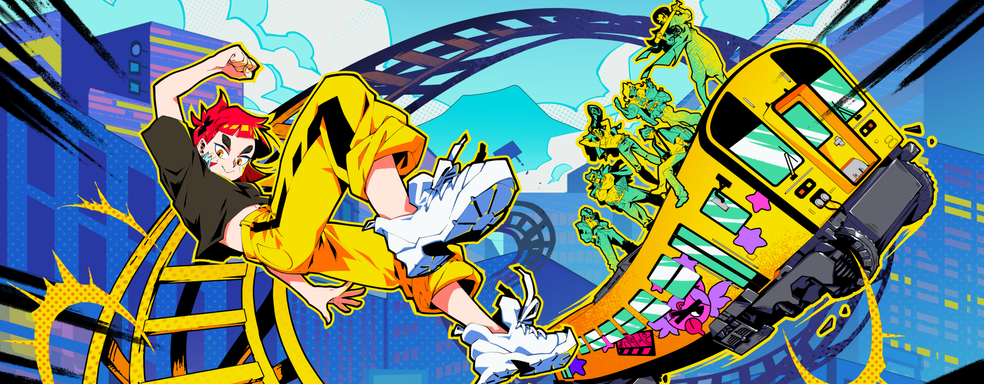
From the very first frames, the visual style and overall tone of Denshattack! evoke an irresistible association with Hi-Fi Rush. Acidic cartoon aesthetics, cel-shading, emphasis on music and dynamics — the game perfectly captures the modern trend for bright dystopias. Instead of the usual bleak cyberpunk gloom, which is already sickening in the news, the developers present their world in the format of a "sweet pill": here, everything is still bad with ecology and megacorporations, but it's all wrapped in a riot of colors and drive.
The game's action unfolds in futuristic Japan, which has experienced an ecological catastrophe, after which the world clearly split along wealth lines. Wealthy people leisurely live under special protective domes with clean filtered air, delicious food, and complete comfort. Outside the domes, life also continues, but the poorest population huddles there, forced to breathe far from the best air and put up with class inequality. The only thread connecting these zones remains a giant network of railways.
The main character, Emi, works as a ramen delivery girl and races along the tracks with such daring that she attracts the attention of photojournalist Fernando Tamashiro. He tells her about the "Denshawain" movement, who compete in speed and train control techniques. Emi immediately gets excited about the new idea, tears off her apron, and, following the precepts of Need for Speed: Most Wanted, begins to compete with gangs across Japan — from provincial Kyushu to Osaka and Tokyo — gaining respect and assembling her own team.

The story unfolds according to all the canons of a typical teenage shonen (I didn't believe until the very end that the game was made by Spaniards — it's so imbued with the Japanese spirit). Each new region introduces Emi to another vibrant gang, whose leader first becomes a rival, and after defeat, inevitably joins the company of friends. As the heroes' popularity grows, the plot escalates into a confrontation with the powerful Miraido corporation, which sees Denshawains as dangerous vandals and even hires yakuza to eliminate them. The plot doesn't shock with unexpected twists and is unlikely to make you seriously worry about the heroes, but it captivates with its sincerity, kindness, and charming naivety.
Even secondary characters are memorable thanks to their expressive design, character, and completely insane trains. Between chapters, the narrative unfolds through stylish comic book sketches and news with a propaganda mole in the corporation's service, who retells the consequences of another skirmish.
More is not required from the story, because the main plot twists of Denshattack! happen on the rails: from the first hesitant jumps to tricks after which it's time to check if the gamepad has caught fire while the heart beats wildly somewhere in the throat.
Tony Hawk on Rails
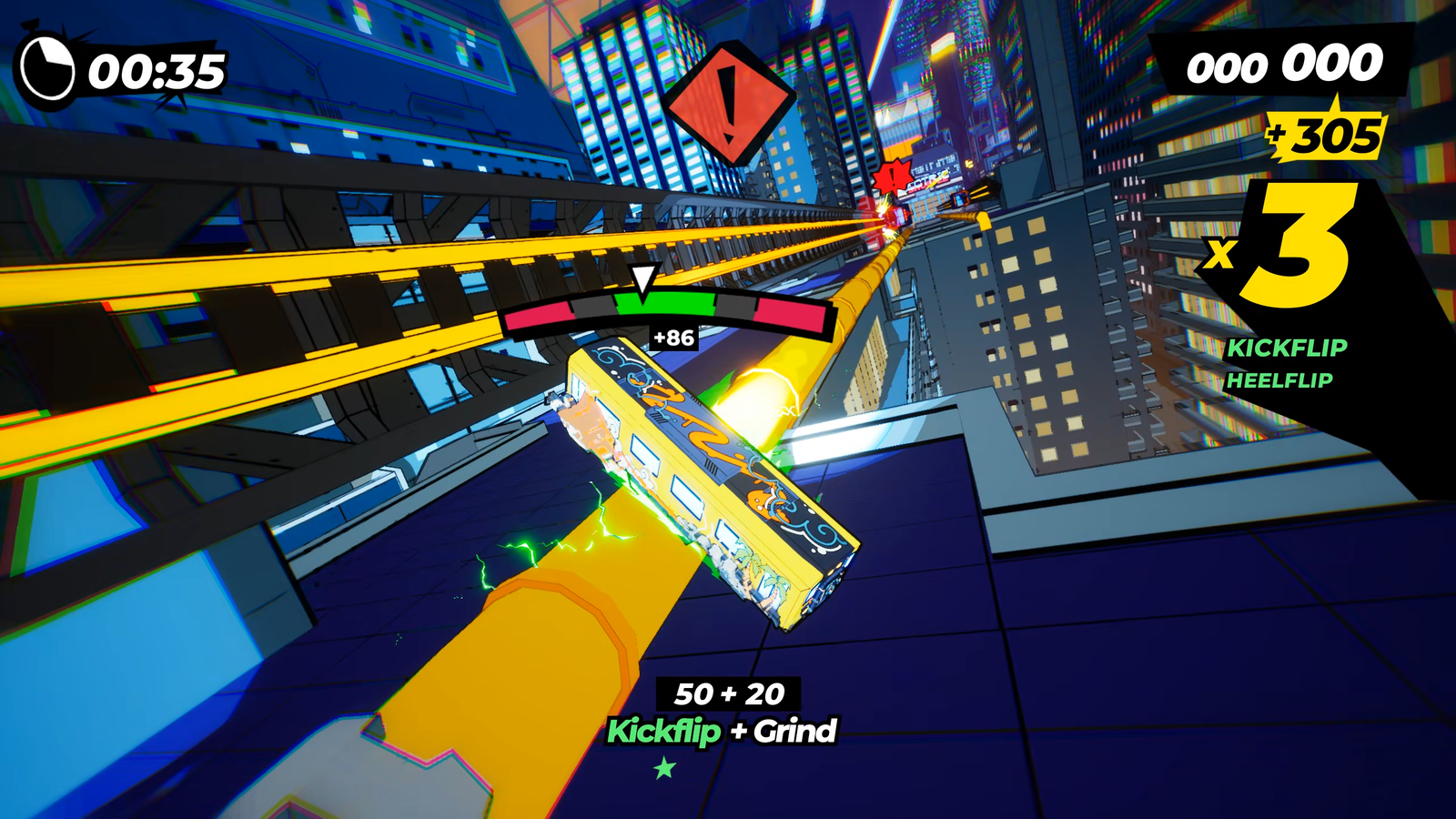
At first, it's indeed very easy to mistake the game for another straightforward mobile runner in the style of Subway Surfers: we take control of a train that constantly rushes forward, dodges obstacles, and tries to reach the finish line. But all similarities end there.
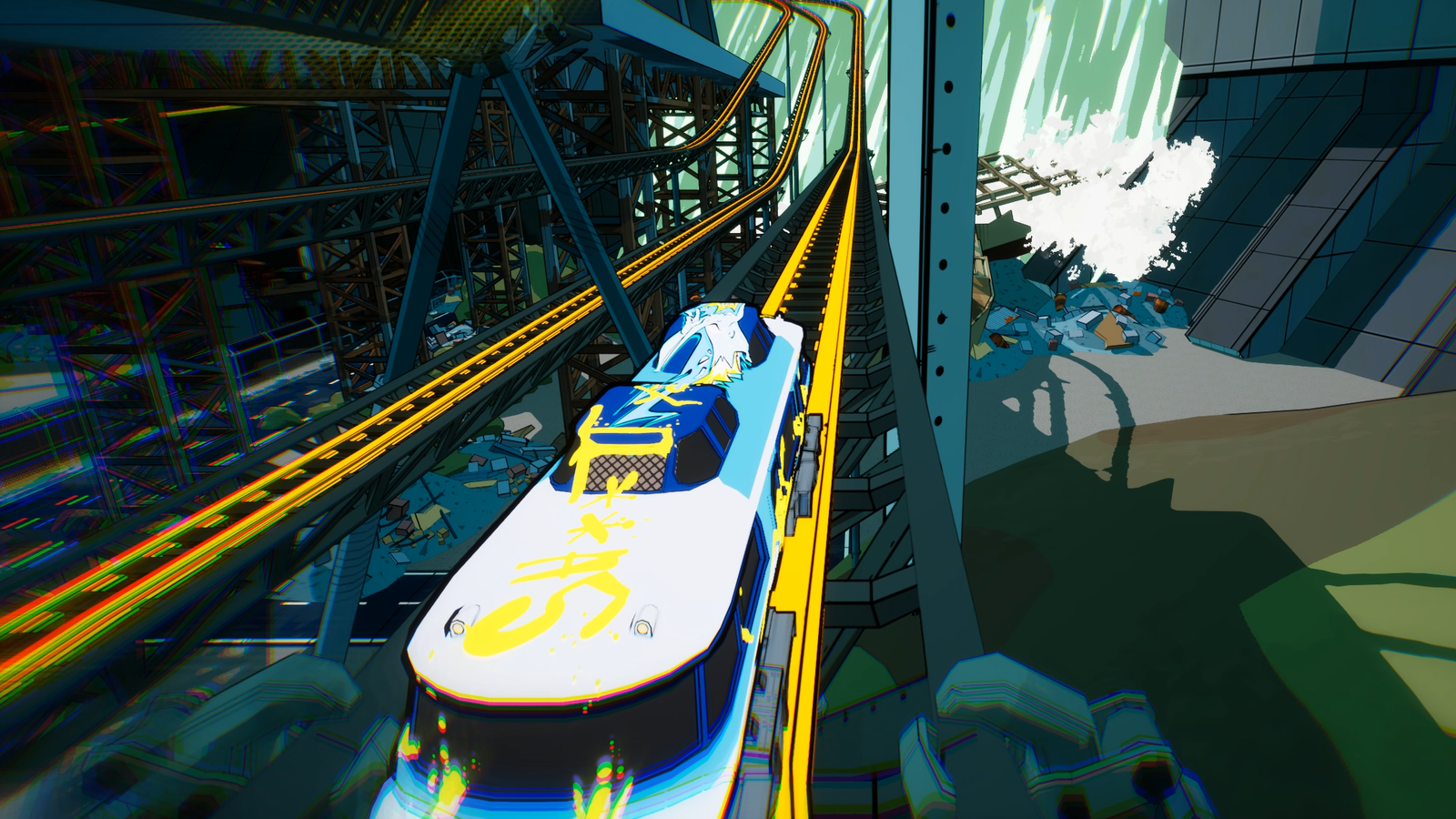
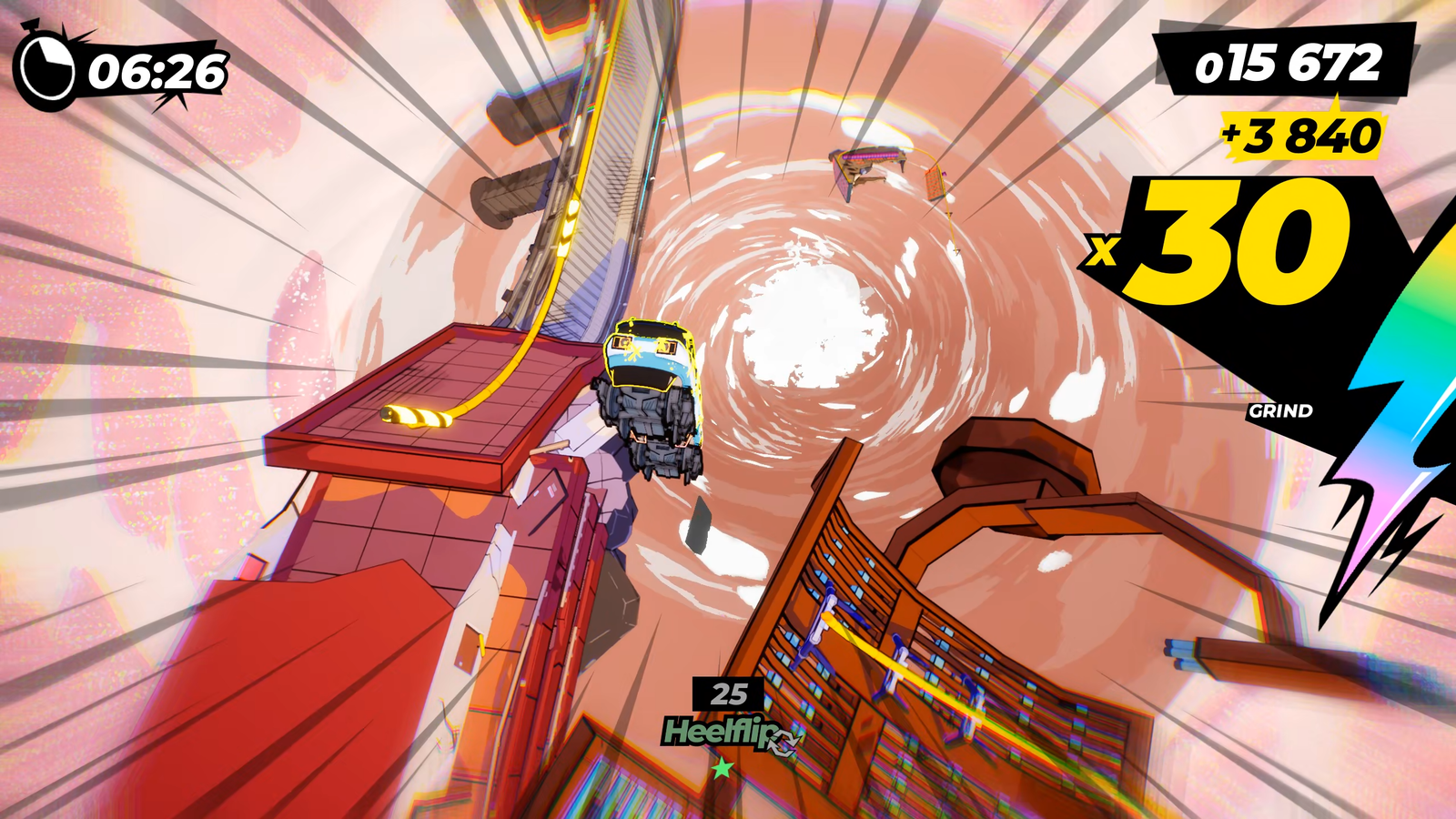
Denshattack! is a full-fledged arcade extreme sports simulator, where instead of a skateboard, we have a train that can grind on railings, drift, jump, and perform the wildest somersaults in the air. The right stick is responsible for tricks: you can spin it however you want, and at first, something will work out. The starting arsenal also includes a horn to destroy small obstacles and a sharp slam to the ground, allowing you to avoid colliding with a higher obstacle or cancel an unsuccessful jump so that the train doesn't fly into the abyss.
You'll often fly off the track at first, but Denshattack! is not at all annoying thanks to its Ghostrunner-like approach. You rush at insane speed and regularly make mistakes, but thanks to densely placed checkpoints, you instantly get back into action — even after a dozen failures, there's no feeling that you're wasting time. The game forgives mistakes and allows everyone to calmly reach the finish line — with the exception of some types of levels.
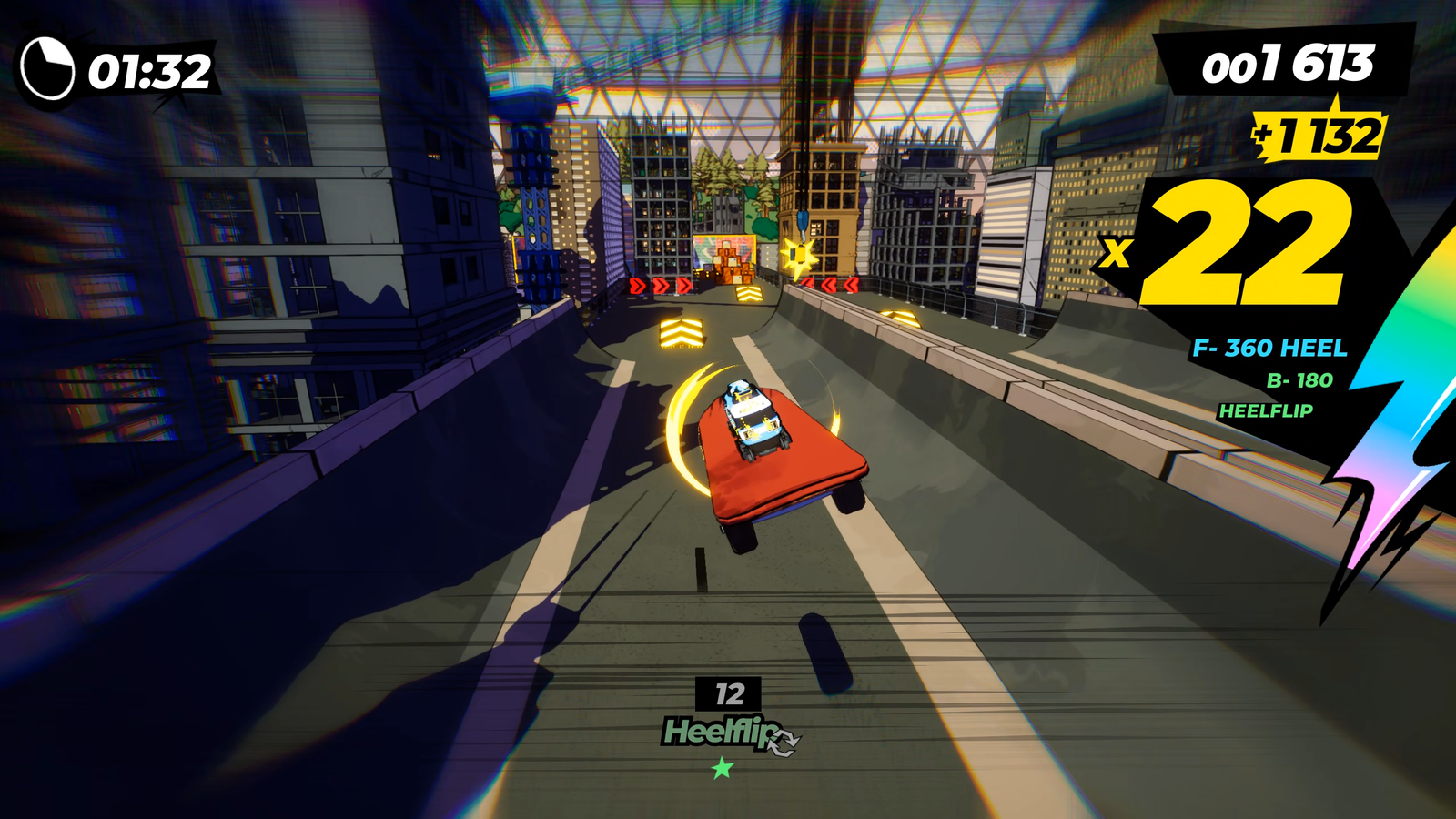
The task structure generally directly refers to Tony Hawk's Pro Skater. Each race has tasks for completion time, points scored, and additional challenges — to drive without accidents, break wooden bridges, scare bats in a cave, or perform a specific trick. Points are awarded for all this, and a final rank is assigned. To get a gold medal, the level will have to be studied and replayed many times, but this is where the main excitement lies.
At the same time, the developers did not stifle the poor gamer here either: all additional conditions do not necessarily have to be completed in one race. You can safely get a gold medal by first focusing on speed, another time on collecting items and completing achievements, and a third time on scoring the maximum number of points.
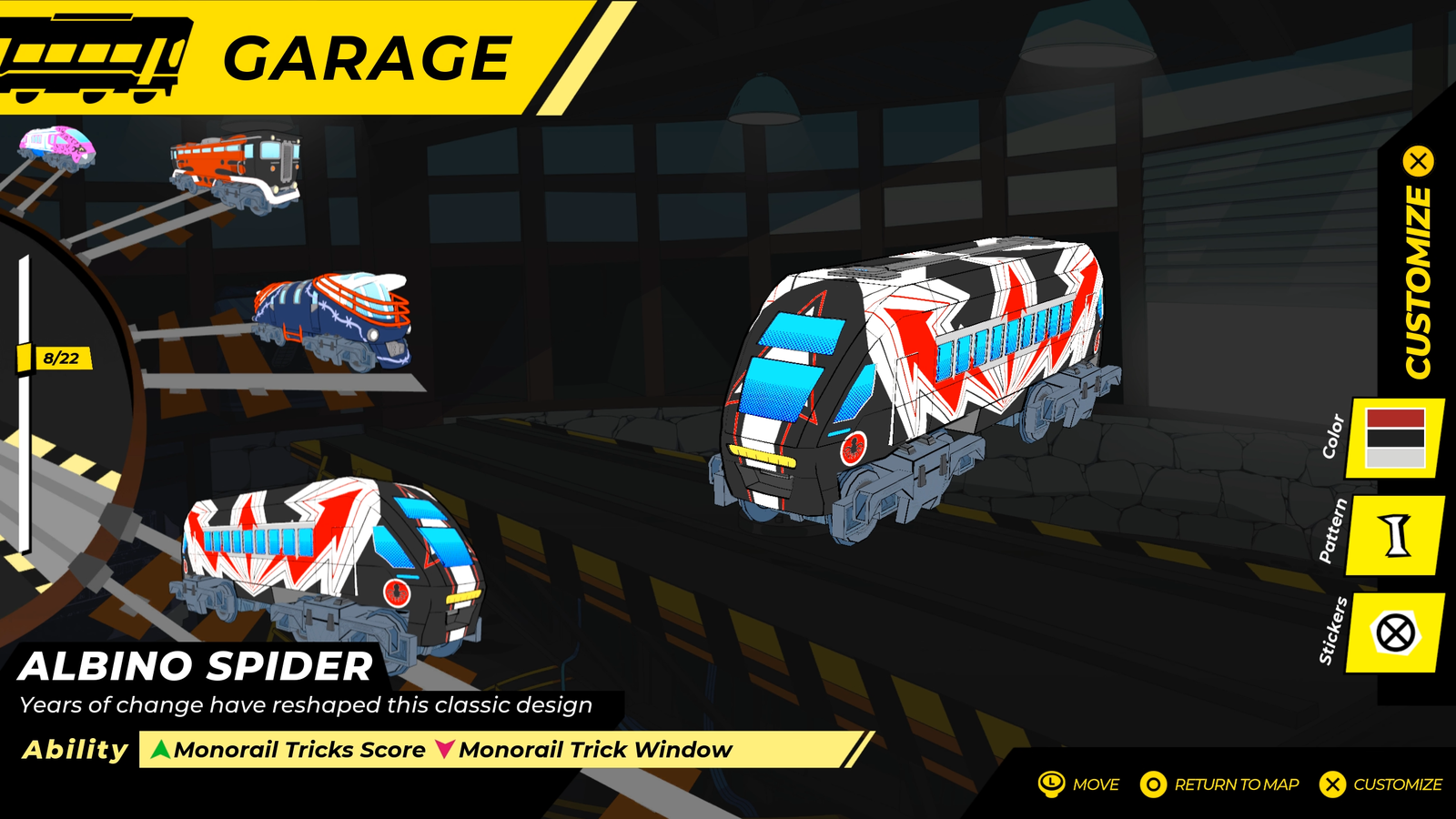
New trains, available for purchase from the third chapter, help greatly in this. Each train has a unique balance of one positive and one negative passive skill, allowing for flexible adaptation to a specific goal. For example, one train simplifies grinding or highlights the ideal window for drifting, but in return, it cuts the points received for these tricks or narrows the timing itself. Another helps maintain long combo series more easily, and a third can dampen inertia when passing through tunnels, although it pays for this with a reduction in the final score.
The mission format itself changes regularly. The game features short sprints of 2-3 minutes, two-minute arenas where you need to score maximum points, large-scale locations with several routes where you need to complete the set goals as quickly as possible, and races with other trains. This is where the first serious difficulties can arise, because you must finish in the top three. However, personally, I only failed to do this on the first attempt in one of the final races, when the game picked up truly insane speeds.
No Brakes and No Common Sense
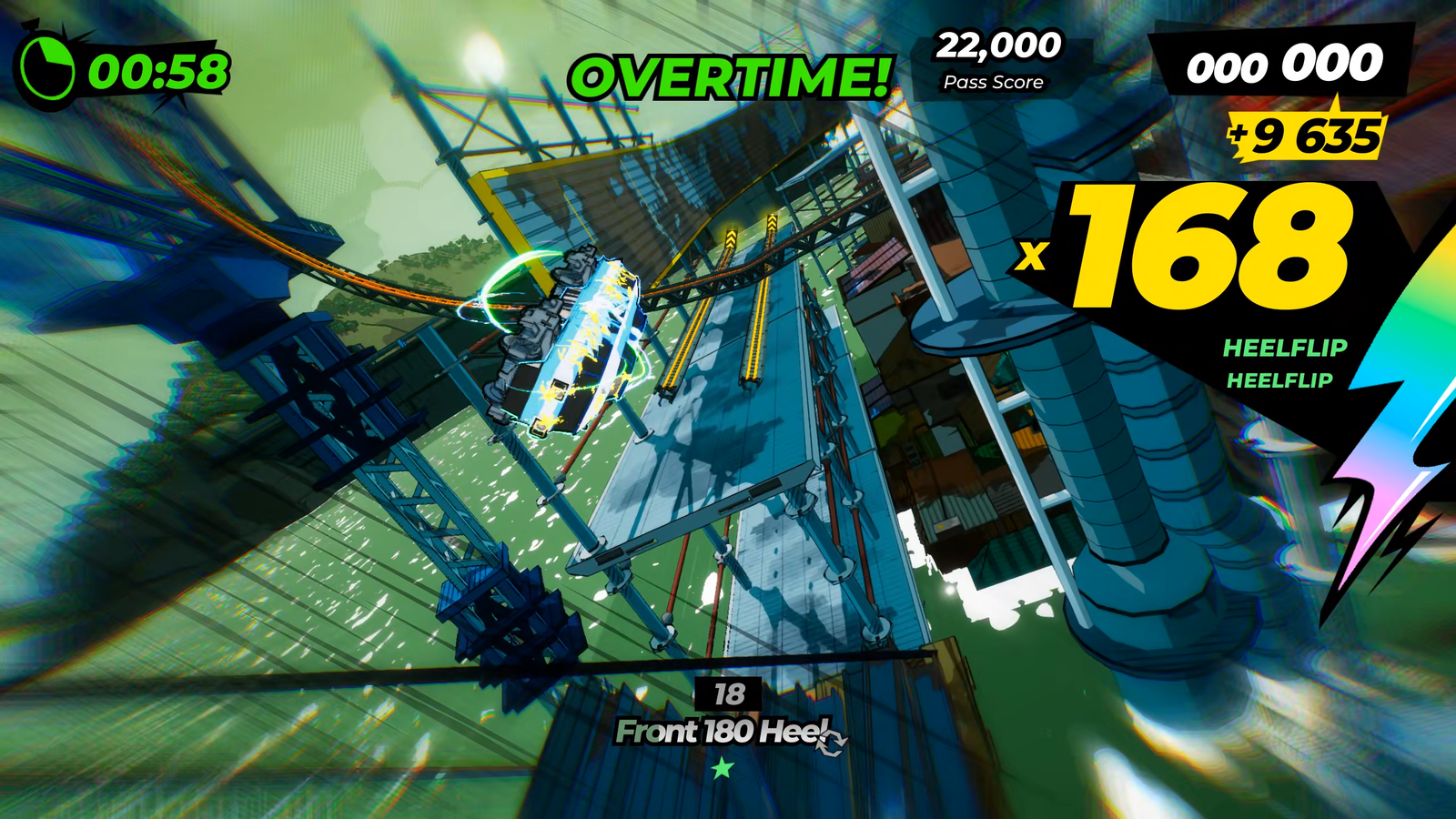
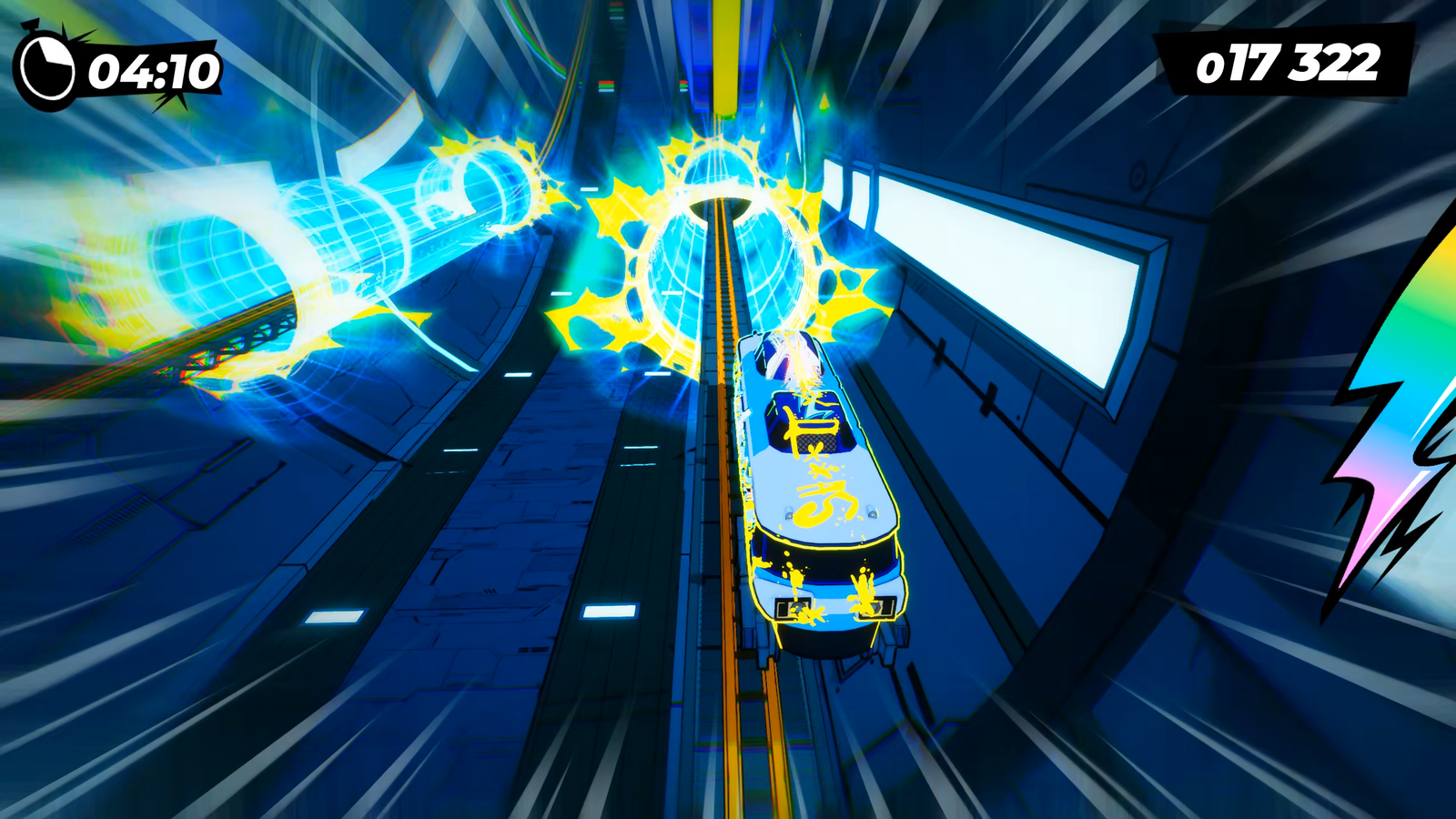
In the first chapters, the game teaches the basics, but then it generously acquires new features. Filling the energy bar with trick series opens up rainbow (in a good way) tracks — alternative routes that can offer both a difficult challenge with a lot of points and a safe shortcut as a well-deserved reward. Each chapter introduces a fresh mechanic into the arsenal: from wall riding and activating switches with tricks to flying on air currents, riding cable cars, double drifting on two rails at once, and magnetic tracks that allow you to rush upside down.
At the same time, the level design becomes more complex — the developers weave each new ability into the geometry of subsequent tracks, repeatedly testing the player's endurance and finding new ways to amaze them with the unfolding spectacle.
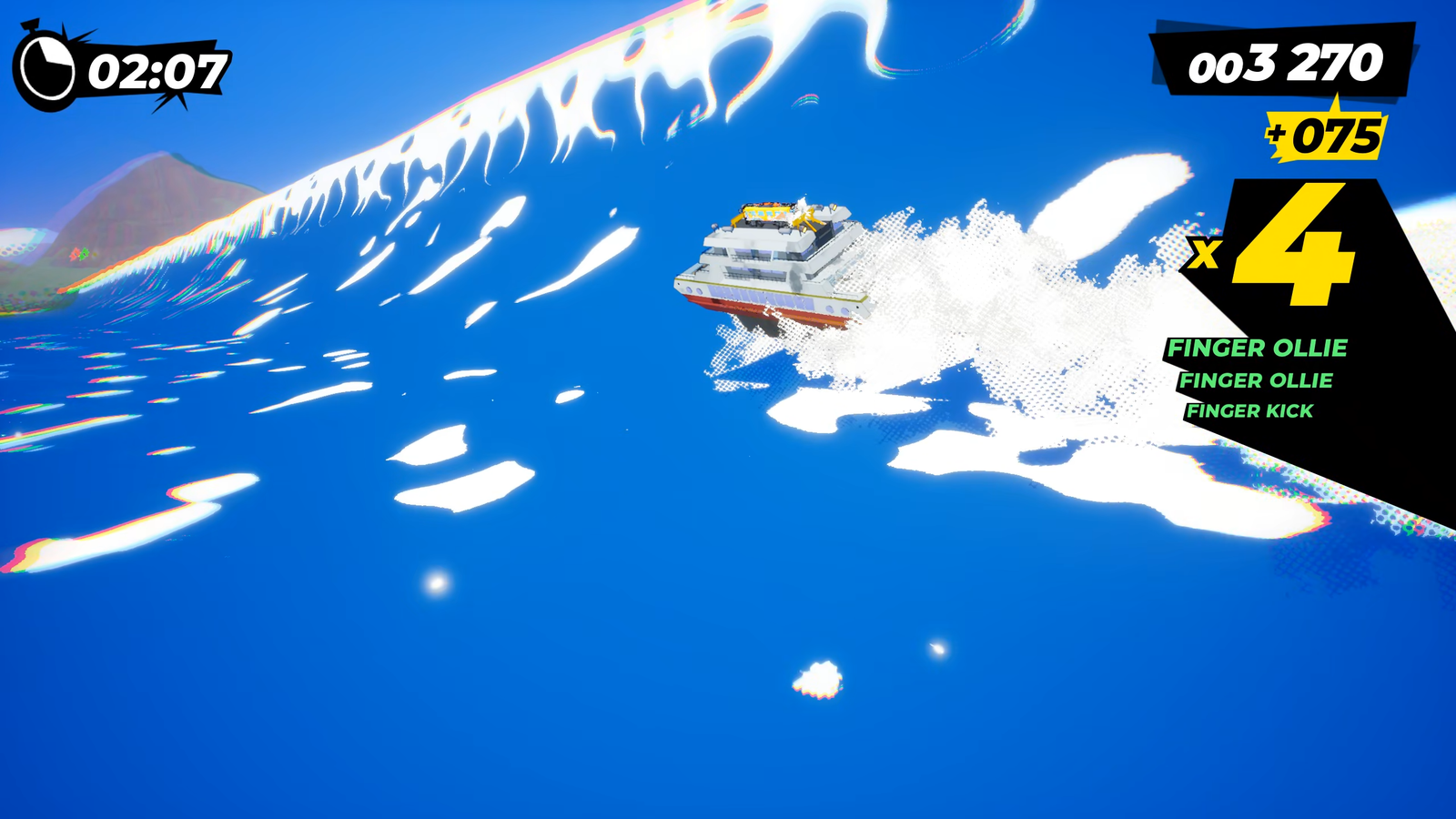
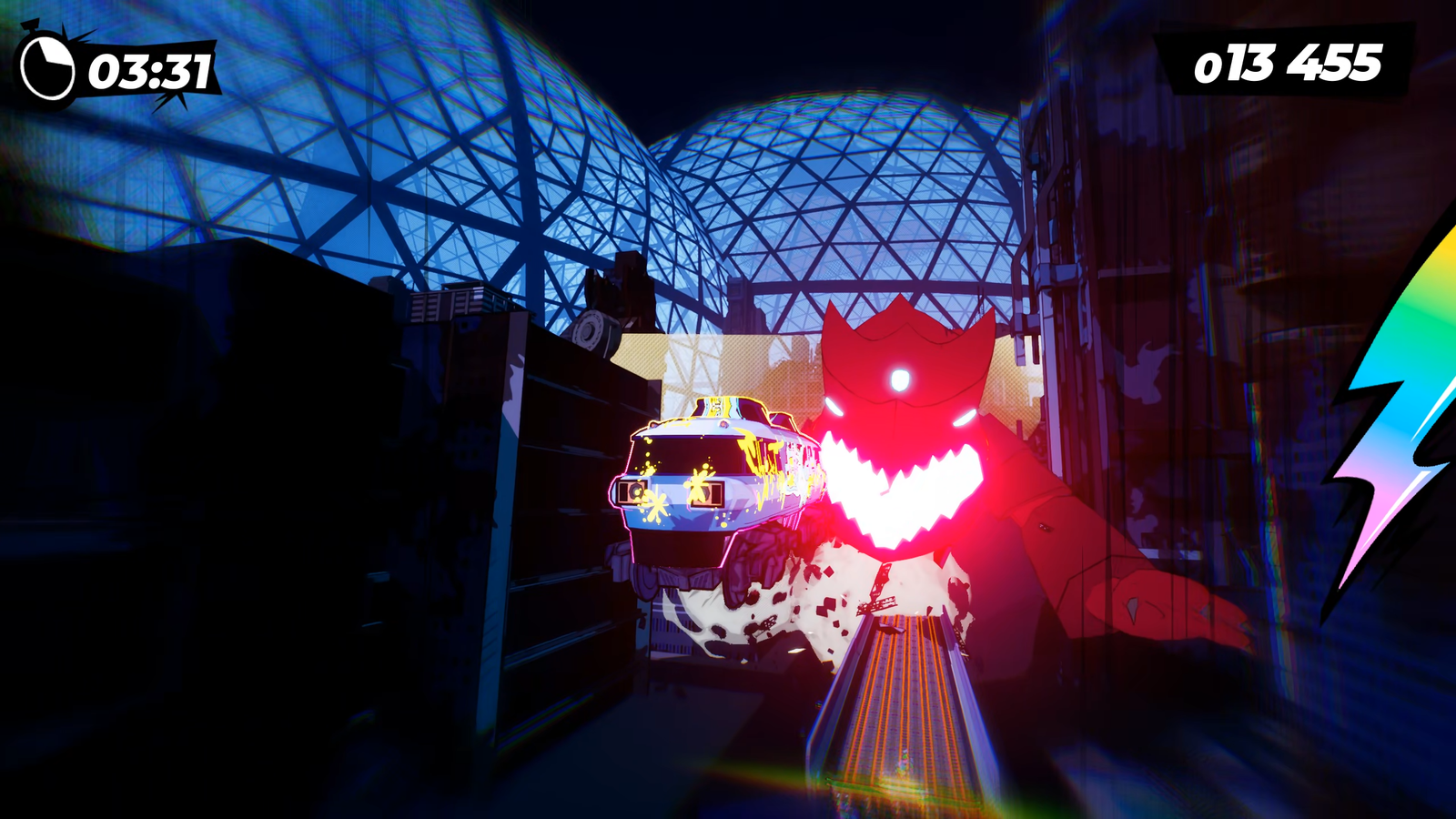
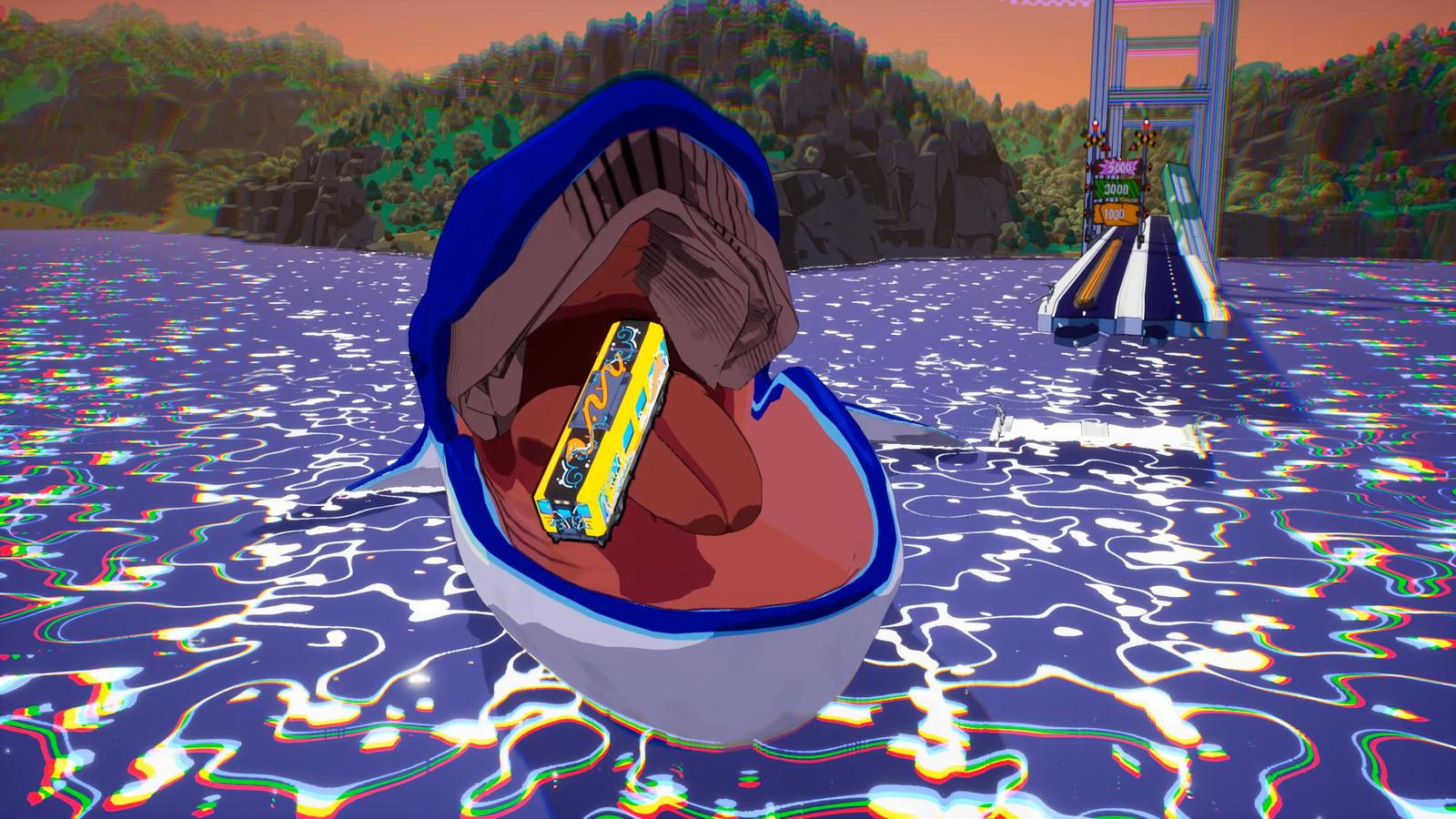
Imagine: just now you were rushing inside an erupting volcano, and a few minutes later you're already smashing a construction site, flying onto a Ferris wheel, and spinning it with a fifty-ton train. Then you jump onto a boat and glide over the waves like a surfer, deflect baseballs with tricks, push off mushrooms with a slam in an underwater location with lunar gravity, and then fly onto the ice, knock down giant snowmen, or try to dodge a kaiju destroying a metropolis! Sounds crazy? There's more to come. Of course, all of the above doesn't literally happen in one mission, but it's not even a tenth of what Denshattack! does, because each of the 65 full-fledged levels is a new fit of game design fantasy.
The dynamic camera also has no intention of calmly hanging behind the train. It dives under the rails, soars into the sky, turns in profile, and picks spectacular angles for jumps, chases, demonstrating grandiose panoramas and destruction. In one second you are watching obstacles ahead, in the next you are already fighting off a pursuer while half the city collapses behind you. Vin Diesel with his "Fast and Furious" couldn't even dream of such a thing. Do you think the authors didn't reach the Moon? Oh-oh-oh, you have no idea what they did on the Moon!
Pass to the Major League of Denshawains
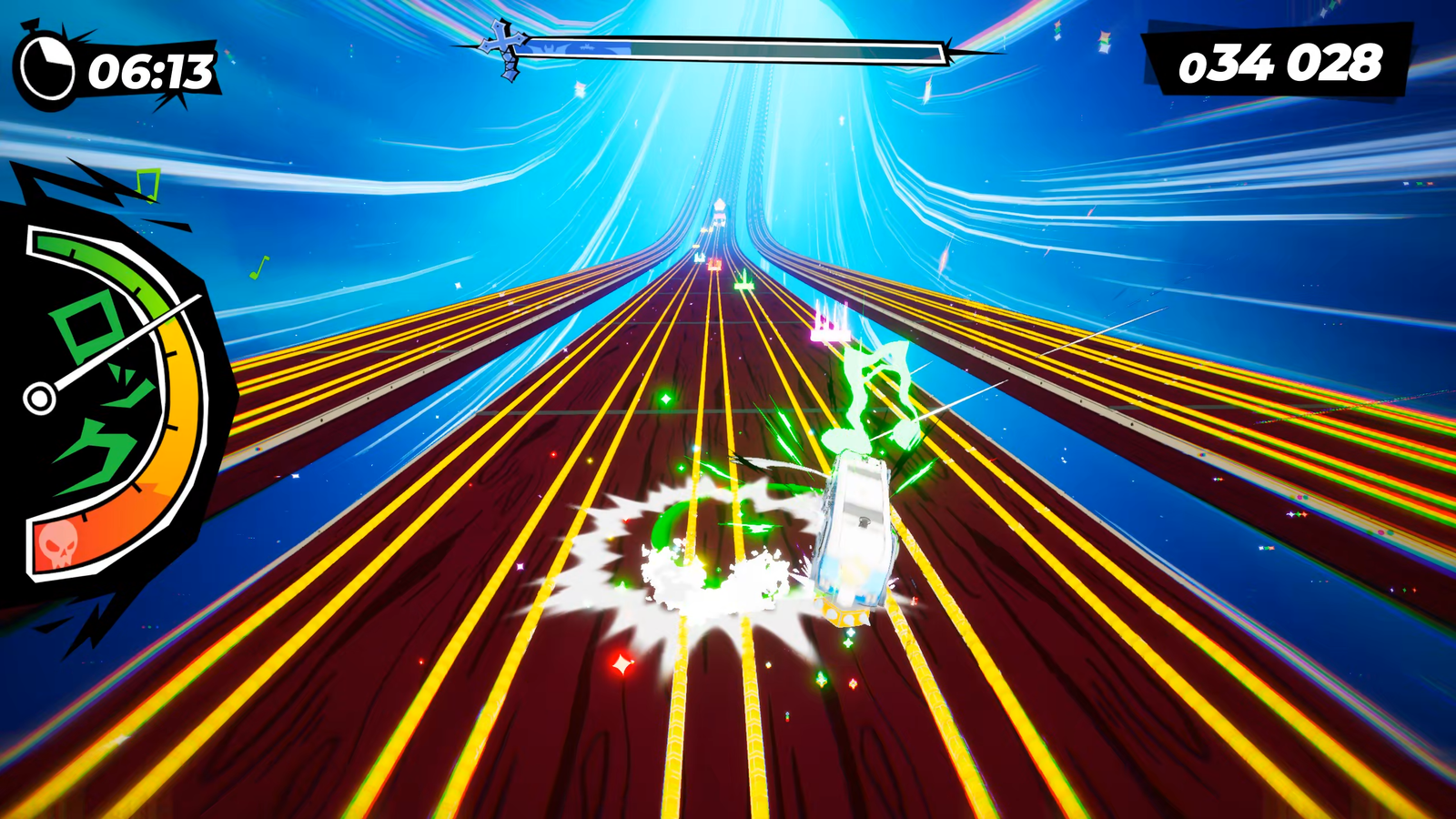
The culmination of this insane action carousel are the boss battles that crown each chapter. In essence, the developers use familiar tools: jumps, drifts, grinds, slams to the ground, magnetic rails, and air currents. But thanks to how skillfully the game combines previously introduced mechanics with cool staging and excellent music, the result is bright and memorable battles that always stand out with something unique — be it a musical duel from the seventh chapter in the style of Guitar Hero or a battle in the clouds against two bosses, where you constantly have to change the train's polarity to reflect incoming projectiles back at opponents.
Although the game is often demanding in boss battles, the same principle applies here as in regular races: checkpoints are placed right within the boss battle, so you don't have to start from scratch if you die. And only if you need a gold medal, then you'll have to learn the boss to perfection, meticulously working through each phase.
Pit Stop
From a technical standpoint, there are absolutely no issues with the game. Despite Unreal Engine 5, on a build with Ryzen 7 7500F, 32 GB DDR5-6000, and GeForce RTX 4070 Super at 1440p resolution with maximum settings, Denshattack! delivers a stable 144 frames per second, barely utilizing the graphics card at 40%.
Unfortunately, this celebration of life has not been translated into Russian — there is no localization even at the subtitle level. However, this does not become a critical problem: the dialogues here are quite simple, the plot is easily understood from what is happening on the screen, and there is no need to delve into multi-level characteristics and item descriptions.
At the Sound Barrier Limit
It's impossible not to praise the soundtrack, which involved more people than the rest of the game combined. And what people! More than twenty musicians and performers from all over the world participated in creating the impressive tracklist of 80 compositions.
Among them are industry legends like Tee Lopes (Sonic Mania), Shoji Meguro (Persona), SEGA veteran Takenobu Mitsuyoshi, who worked on the Yakuza series, Virtua Fighter, and dozens of other projects, Harumi Fujita from Capcom, and Richard Jacques, who contributed to Jet Set Radio, the Sonic the Hedgehog series, and even Mass Effect. In short, just listing the names and accolades of the composers featured on the album could take more than a thousand characters.
As a result of such a stellar and diverse lineup, the musical accompaniment has turned into an incredible vinaigrette of genres: Japanese rock and pop here are replaced by hip-hop, breakbeat, electronic music, drum and bass, and God knows what else — all these enumerations only outline the general picture with superficial strokes.
The main thing to understand is that the music perfectly stimulates what is happening, adding another couple of hundred kilometers per hour to the train's speed and another dozen beats to the player's pulse. However, after completing the game, I could hardly recognize even a fifth of the album right away. During the ride, the brain is occupied with more pressing issues: which rail to jump on, when to start drifting, and how not to crash a fifty-ton train into a wall. And even if the brightest compositions involuntarily dissolve in the general adrenaline rush, without this textured soundtrack, the game would surely lose a good half of its arcade-nostalgic charm and bright Japanese flavor.
Verdict
Denshattack! is a pure "inhale-exhale" style game, operating on the principle of a roller coaster. You press "Start," the train instantly takes off, and from that moment on, you can't — and don't want to — stop.
I'll be frank: I have absolutely no complaints about Denshattack!. In my understanding, it is flawless, and inventing flaws for the sake of imaginary "objectivity" would be mere cunning. When every mechanic works like clockwork, every mistake is only your mistake, and the developers don't run out of ideas until the very credits, all that remains is to tip your hat to their skill.
Over 12 hours, Denshattack! did not cause me a single negative emotion and did not bore me for a minute. It constantly pumped adrenaline through my veins, mixing it with pure audiovisual and gameplay pleasure. This game is pointless to watch — you have to play it. If you even missed the times when games were created for unbridled fun and adrenaline-fueled drive, passing by Denshattack! is a real crime. Buy it, jump on the rails, and get ready for the best ride of your life.
Never miss our newsAdd this site to your preferred sources to see us more oftenAdd on Google

![[Video] RIP RTX 5090 / GTA 6 Leak / Blizzard Broke WC3 / Cyberpunk 2077 Movie / Phantom Blade Zero Preview](https://media.ixbt.games/fit-in/312x/ixbt-data/1725650/17ffaa31-1709-4a05-91a5-0ee4b75897d7.jpg)