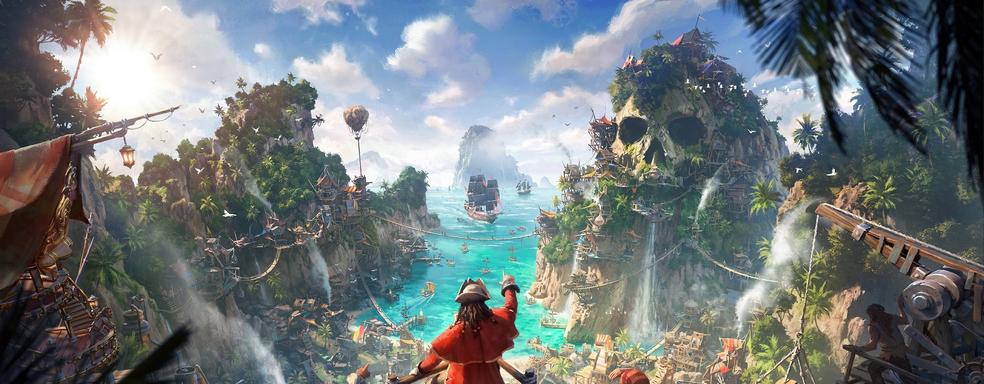
How to Build a Pirate Paradise and Lose it to Soup: Corsair Cove Review
Pirate-themed games are plentiful, but what about pirate strategy games? You might have to go back 40 years to Sid Meier's Pirates! to find the last decent game in this genre. Although even that was more of an RPG than a strategy game. And Corsair Cove fills this long-forgotten niche.
When you hear the phrase "pirate game," images from the recent Assassin's Creed Black Flag Resynced usually come to mind: Caribbean voyages, naval battles, and real political intrigue. For people less familiar with games, the image of Pirates of the Caribbean is strongly associated with the eponymous film series starring Johnny Depp. Sea monsters, the undead, and the search for ancient treasures have become part of the image of sea robbers.
Corsair Cove looks at pirate romance from a completely different angle. Instead of open-sea wanderings and role-playing a specific character, you will be setting up a haven for sea robbers, establishing production, and building logistical chains to turn a transit camp into a thriving settlement. However, on the way to creating a city, you will face many difficulties. You will have to learn the local mechanics of settlement development and the principles of seafaring, as well as understand how important logistics are here.
Pirate Romance with a City-Building Twist
Corsair Cove is a city-building simulator from Limbic Entertainment, previously known for Tropico 6. In the main campaign, a group of pirates escapes from a prison ship to an uninhabited island and must now set it up to protect themselves. As we progress, we complete a chain of story quests, gradually unlocking new production buildings, technologies, resource types, and mechanics, as well as sending ships on expeditions to explore the archipelago.
In addition to the campaign, the game offers an "Exploration" mode. It provides two more locations for base construction with their own storylines, as well as additional difficulty settings: the radius of pirate camps, the amount of resources, and consumption volumes.
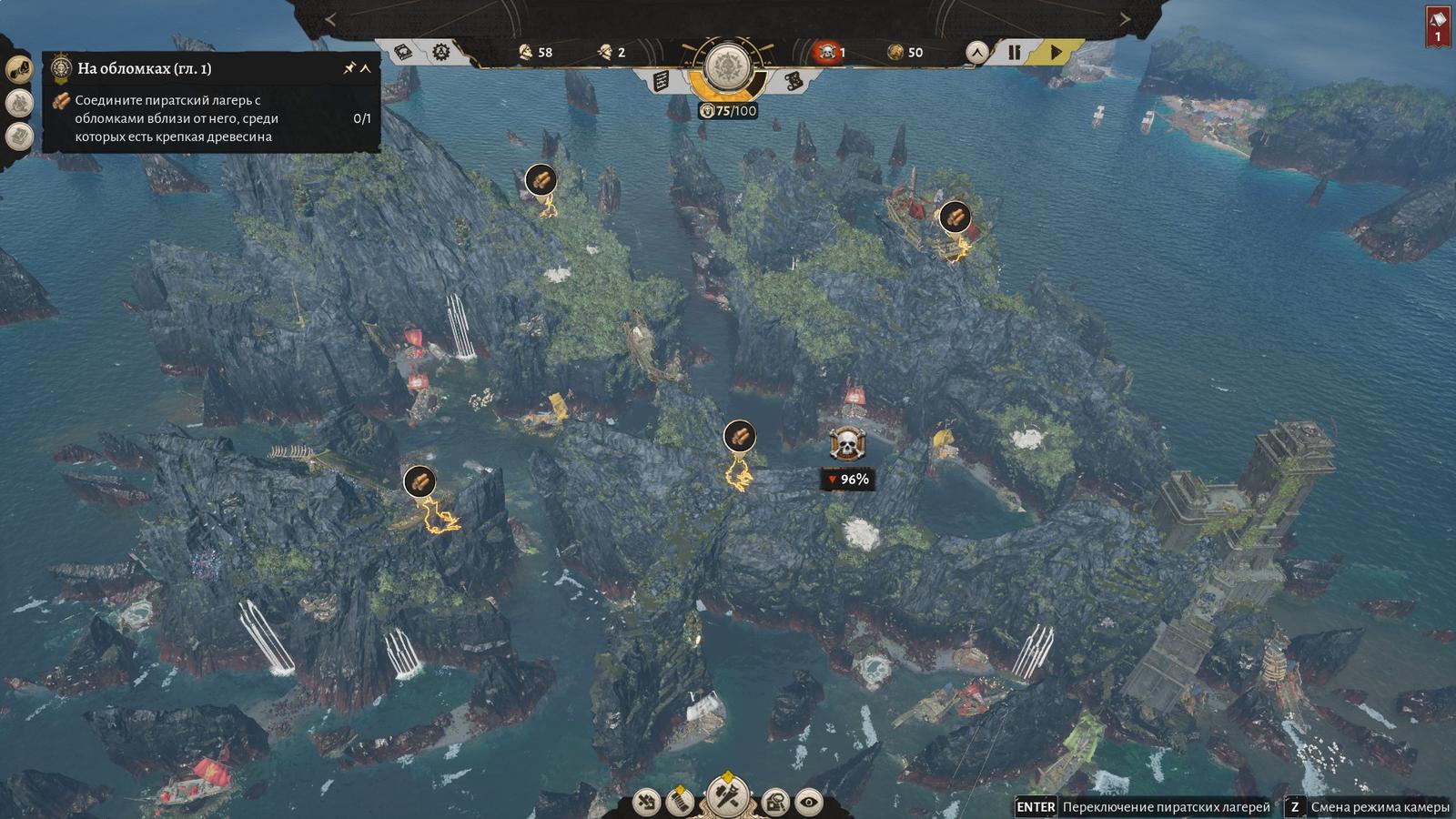
The uniqueness of this project is given not only by the pirate aesthetic but also by the setting. You set up your base on a rocky island with very few flat areas. In a typical city-builder, this would be comparable to the maximum difficulty level. However, here the city-building gameplay involves placing buildings on vertical surfaces. And the entire city will be dotted with stairs, ziplines, and bridges.
The choice of a mystical and adventurous setting for the Golden Age of Piracy works perfectly not only for the gameplay but also for the content itself. The second foundation of the game lies in direct sea raids. For this, you build ships, assemble a crew, and send them on various adventures. The plot offers you to achieve one of the key goals: build a pirate state, uncover the mysteries of the seven seas, gain fame, or amass untold riches.
Each adventure has its own characters and development branches. Ships are also assigned specializations for certain crafts. Therefore, for the comprehensive development of the base and fleet, it is very important to have all types of ships. Nothing prevents you from completing all storylines up to the key moment where you have to choose one of four final directions for events to unfold.
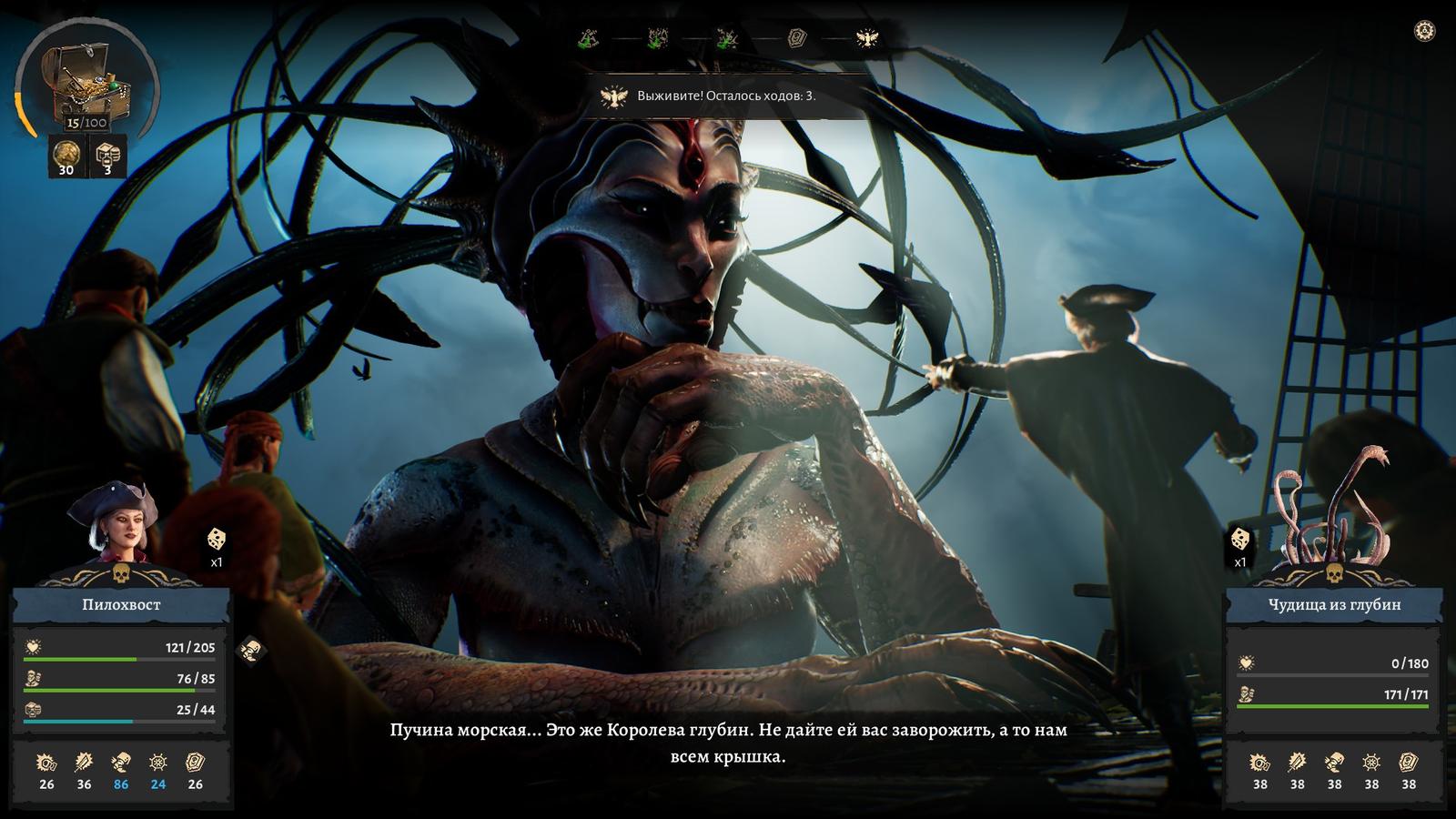
The third important part of the game is the card-RPG mechanic. All the action is a slideshow with monotonous tasks, against which you must score a certain number of points using cards and dice. The deck represents a set of various actions: attacks, defensive maneuvers, crew enhancements, and special abilities. Each turn, you have to choose the most advantageous combination, taking into account available energy, the current state of your ship, crew size, and enemy actions. And if at first this could cause some irritation, by the middle and end of the story, this mechanic turns into a mundane clicking of the same cards.
Urban Planners Wouldn't Dream of It
We have already mentioned that the main feature of city-building here is an unusual approach to placing buildings. While most games offer the player to gradually occupy new land plots and expand the city horizontally, here you have to develop islands with limited space, where every meter of surface matters. The developers have focused on vertical construction: pirate settlements gradually turn into multi-level complexes.
However, the basic principles of city-building remain unchanged for the genre. Settlement development is built around four main elements: residential buildings, production buildings, and special resource extraction points, rigidly tied to deposits on the map. As the settlement grows, free space becomes scarcer, and new buildings require more thoughtful placement. Therefore, it is necessary to use the features of the terrain. For example, farms and plantations can only be placed on fertile plains, while mines and other wild resource collection facilities can only be placed on rock deposits and other sources.
It is also important to note the logistics. Roads are a key element in settlement building games. They connect residential buildings, work areas, and other buildings into a single network. And if you don't bother with its development, the player risks creating a traffic collapse from congestion. This, in turn, paralyzes services and makes the city unfavorable for living. In Corsair Cove, there are no traffic jams, but logistics remain a very important element. Especially when your settlement grows in height, not width.
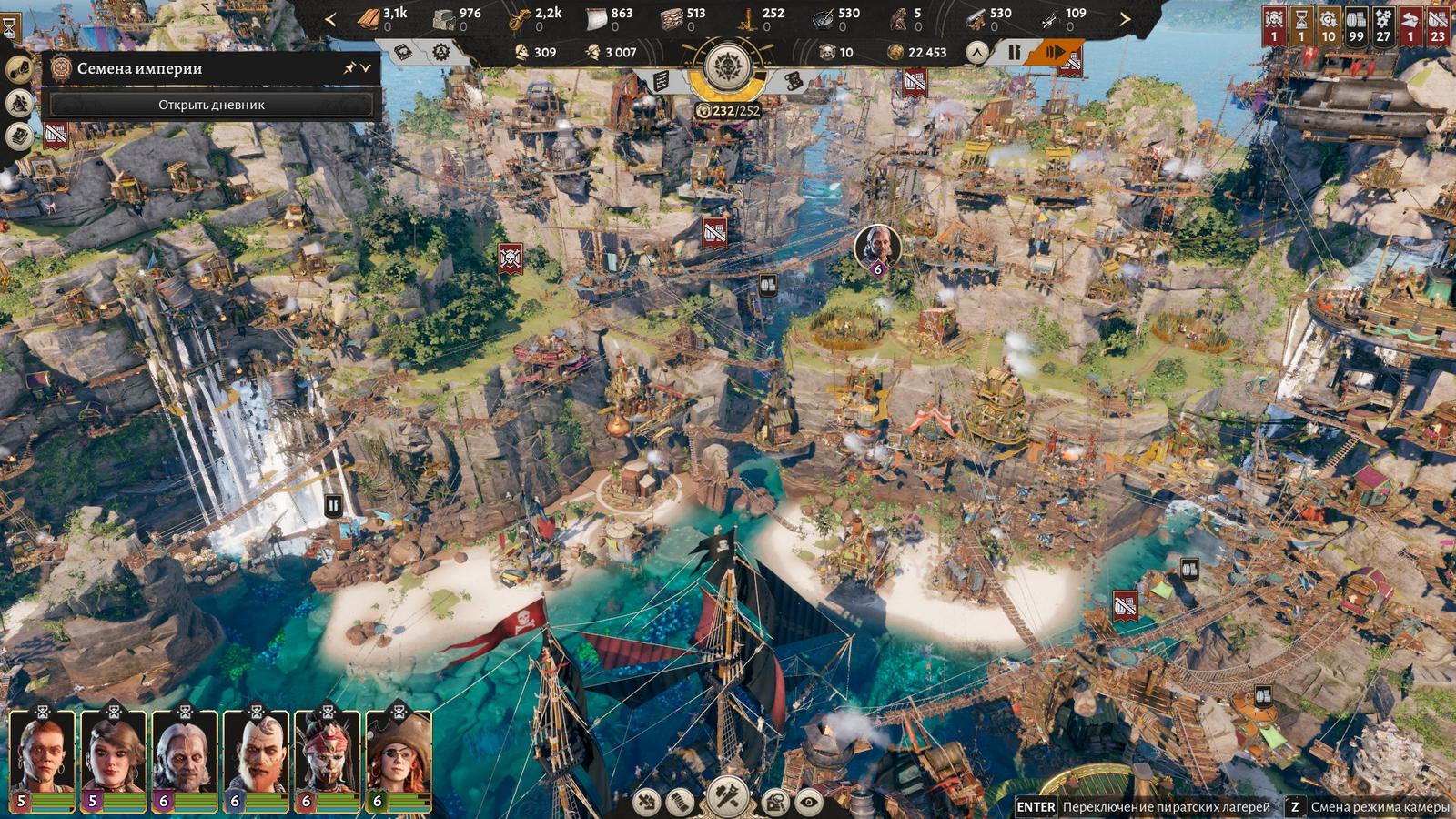
The game offers a special set of means of transportation in three-dimensional space. At the start, you will have access to suspension bridges and roads along cliffs. Later, elevators, ziplines, and cable cars will be added to this set. With their help, workers move much faster around the island. And their main distinguishing feature is that you can place them absolutely anywhere. Buildings do not interfere with the construction of additional communication routes. Therefore, you can regularly modernize logistical chains, which will speed up deliveries to production.
It is worth explaining the features of the entire settlement's development separately. Its entire structure is divided into camps, each of which is an independent economic unit with its own buildings, residents, and production capabilities. Each camp has its own needs, available resources, and development directions, so simply building a few key objects in one place and forgetting about them will not work. Each new area requires separate attention: it is necessary to provide residents with necessary goods, assign workers, and create production chains capable of supporting its autonomous operation.
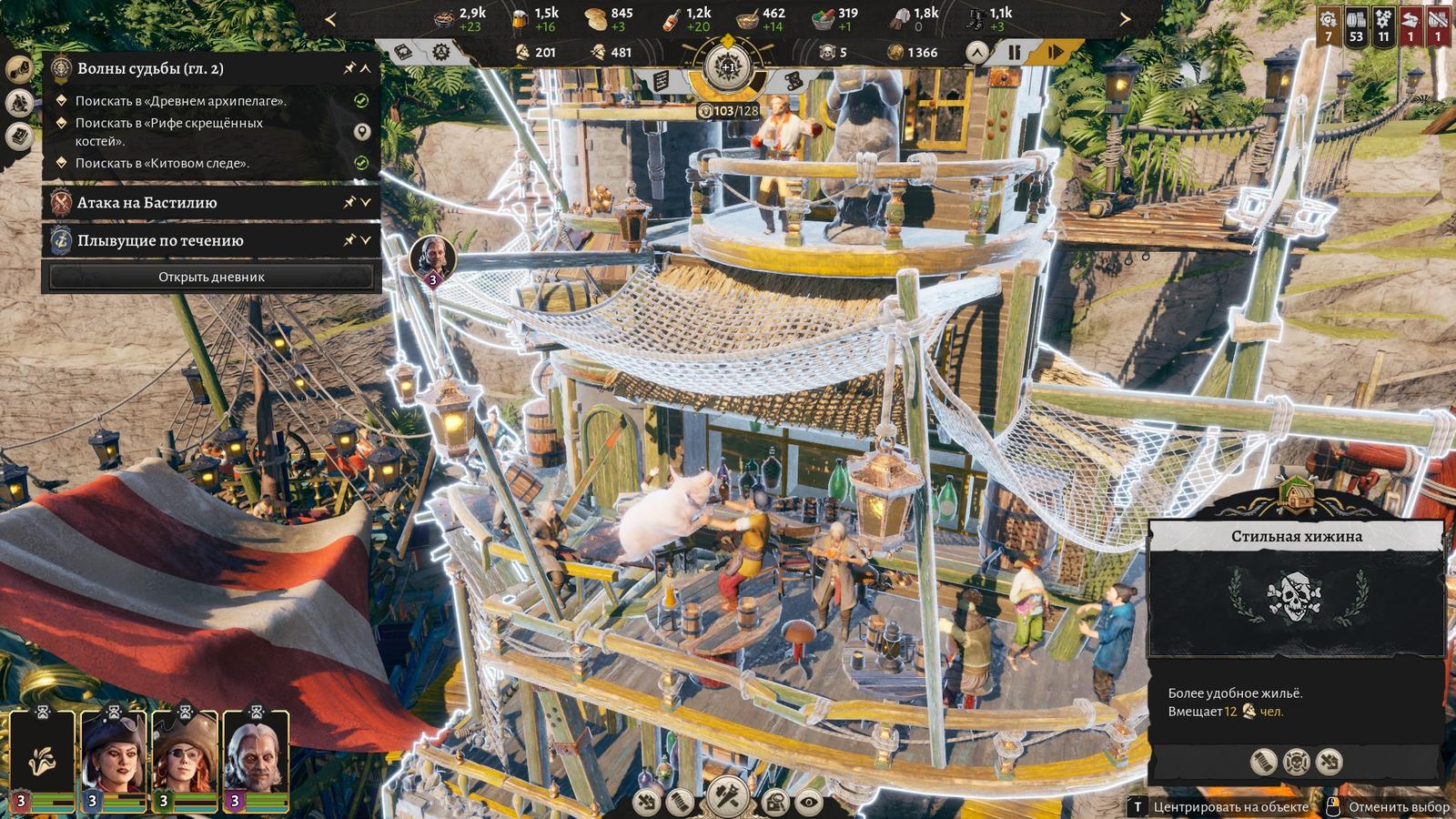
The game allows you to connect different camps, creating a supply network between remote areas of the island. However, in practice, such a system often turns out to be too expensive and difficult to maintain. Therefore, it is easier to allocate space for new factories and farms within each camp. This choice between centralization and autonomy becomes one of the main dilemmas in the development of the island.
Another characteristic feature of the genre is the settlement development mechanic. Here, the tree of principles – a local analogue of the technology tree, where new buildings, production chains, and improvements gradually become available – is responsible for unlocking new opportunities. However, it develops in a not entirely conventional way. While in most city-building strategies the player independently chooses the direction of research, in Corsair Cove a significant part of the progress is tied to fleet development. As higher-class ships are built, new branches of principles open up, and with them, new production buildings and ways to develop the colony.
Due to this vector, a controversial point arises. The crew's needs change with the level of ships, which means production chains constantly have to be rebuilt. If in the early stages experienced sailors require rum and potatoes, meaning space has to be allocated for gardens and distilleries, later these goods completely lose their relevance. They are replaced by weapons, luxurious clothing, and other items necessary for elite crews. Because of this, your island has to be regularly rebuilt, replacing some productions with others.
The leveling itself is a constant completion of specific tasks. Each development branch has its own set of small challenges. Completing them earns research points, but they can only be used in the branch to which the quest belonged.
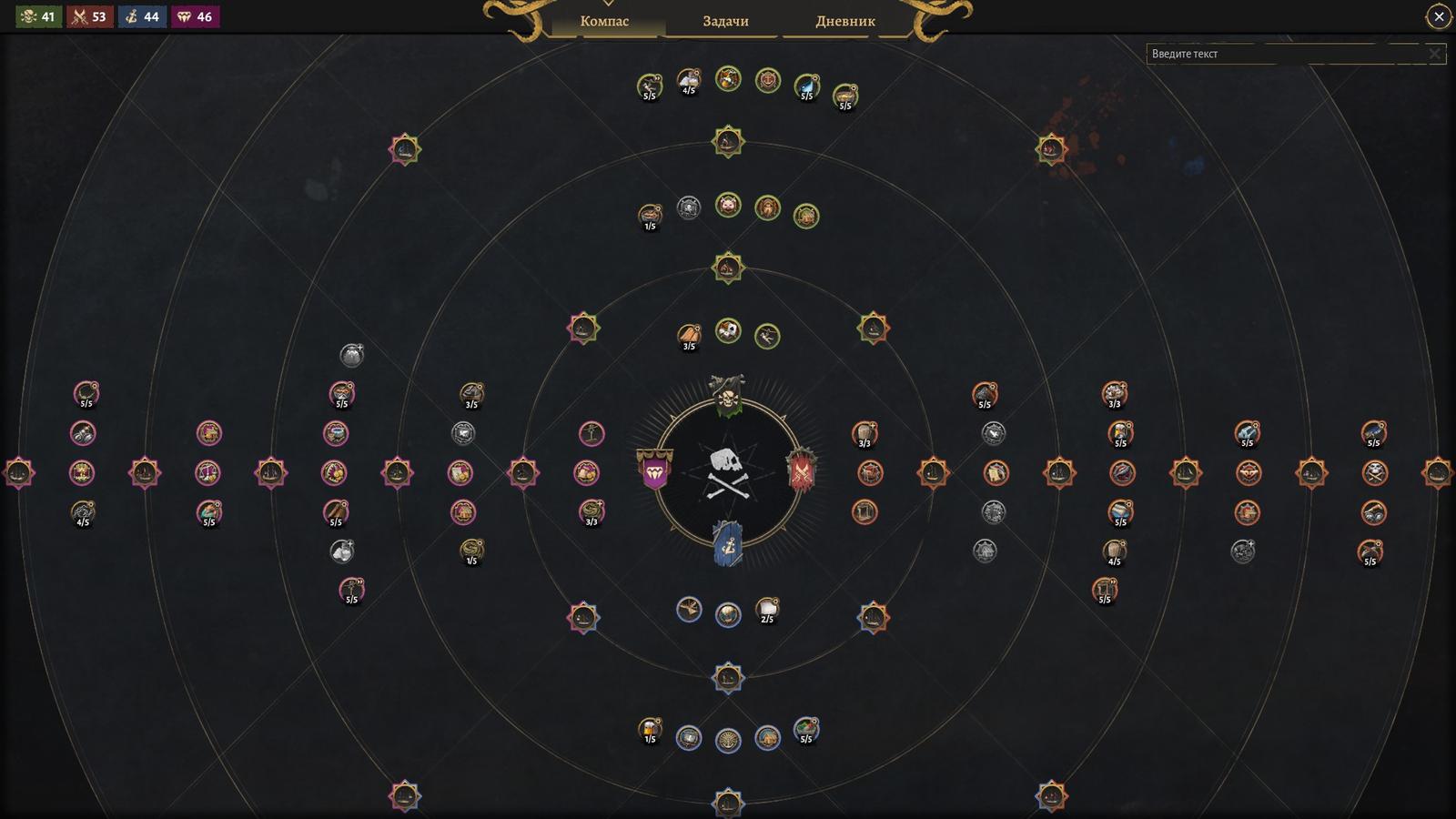
Sea expeditions become an additional source of points. In the open sea, the game offers various side quests: helping strangers, dealing with pirate conflicts, delivering cargo, or completing another small story. Successful completion of such missions also awards principle points. They are also tied to a specific development branch. But some tasks directly offer to choose the desired reward before starting.
Happiness is Not in Money
Corsair Cove's economic model is built on two parallel resources – goods and money, with their purpose fundamentally different. Most raw materials and products can be produced independently. But it is impossible to completely close the economy on your own production. Some valuable goods cannot be manufactured on your own, so the only way to get them is to raid merchant ships and attack ports. It is these trophies that often turn out to be the most in-demand, because experienced crews demand them as payment for service, and without such supplies, it will simply be impossible to maintain a powerful fleet.
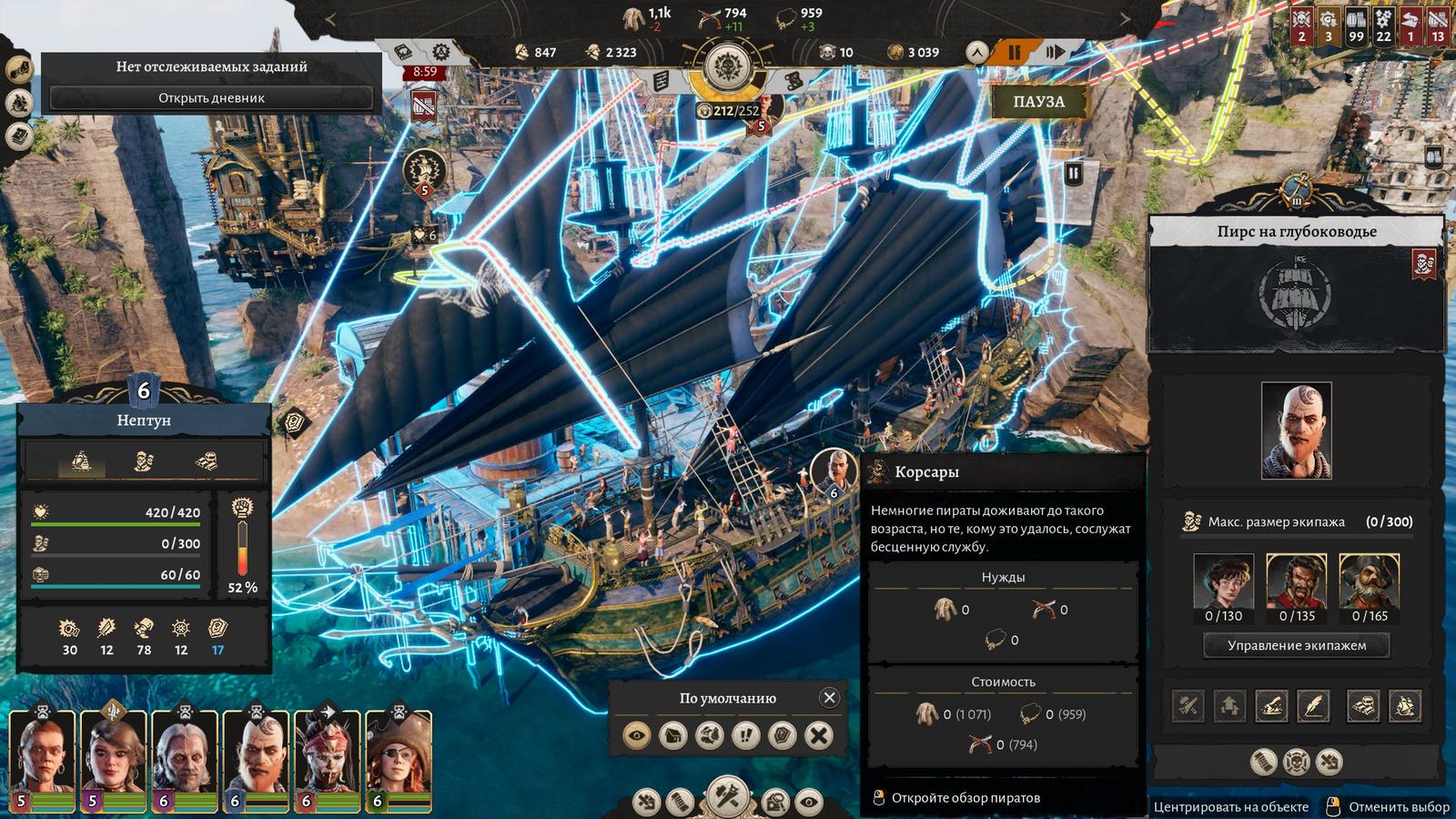
It's curious that money plays far from the main role for the pirates themselves. Hiring new sailors and further maintaining crews are paid for exclusively with goods. The main use of currency is the development of the settlement itself. It is used to build roads, residential buildings, and enterprises, and in later stages, special structures become available that can significantly change the rules of the game. The arena literally allows you to exchange part of the population for money, the palace makes natural deposits inexhaustible, and the sea coliseum literally resurrects fallen crew members after each successful mission at sea. Such buildings are expensive, but their effects significantly facilitate the development of the colony.
Periodically, the measured economy is disrupted by random events that require difficult decisions. Residents may ask for help, conflicts may erupt between individual groups, and unexpected incidents will force a choice between profit and the well-being of the colony. Sometimes you can quickly earn money by sacrificing worker efficiency, in other cases you will have to part with some resources or even part of the population, and the riskiest decisions can damage the ruler's authority.
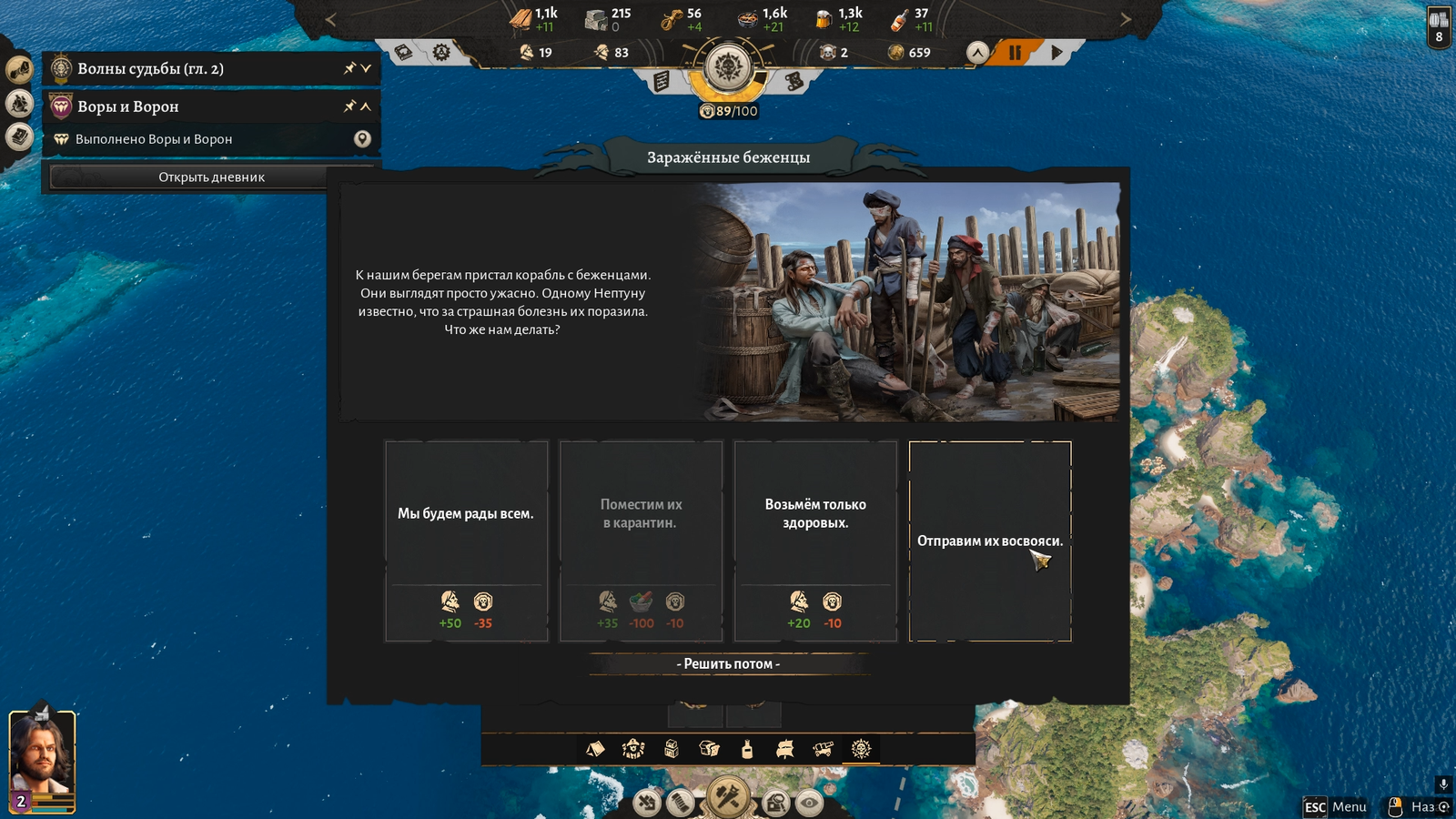
The stability of the entire colony is determined by the "cohesion" indicator, which effectively replaces the genre's usual happiness level of the population. As long as its value remains high, the settlement continues to develop peacefully. However, prolonged rebellions and unsuccessful decisions in random events gradually reduce this indicator. If cohesion completely runs out, the community will collapse, and the game will end in defeat.
The reasons for the rebellions themselves often look both logical and amusing. The islanders are quite content with the harsh pirate life, but if turtle soup or chicken legs run out in the dining halls, or rum or wine in the taverns, the countdown to a full-blown rebellion begins. Usually, 10 to 40 minutes of real time are given to eliminate the deficit. If supplies are not restored within this period, the angry pirates move from threats to action and begin to set fire to residential buildings and production facilities, turning a local supply problem into a full-blown catastrophe for the entire economy.
At the same time, the cohesion system itself works quite categorically. Unlike the usual happiness indicators in other city-building strategies, where the mood of the population gradually deteriorates as problems accumulate, here everything is arranged much more rigidly. As long as the island is provided with the necessary goods, the indicator remains full, and no negative consequences arise. But as soon as supplies run out for a short time, the situation almost instantly enters a crisis stage. Because of this, it is not always even possible to notice the problem. The game gives an audible alarm when the satisfaction level drops to 50%. But, given how quickly this indicator falls, you will have to prevent a rebellion in an emergency mode.
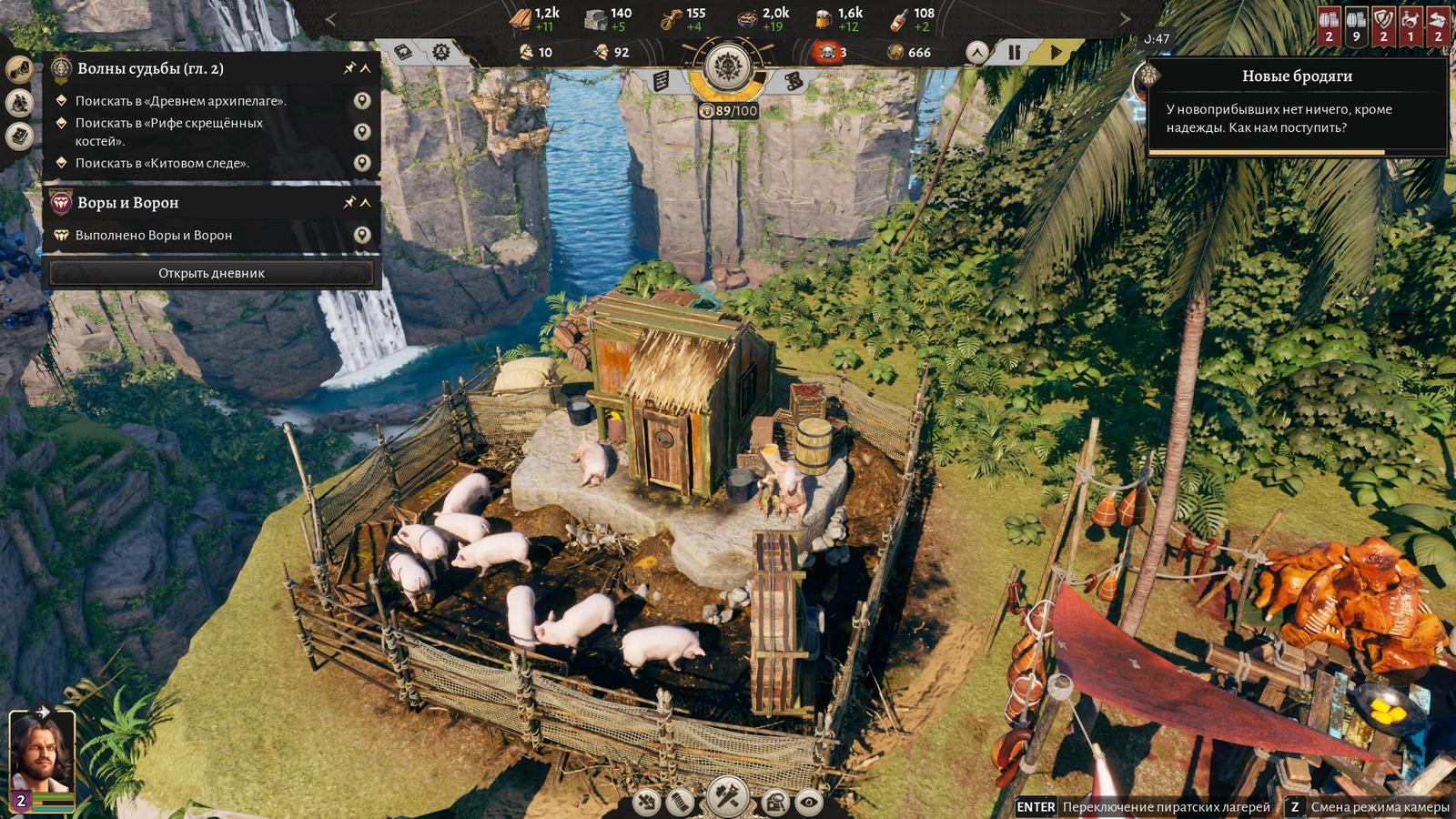
Fortunately, replenishing cohesion is quite simple. The main source is sea missions: island defense, story missions, and recurring raids on merchant ships and ports regularly bring new points. Moreover, the maximum cohesion reserve is not limited to the initial hundred units. As the settlement develops, banners can be installed, each of which increases the capacity of the scale by several more points. As a result, by the middle of the playthrough, an impressive margin of safety is formed, allowing you to react much more calmly to the consequences of controversial decisions and quickly compensate for losses by simply going on another sea voyage. Because of this, closer to the finale, the threat of public discontent gradually loses its sharpness.
Sea Adventures
The second important part of the gameplay is sea expeditions, which gradually become the main gameplay in the middle and end of the playthrough. If island development is a measured construction and economic management, then going to sea is responsible for the very adventurous component that you usually expect from a pirate game. This is where battles, dangerous journeys, and various events appear, forcing you to temporarily switch from managing the settlement to commanding your own fleet.
Various tasks are scattered throughout the archipelago, which can be completed as the fleet develops. At the same time, the missions themselves do not differ in complex structure or unique mechanics – in most cases, their availability is determined by the requirements for the ship's level, crew characteristics, or the presence of certain improvements. More powerful ships allow you to go to dangerous areas where you can get more valuable rewards, but also face more serious threats. Therefore, fleet development becomes not just another direction of progression, but a kind of key to mastering new areas of the map.
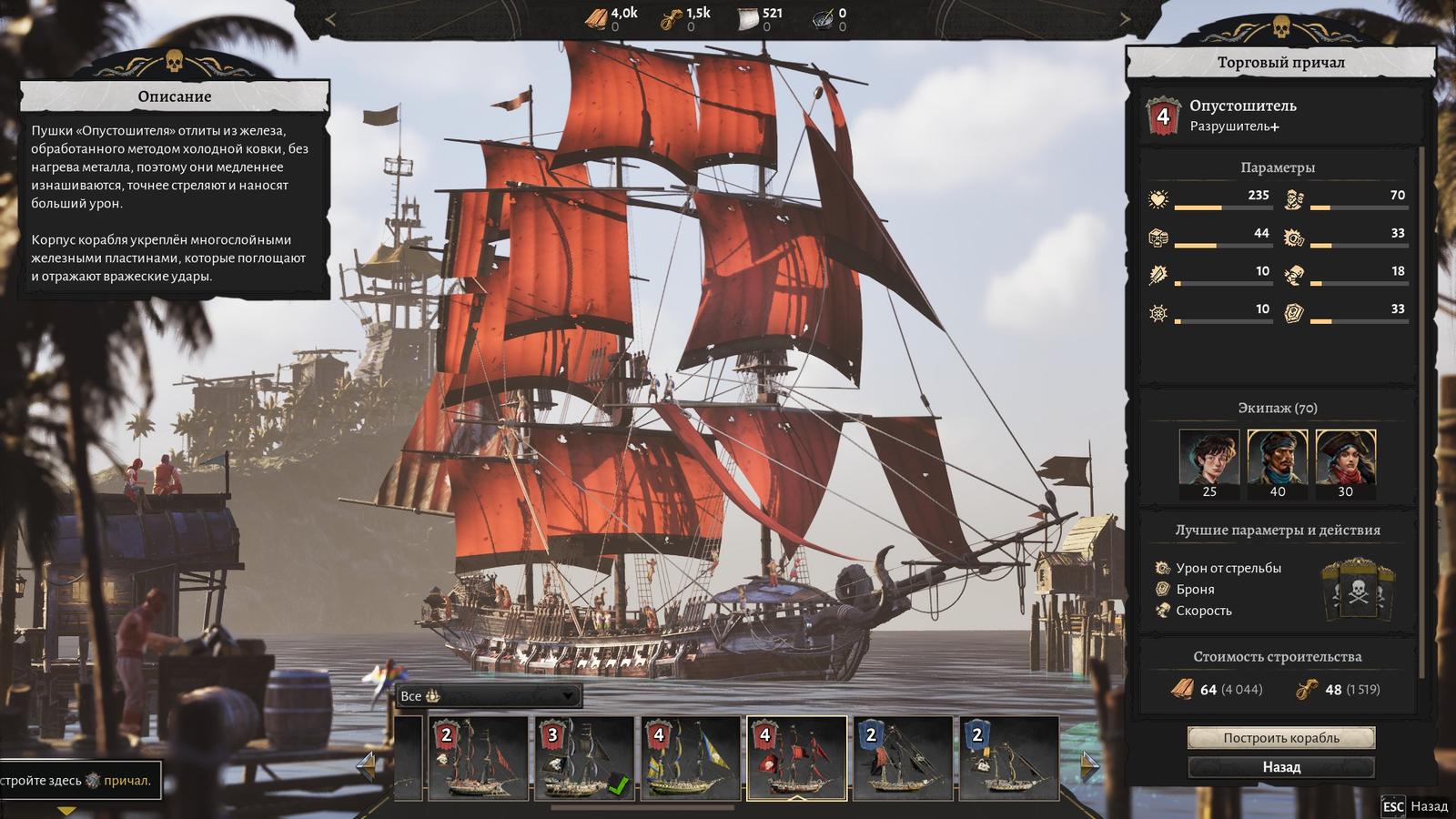
In addition to pre-prepared tasks, sea voyages are regularly accompanied by random encounters. Depending on the region and sailing conditions, the player may encounter completely different dangers. In some places, giant whales will be a threat, in others, you will have to fight off pirate hunters. And sometimes a ghost ship appears on the horizon, turning an ordinary voyage into an unexpected chase from a ship of the dead.
The missions themselves and random encounters are built around a simple card system, which becomes the basis of all interaction with opponents and the surrounding world. Each sortie consists of several rounds, where the player receives a set of action cards. Some of them are general, others are assigned to the ship, reflecting its features, and another unique ability belongs to the captain. Due to this, different ships build their own strategy, although the general principle of completing missions remains almost unchanged.
In each round, the player is faced with one of several typical tasks: sometimes it is necessary to cover a certain distance, collect information during exploration, or simply last a given number of turns. During some events, it is necessary to enter into a full-fledged confrontation, where the main goal is to destroy the enemy's durability and crew. Similar indicators are also present for your own ship: if the enemy completely depletes the ship's health or crew size, the expedition will be considered failed.
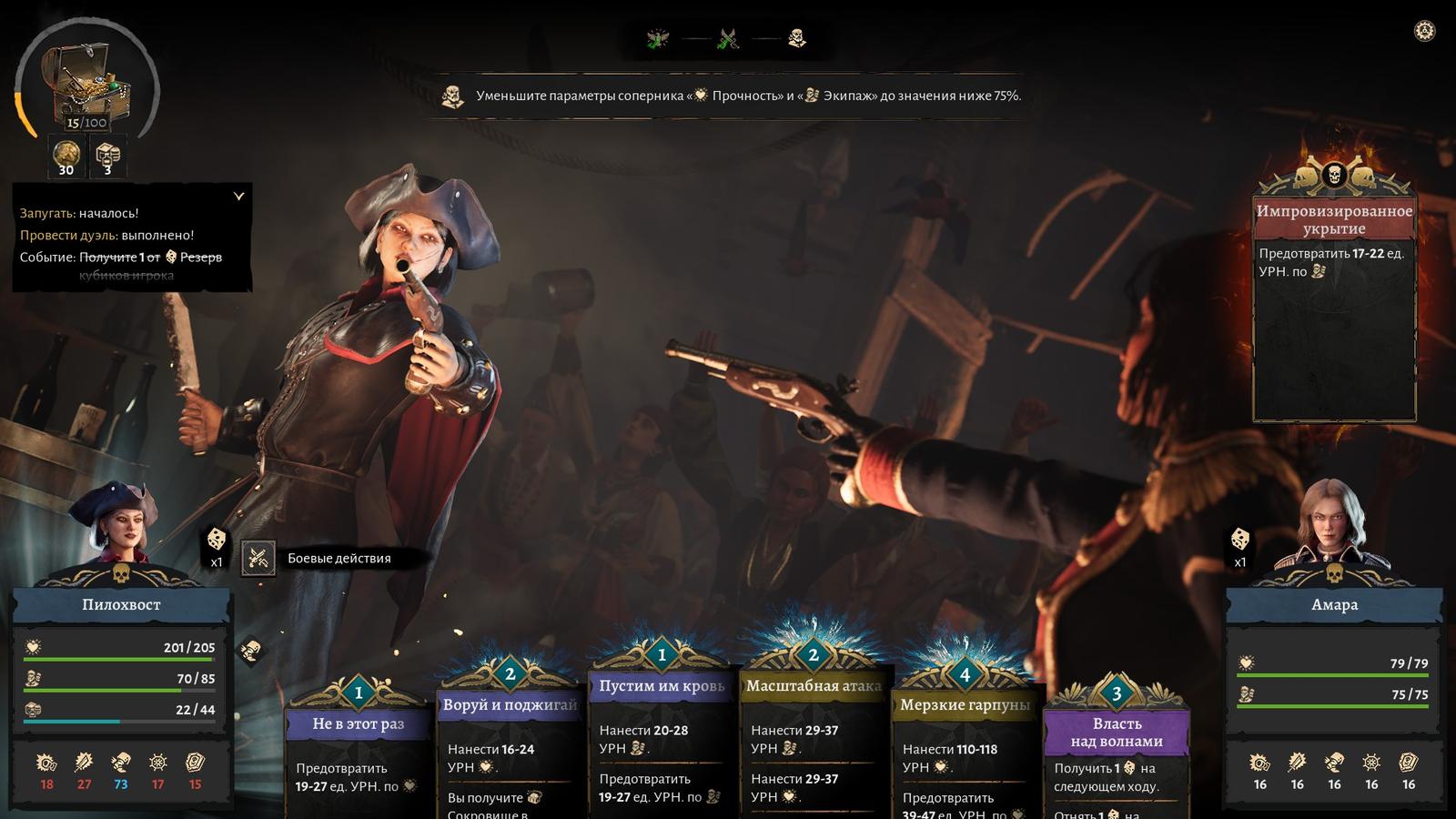
Supplies are the main limiting resource during battles. They determine what action the player can perform: each card requires a certain amount of resource points. Therefore, thoughtlessly playing the most powerful abilities will not work. When supplies run low, you have to use support cards. They allow you to replenish supplies, but in return require sacrificing ship durability, crew, or loot obtained during the task. Loot during a mission is an additional optional indicator, the filling of which provides additional funds and restores some supplies after the mission is completed. Loot can be collected using the same action cards.
Verdict
Corsair Cove can hardly be called a revolution for the city-building genre, but it has many of its own ideas to stand out among competitors. The unusual construction system, multi-level settlement development, well-thought-out logistics, open-world exploration, and a full-fledged story campaign are the main advantages of the project. The development mechanics clearly show that the player needs to constantly adapt to new conditions, adapt to the needs of the fleet, and find the most effective ways of organization. Therefore, there is no need to be afraid to demolish your own factories and sacrifice pirates for prosperity.
At the same time, the game has features that can be a serious challenge for players not accustomed to economic strategies. Mistakes in settlement planning can be costly here. Sometimes, to correct unsuccessful decisions, entire camps have to be demolished and production chains rebuilt from scratch. Because of this, the first hours can be extremely difficult, especially if the gamer is not used to planning infrastructure development in advance and taking into account the long-term consequences of their decisions.
Nevertheless, Corsair Cove remains a fairly friendly project for getting acquainted with the genre. The game gradually introduces new mechanics, does not overload with unnecessary complexity, and allows you to enjoy both the construction process itself and world exploration. At the same time, the pirate setting here acts more as a successful design than the main element of the formula. It adds an atmosphere of adventure to the game and distinguishes it from other city-building strategies.
Never miss our newsAdd this site to your preferred sources to see us more oftenAdd on Google