Aniimo Review: AI-Slop and Superglue
"Damn, what kind of nonsense am I doing!" - the gamepad falls onto the sofa, the console goes into sleep mode, and Aniimo disappears from my life. Several tens of hours vanished into thin air, leaving behind a dull irritation. Of course, in this game, "there's something for everyone," but, damn it, why did I spend so much time for a crumb of pleasure?
By its cover
As is known, one is met by one's clothes. And the first thing that catches the eye when getting acquainted with Aniimo is the peculiar design of characters and creatures, as well as their animation. And this, alas, is a negative trait. The characters look “plastic,” “doll-like.” I wouldn't claim that AI worked on their design, although nowadays little goes without AI. But if artists worked on the characters, there's nothing to be happy about: they produced quality AI-slop without AI.
Let's start with the human characters. They desperately lack naturalness and detail. Instead, they flaunt strange outfits with a tasteless K-pop vibe. Precisely tasteless: top performers, in fact, know how to dress stylishly.
In the case of the main characters, such a decision can still be understood: developers need to sell skins. But what about dressing NPCs decently? Among them are young “students” and gray-haired professors. One wants to ask the designers: have you ever seen modern youth? Go to a university campus and look around. It's clear that we have a fantasy world, but still. The characters look disappointingly generic, as if created by the prompt “cute anime girl student in a bright outfit, 3D anime style.” Give an AI such a request — and you'll get more or less a picture from Aniimo.
Take any HoYoverse character from Genshin Impact, Honkai: Star Rail, or Zenless Zone Zero. Open their screen and rotate the model. Count how many small details are on the costume. HoYoverse designers don't like symmetry and know how to play with asymmetry so that the outfit looks interesting and memorable. Every detail works for the image, not just filling empty space.
In Arknights: Endfield, where the design is not as elaborate, characters have charisma, character, and their own style. And the recent Neverness to Everness looks more interesting in terms of visual elaboration, although in overall impression it is a much less ambitious project.
With the design of “Pokémon” — Aniimo — the situation is slightly better. The cute aesthetic and recognizable images of real and fantastic animals are appealing. Here, the concept itself works for the designers: creatures don't have to look realistic to be charming. But if you apply healthy skepticism, the claims turn out to be roughly the same. Aniimo also often look unnatural and fake; they lack detail and elaboration. Even where the design should be captivating on its own, it leaves an impression of something unfinished.
And the problem is not limited to characters and creatures. It extends to the entire open world.
Traveling through it, I constantly came across messages from other players like “what a beautiful view.” And indeed, from afar, everything looks beautiful. But as soon as you reach another picturesque spot, the magic disappears. Instead of a full-fledged, detail-rich place, you find a decoration: the landscape is broadly outlined, textures are stretched over models — and that's it. There's a lack of details and accidental finds that give a location character and make it memorable.
As a result, the world of Aniimo resembles a beautiful picture that is pleasant to look at from afar, but uninteresting to examine up close. There is external attractiveness, but depth and individuality are often lacking.
What about the mind?
But perhaps the plot is so captivating that you can't tear yourself away from the game?
At the heart of any good drama or comedy must lie a conflict. External, internal — or better yet, both at once. Then, by solving an external problem, the main character, our alter ego, also deals with their own issues, changes themselves, and, ideally, changes the world for the better. At least, that's how a story with something to tell works.
It's probably strange to articulate such things in an Aniimo review, but it's necessary. Our hero has no clear internal conflict, and the external one is so conditional and colorless that it absolutely does not stimulate progression. We go somewhere, explore something, meet someone, complete tasks, and uncover the secrets of Idylia. But for what? What drives our character? What will change if we reach the end? The answers are lost amidst endless running around or simply fail to pique interest.
For some, it might be a revelation that even in casual games, merely seasoned with narrative, like mobile farms or match-three games, there can be a quite clear conflict. Of course, if a good team is working on the game. Our character — a city dweller, a bit of a loser (internal conflict) — inherits a neglected farm that needs to be restored (external conflict). Gradually, they put the farm in order, change the lives of those around them, and at the same time deal with themselves. Even weeding beds begins to feel like part of something bigger.
Against this backdrop, Aniimo's plot resembles playing in a sandbox, to which a main storyline has been attached for appearances. We arrive in Idylia, meet the local inhabitants, explore the mysteries of the world, deal with the mysterious flow of Prismanna, and gradually get drawn into a story about a mysterious group hunting powerful Aniimo. The material is there: secrets of an ancient world, unusual creatures, mysterious forces, and villains with their own plans. An exciting adventure could certainly have been made from this.
But in practice, a cohesive story doesn't emerge. Story quests become just another item on a to-do list, characters appear, tediously deliver necessary information, and then make way for the next ones, while global events remain far removed from the player's daily grind. Moreover, between the main story quests — which are tiny in duration! — there are grindwalls: first level up to 30, then to 40, then to 50. With such an approach, it's impossible to piece the story together into a coherent whole.
You seem to be participating in saving the world, but it feels like you're doing trivial things that don't match the stated scale. The scale of what's happening exists only in words. And it's not that the story must necessarily surprise with unexpected twists or evoke pity with dramatic scenes. It's enough to give the player a clear goal, make them interested in the characters, and create a sense that what's happening matters.
At the same time, the game features micro-stories that could be quite engaging. For example, the story of the conflict between the Helmets and local dragons. The premise is interesting. First, you still need to manage to start this side story by embodying an Aniimo in a metal helmet. It is kidnapped by an evil dragon who intends to make the uninvited guest a toy for its offspring. For some reason, the comedy “The Toy” with Pierre Richard immediately comes to mind.
Then we play with the young dragon, solve a puzzle, and along the way uncover a secret of Idylia's past: once, two species of Aniimo lived in peace and harmony. Here it is, a potentially interesting story about conflict, prejudice, and lost understanding! How does it change the world? Not at all. Does it change the characters? Not either. And how long does the entire micro-story take? Um... A few dialogues and one puzzle. How can that be?
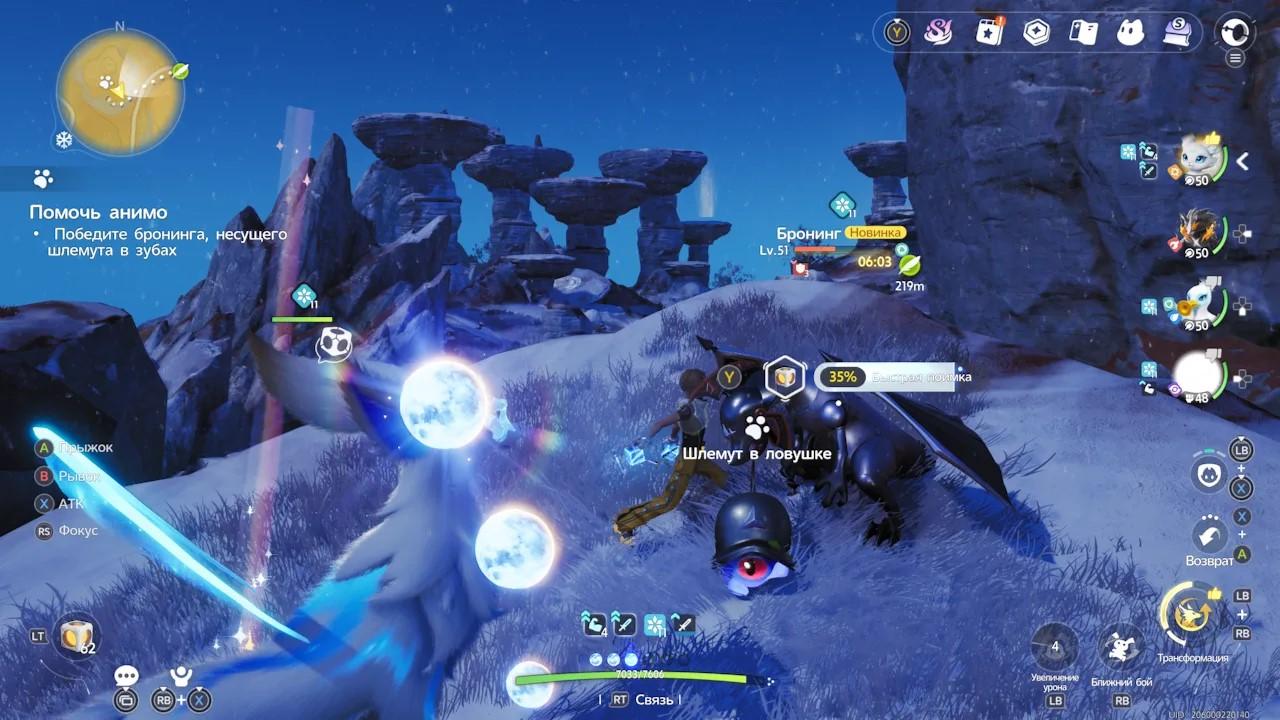
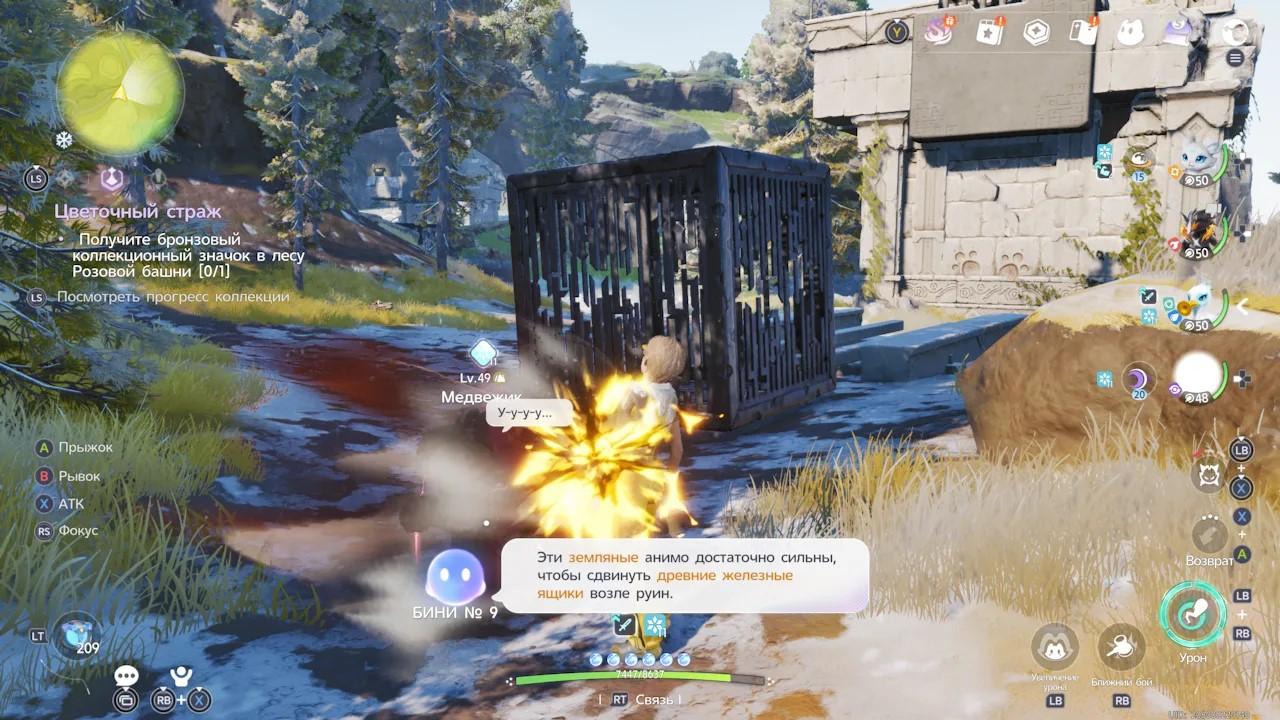
And the problem isn't a lack of interesting ideas. They exist, but the game seems afraid to dwell on them for even a minute longer than necessary. Just as the story begins to take shape, and there's reason to be interested in the characters and the conflict between them — it all ends. No development, no full resolution, no sense that what happened changed anything.
Instead — AI-slop of empty dialogues and hints of full-fledged plots. You'll say a scriptwriter wrote this, not AI? Congratulations. Your scriptwriters write AI-slop. And worse than AI under competent scriptwriter guidance.
Inner World
Open-world game gameplay relies on three components: world exploration, puzzles, and combat system. Good gameplay is when at least two of them work as they should. In an excellent game — all three. In an ideal one, beautiful visuals and an interesting plot are added to this, but we've already established that this is not about Aniimo.
We partially touched upon world exploration when talking about visuals. But now, in a bit more detail. The main problem with open-world games is emptiness and low eventfulness. Aniimo has both. The world is more often empty than not. And this is despite the fact that it only seems large.
In reality, Idylia is cut into relatively small locations: a seashore, an island, a swamp, snowy foothills. They are quite roughly separated from each other, and physically so. For example, the aforementioned swamp is cut off from other locations by a mountain wall, through which there are only a couple of passages. With plains, it's a bit simpler: there are no such sharp transitions, but the “grid-like” arrangement is still felt. Separate locations were made, somehow glued together — and that's that.
Different Aniimo have their own habitats, so exploration mostly comes down to combing the world at different times of day in hopes of encountering someone not yet in the collection.
As a result, the world doesn't feel cohesive. In some places, it's genuinely interesting: you want to climb higher or explore deeper caves. Especially since in Aniimo, this can sometimes be truly engaging. We transform into the desired Aniimo-Pokémon, who can fly, swim, or climb, and interact with other Aniimo. Initially, this is amusing, but over time, the novelty wears off. Everyone flies and swims roughly the same way: there are almost no differences in the mechanics themselves.
Some nuances still occur: a fire-element Aniimo can burn an obstacle, an ice-element one can freeze water. But mostly this works in dungeons and is almost not transferred to the open world, with the exception of individual puzzles.
Things aren't smooth with them either. For every one you want to praise, there are three you don't. In addition, Aniimo tries to be a bit of an MMO: players can leave messages for each other right in the open world. As a result, everything is covered in spoilers. You approach an important place and already see that something is about to happen. Even if you don't read the messages, the abundance of markers screams: “Something is about to happen!” And if you read them, you can find out exactly what, how to solve the puzzle, and when it's best to come — morning or evening.
Combat system? Players familiar with the Pokémon series note that it's unique here, although the resemblance is obvious. In the open world, an Aniimo can be both an independent combat unit and a fighter under your direct control. In the first case, you act as a support; in the second, you control the fighter yourself.
There are up to four Aniimo in a party. Each has its own characteristics, attacks, ultimates, and element. But there are no revelations here: the elements are built on a “rock-paper-scissors” principle, so some Aniimo are more effective against others, and the party should ideally be chosen wisely. However, elemental antagonism is not strong enough to decide everything: a battle can be won even with an unsuitable element if your Pokémon is sufficiently leveled up. In general, battles come down to spamming the enemy and using abilities and ultimates on cooldown.
What else? Your own mobile home and a farm with beds where captured Aniimo can work. Hello, Palworld! Grown produce can be sold. There's also a hub world where you can hang out with other players, trade items, and chat. Aniimo hasn't become a full-fledged MMO, but some elements are in place — including co-op play.
Oh, right, collecting Poke... Aniimo. We sneak up on it and throw a Pokéball, that is, an Anipod. The better the Anipod, the higher the chance of catching an Aniimo. A simple one can be caught with a simple Anipod — especially if you sneak up from behind or catch it sleeping. But an Alpha, the local big shot, is almost impossible to catch with a simple Anipod. More precisely, it's possible, but the chance is close to zero. But with a special one — it's easy.
And that's not very good news.
Bring back gacha
Gacha is, of course, manipulative nonsense that exploits human gambling addiction. But it also has a flip side: if you build a game around random drops, at least you understand how it works. Aniimo has no gacha, but it has its own monetization methods, which sometimes seem no less questionable.
Run out of good Anipods? Welcome to the shop.
This is especially evident with Alphas. First, you find a rare creature, then you defeat it in battle — and here, it would seem, is a well-deserved reward: you can try to catch it. But the base chance of catching it with a regular Anipod is 6%. And there's only one attempt: if the cube doesn't work, the Alpha disappears. And the attempt itself costs 30 units of local stamina — a separate resource that limits the number of such hunts.
And this is where they appear — the Hyper Anipod, the Sparkling Cube, and other advanced types of Anipods. Some not only guarantee a catch but also transform the caught Aniimo into a special version. Yes, the sparkle doesn't provide a mandatory combat advantage. But it is important for the collection, and obtaining sparkling Aniimo is associated with achievements and rewards. That is, the “correct” cube allows you not only to avoid a failed throw but also to predictably complete collection goals.
You don't expect such a trick from Aniimo. It's as if the calculation here is for a more relaxed adventure: you explore the world, collect cute creatures, hunt for rare specimens. And it is precisely this audience that risks falling into the trap of expectations. Defeating an Alpha doesn't mean getting it into your collection, and the desired catch can turn into a series of failures, the expenditure of a limited resource, and the temptation to buy a cube that finally guarantees a result.
This isn't pay-to-win in its purest form, but that doesn't make the monetization any less unpleasant. Developers sell skins (approved), sell ways to simplify catching rare creatures (disapproved), and also integrate paid tools into collection mechanics (condemned). The player isn't forced to pay directly — they are offered to spend money to get rid of artificially amplified uncertainty or to get the desired version of Aniimo.
But for those accustomed to combat gachas, such mechanics have long been familiar: there, it's part of the usual system. Vicious, but familiar, and a player who comes to Aniimo for relaxed collecting may find that even after defeating a rare creature, the game is not in a hurry to give them the reward. Only to then obligingly offer them a way to solve the problem for money. And they also offer to play in a casino.
And this is no longer a cozy adventure at all.
Technical condition
Technically, everything is fine. On Xbox Series X, Aniimo ran smoothly, the console didn't start making noise, and I didn't encounter any crashes or other noticeable problems. At least, during my playthrough, the technical side of the game gave no cause for irritation.
With sound and music, it's more complicated. They exist, they accompany what's happening, but now, sitting at the keyboard in front of a text editor, I can't recall a single melody that stuck in my head. Instead of Aniimo's soundtrack, my memory obligingly offers music from other games. There — yes, a melody! But here... In short, the musical accompaniment isn't irritating, but there's nothing memorable about it either.
But I remembered the interface perfectly. Multi-layered, overloaded, clunky — as much as I'm used to gacha interfaces on smartphones and consoles, Aniimo managed to exhaust me. Simultaneous pressing of triggers, bumpers, and face buttons, pop-up menus, the need to constantly keep key combinations in mind... Horrible.
It seems that the interface was adapted for the gamepad using the simplest principle: they took existing menus, assigned buttons to them, and decided that was enough. And here, the elaboration was lacking.
Diagnosis
So at what point did the gamepad fly onto the couch, and the console go to sleep? While poking at another Aniimo in the open world, I suddenly caught myself thinking: why am I even doing this? What does this game give me?
Do I like the visual style? No, not really. Not that it's disgusting, but it lacks detail and elaboration.
Do I like the plot? No, I don't. It's not disgusting, but it lacks conflict and elaboration.
Do I enjoy the battles? No, I don't. The combat system is unoriginal; it lacks elaboration.
Puzzles? World exploration? Anything that's truly appealing? Anything that doesn't need refinement after the developers glued all this AI-slop together with superglue and offered it to players as a finished game? No.
And if this isn't AI-slop, but the result of a whole team of authors, then perhaps it's worth looking for other authors.
Aniimo is not a failed game in the sense that we usually talk about failures. It's just “nothing.” And spending your time on “nothing” — why?
Never miss our newsAdd this site to your preferred sources to see us more oftenAdd on Google