Sony was not thrilled with Death Stranding's financial performance, which is why it refused to cooperate with Hideo Kojima, says analyst
Translated with AI from the Russian original.
Death Stranding 2: On the Beach sold 2.5 million copies.
Sony may have refused further funding for Hideo Kojima's new game Physint due to the relatively low financial returns of the Death Stranding franchise. This conclusion was reached by analyst Rhys Elliot, who studied the estimated sales of both parts of the series and their revenue on PlayStation and other platforms.
According to Alinea Analytics, Death Stranding 2: On the Beach sold approximately 2.5 million copies: about 1.8 million on PlayStation and another 700 thousand on Steam. The total revenue of the game on these platforms is estimated at approximately $170 million. About $129 million came from PlayStation, with about 65% of this amount received in the first two months after release.
On PlayStation, Death Stranding 2 sold approximately one million copies in the first two months – about 722 thousand copies in June 2025 and another 381 thousand in July. However, sales then sharply slowed down: in subsequent months, the game barely exceeded 100 thousand copies, and in August, the figure was below 30 thousand. Even a price reduction to $40, according to estimates, did not have a noticeable impact on demand.
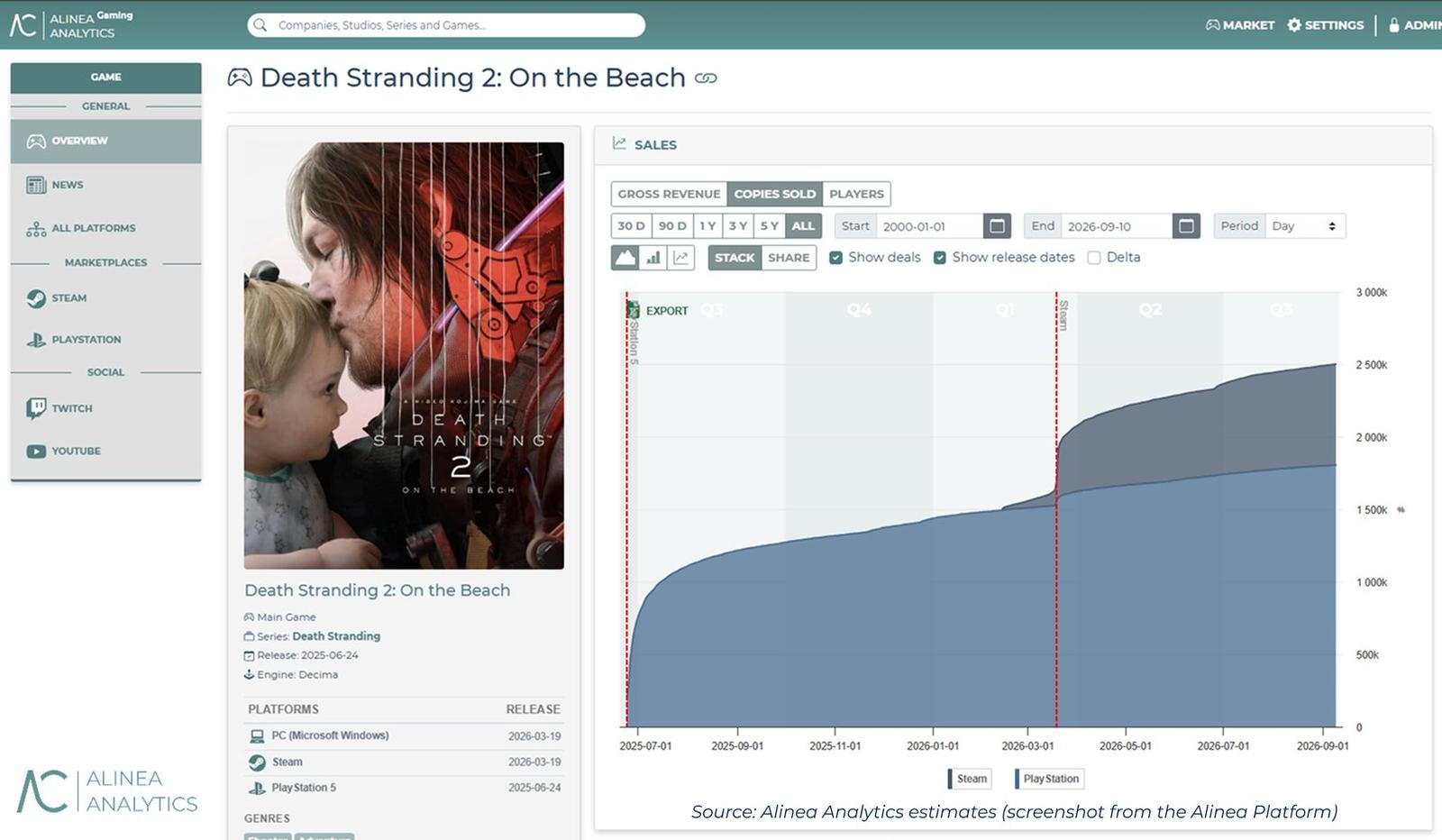
A similar situation was observed on Steam. About 550 thousand of the 700 thousand copies of Death Stranding 2 sold were realized in the first two months – that is, about 80% of the total circulation on the platform. The game has already participated in sales twice, but they also did not provide a significant acceleration in sales.
For comparison, the original Death Stranding achieved approximately 5 million copies sold over a similar lifecycle. However, the first part repeatedly received more significant discounts – up to $20. Its total revenue is now estimated at approximately $243 million: about 71% came from PlayStation, 25% from Steam, and another 4% from Xbox.
The two Death Stranding games could have brought Sony about $413 million in total revenue over ten years since the announcement of the first part at E3 2016. However, the second part has earned less than the original so far, despite a significantly higher development budget.
According to rough estimates, the creation of the first Death Stranding cost approximately $100 million, while the budget for the second part could range from $150 million to $200 million. Longer development, the COVID-19 pandemic, and related difficulties significantly increased costs. If marketing and alternative costs are taken into account – in particular, the diversion of Guerrilla Games employees to develop the first part – then the entire franchise probably managed to break even, but it may not have brought significant profit beyond the investments.
It is the financial side of the issue that may explain Sony's decision to distance itself from Physint. Even an estimated return on investment of 18–38% means tens of millions of dollars in profit for the company, but for a project with a budget of hundreds of millions of dollars, such a return may be insufficient. In the modern gaming industry, high margins and efficient use of internal studios are especially important for large publishers.
At the same time, it is unknown what exactly caused the possible revision of plans regarding Physint. It was not publicly reported whether there were problems with compliance with production plans, disagreements with Kojima, or other circumstances. Therefore, Sony's decision cannot be linked solely to Death Stranding sales yet.
However, from an image perspective, the situation is not looking good for PlayStation. The decision was made against the backdrop of the release of Marvel's Wolverine, which received a mixed critical reaction, as well as intensified disputes surrounding Sony's abandonment of physical copies of games. For some of PlayStation's most loyal fans, the refusal to cooperate with Kojima may look like another sign that the company is increasingly focused on financial performance and profitability, rather than on creating unique projects.
Read more on the topic:
Never miss our newsAdd this site to your preferred sources to see us more oftenAdd on Google