Magical realism that hurts. Review of action platformer South of Midnight
Translated with AI from the Russian original.
An action platformer with elements of magical realism and Southern Gothic, to the sounds of the blues, leads the player into a bizarre world where voodoo, French folklore, and Creole mythology intertwine with the realities of the Deep South. On paper, it sounds alluring, but in practice, this variety plays a cruel trick on the creators, while disjointed gameplay elements pull the project in different directions, preventing it from achieving cohesion. All the details are in our review.
Hurricane chronicles of Prospero
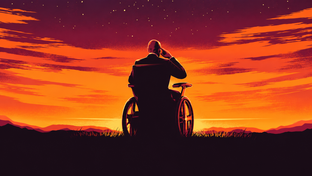
For the southern states of the US, a hurricane is not just a natural phenomenon, but a part of everyday reality. This ruthless predator can destroy a home, take loved ones, and leave behind not only debris, but also wounds that do not heal for years. It is a hurricane that becomes the starting point in the story of Hazel Flood—a runner from the town of Prospero who sets off in pursuit of her house, carried away by a torrential flood along with her mother.
Unable to overcome the elements, Hazel heads to Grandmother Bunny's estate to ask for help. But the haughty white aristocrat clearly has no love for her late son's African American relatives and suggests simply waiting out the storm. Exhausted, Hazel falls asleep instantly.
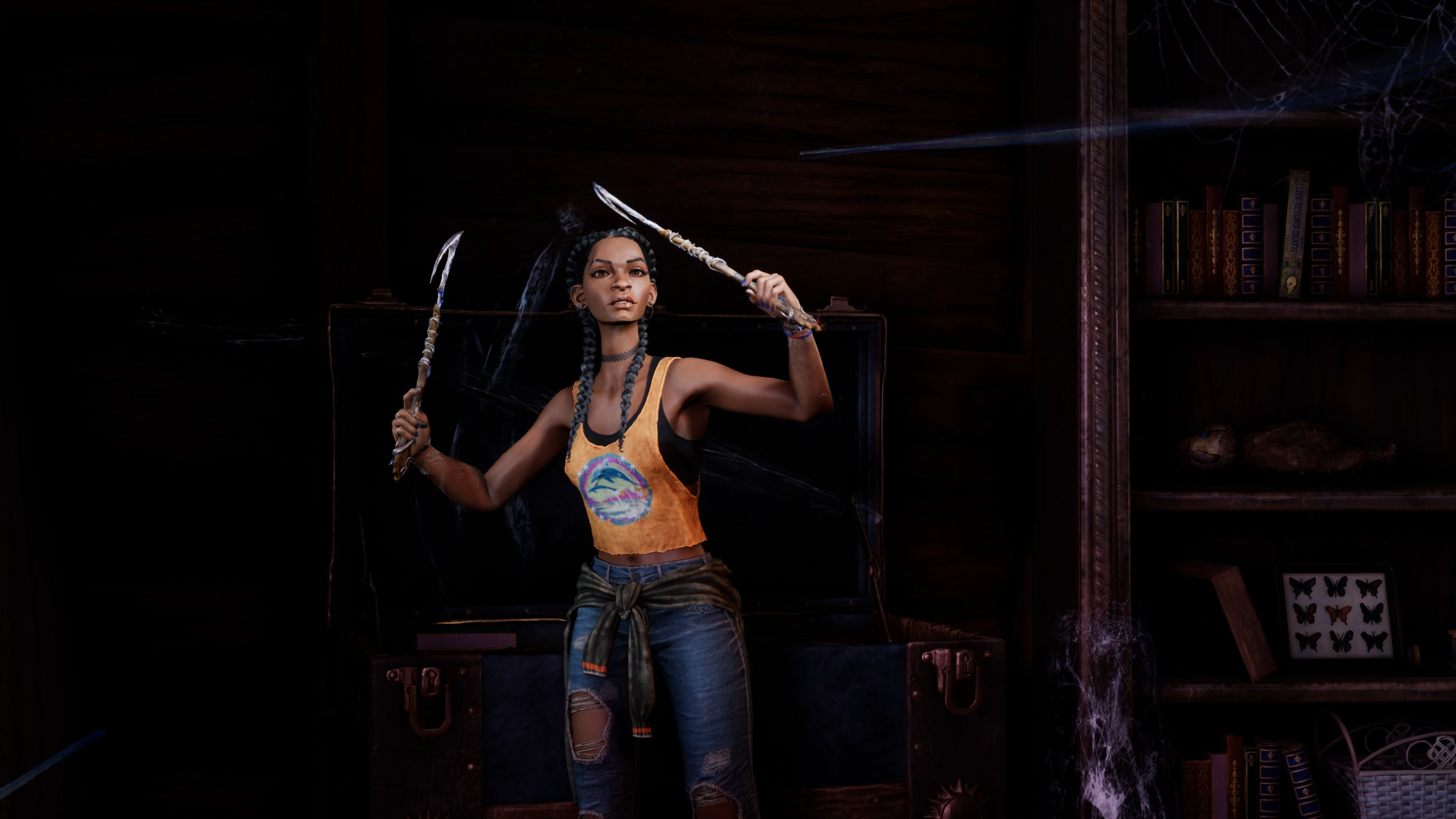
Yet the dream is not destined to last long: the girl wakes up and finds herself locked in. Attempting to escape the estate, Hazel hears mysterious voices that lead her to a hidden room. In an old trunk, she finds a pair of spinning hooks—at first glance, ordinary grandmother's tools, but with a surprise: the hooks awaken in Hazel the abilities of a Weaver—those who can manipulate the fabric of reality itself by interacting with the Great Tapestry.
The Great Tapestry is a mythical structure from which the entire world is woven. In it, the fates, emotions, and memories of all people are imprinted. When someone suffers, the threads of the Tapestry warp, forming scars—clusters of pain and trauma. These scars spawn haints—malevolent spirits that embody unresolved conflicts. The Weaver's task is to “unweave” the haints and scars in order to restore the world's disrupted fabric.
Having discovered her power, Hazel embarks on a journey across flooded hamlets and sawmills, mountain ravines, and murky swamps where fairy tale intertwines with reality. Along the way, she must not only untangle scars and battle haints, but also uncover the truth behind the myths surrounding Prospero, discover her family's secrets, investigate a case of mass child abductions, and—embracing her new role—heal the pain of past ghosts to ultimately attempt to save her mother.
This is where the infamous consultants from Sweet Baby Inc. step in; if the credits are to be believed, they were responsible for the script and narrative. The stories of people traumatized in the past often develop weakly and do not always carry coherent meaning—unless one considers a set of caricatured, clichéd tropes like envious relatives, careless parents, cruel slave owners, and systemic injustice to be meaningful. Moreover, far from all of these episodes turn out to be genuinely important to the main plot.
Nevertheless, learning about this world and immersing oneself in its cultural context is genuinely fascinating. Some stories can be touching—thanks in part to the magnificent musical score, which heightens the emotional impact. At its finest moments, the game feels like a collaboration between Tim Burton and Pixar. And the plot itself has enough twists to sustain interest and the desire to see what happens next. However, all this atmospheric and dramatic potential risks crumbling under the weight of poorly designed and repetitive gameplay.
By the rule of three... or four
The campaign consists of fourteen chapters, throughout which we have to do all of the above—though, truth be told, there isn't much fun in it.
Almost every chapter follows the same template: we trudge through an enclosed corridor-like level with rare branching paths hiding upgrade resources and lore notes. Along the way, we solve primitive puzzles like “push the crate, climb higher,” find monster arenas, and, upon defeating them, bottle up painful memories. We repeat this three or four times, followed by a runner-platformer segment: running away from an unknown mist while jumping across platforms, wall-running, and utilizing the heroine's other abilities.
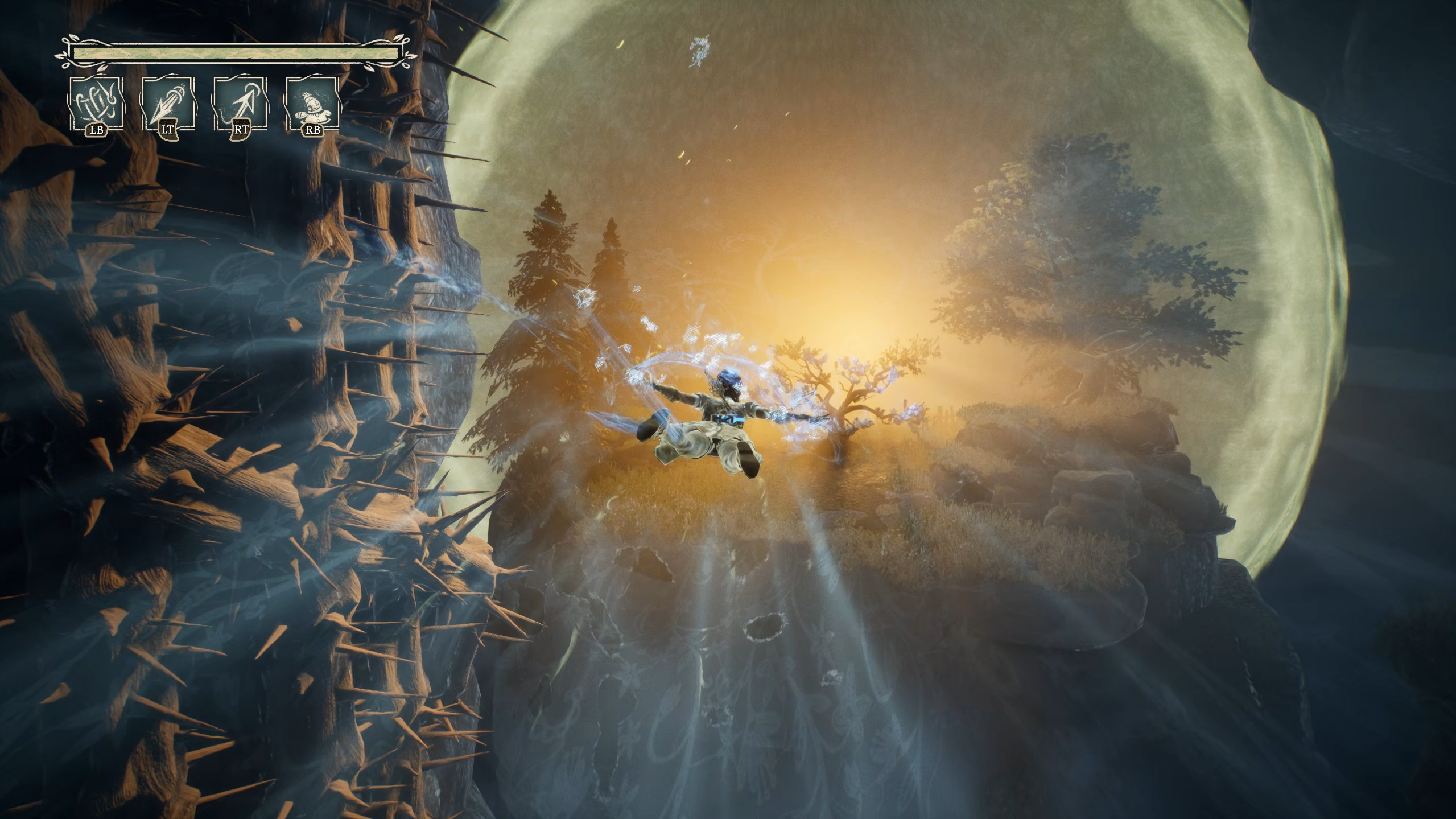
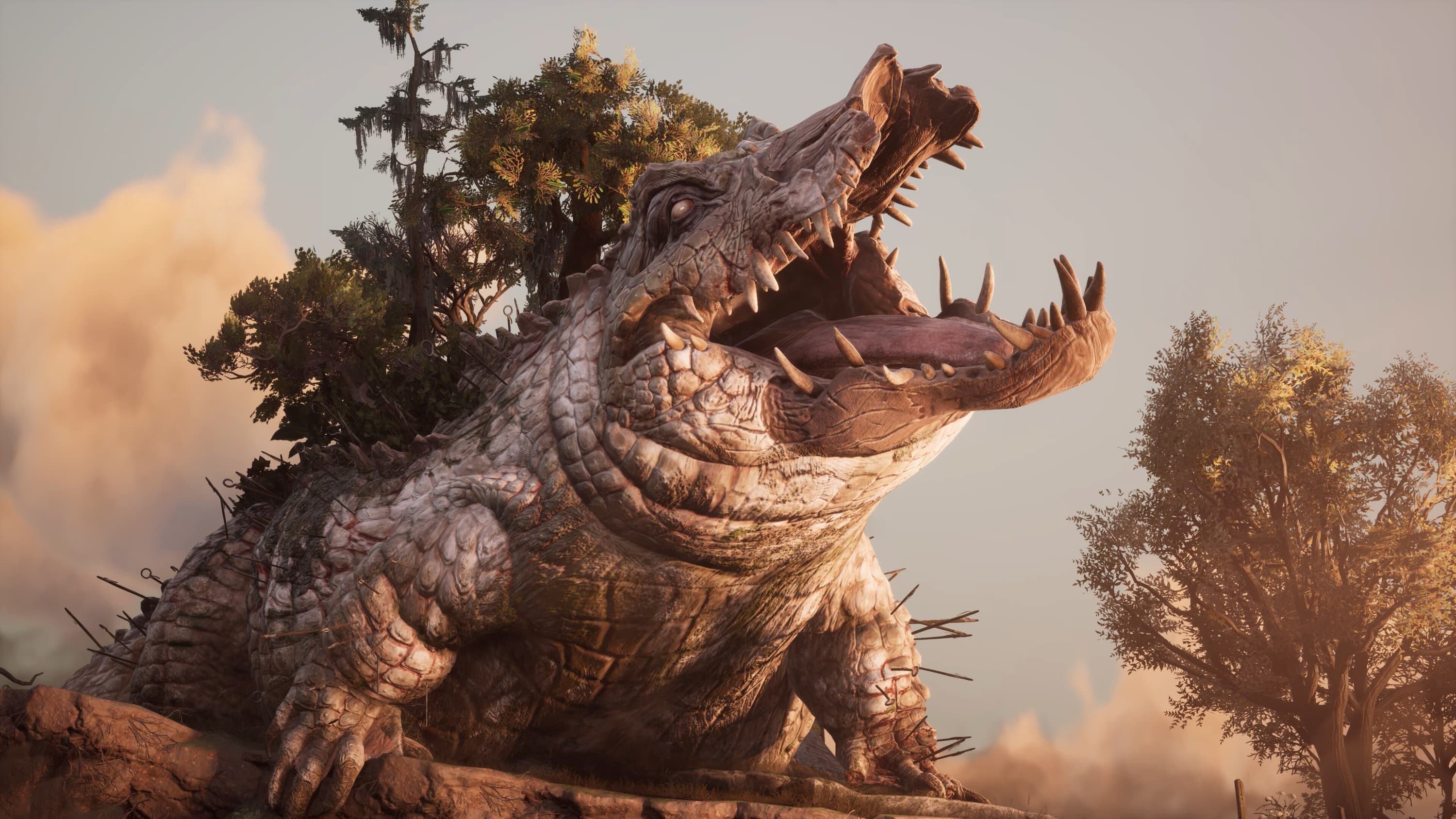
Boss battles occasionally occur as well—four in total, to be exact. And while the first three might still surprise you with their adversaries (like a giant alligator), in the finale the player is simply bombarded with hordes of haints, interspersed with chases from that same mist. The battles themselves lack ingenuity and are built around the same formula—the exact same actions must be repeated several times. For instance, in the first fight, you have to throw a stone at a bell to stun the boss and land a few hits before it becomes invulnerable again.
Despite the wealth of abilities—such as wall-running, double jumping, gliding, grappling, and the power to briefly materialize objects from the past—the platforming in the game is rudimentary, and checkpoints are placed so generously that you might sometimes even end up on the other side of a chasm after falling. I only encountered difficulty at one specific point in the finale—and even then, thanks to a clunky cinematic camera. And do you know where else the camera is clunky? In combat, of course!
Combat that doesn't knit together
Crochet hooks are useful to Hazel not just for darning wounds and socks—they are also great for beating down haints. They are supplemented by magical abilities that allow you to pull or push enemies, entangle them to stun them briefly, and even sway them to your side with the help of a living plush toy named Crouton, who is also used to access places Hazel cannot reach.
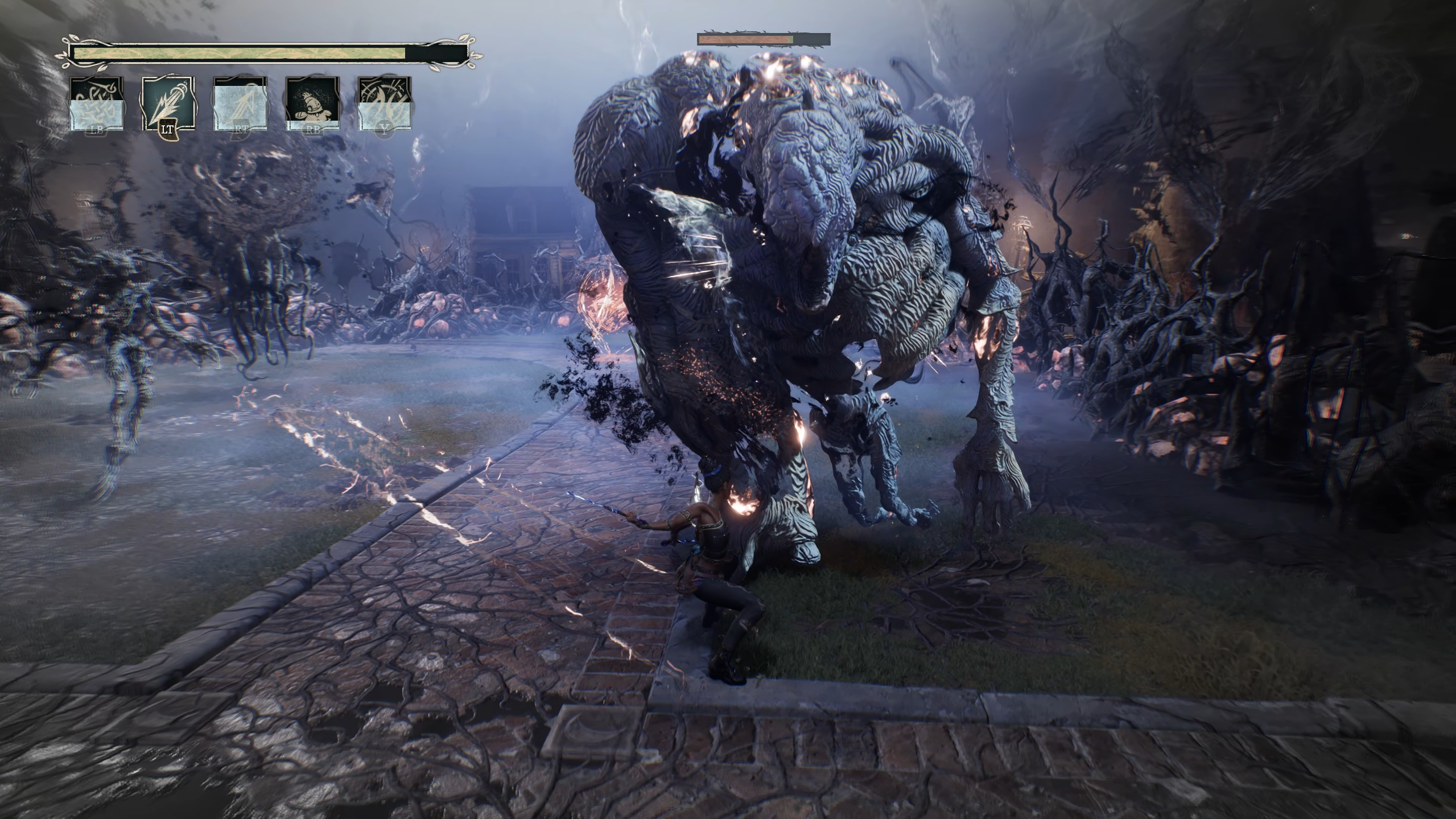
The problem is that the battle arenas are often tiny, and most haints are noticeably larger than the protagonist. Because of this, maintaining proper control of the battlefield proves impossible. Hazel is also quite fragile, and even on normal difficulty, enemy attacks can cut her life short very quickly.
Combined with the swift lunges of certain enemies and the complete lack of defensive tools other than dodging, this makes encounters fast-paced yet excruciating. Especially on high difficulty, where the developers thought of nothing better than simply cranking enemy stats to the max.
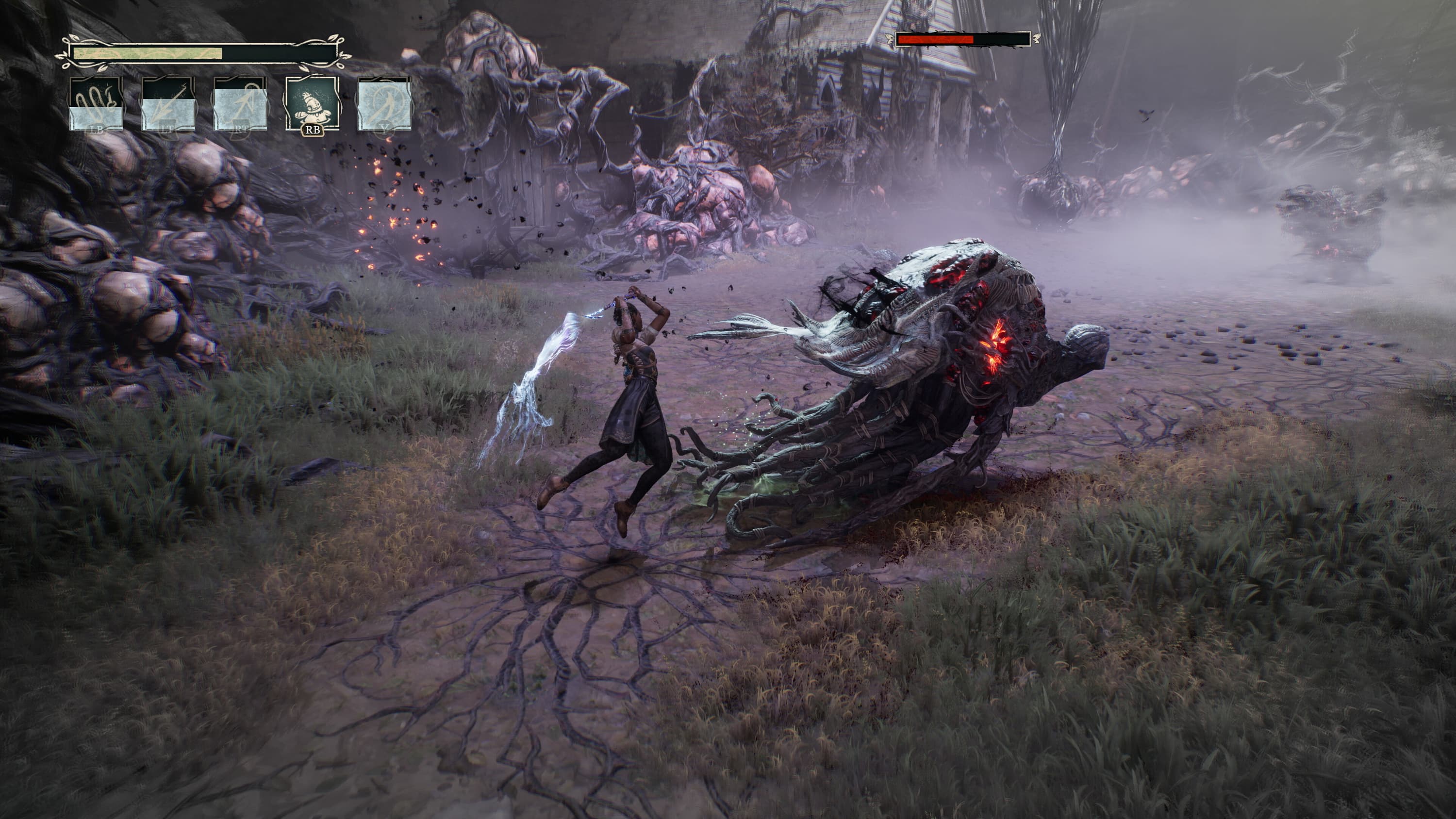
The process of “unweaving” haints is particularly disheartening. Not only are the fights repetitive and tedious, but once an enemy's health drops to zero, they must be “unwoven”—requiring a cinematic finisher with the exact same animation, which feels longer and longer the more you play. If you don't do it, the haint can regain health, forcing you to repeat the entire process.
Magic upgrades, to be fair, are quite effective—especially in later stages, when abilities combo well together. Yet by that point, combat has become so stale that the sensation of replaying the exact same encounter over and over simply never lets go.
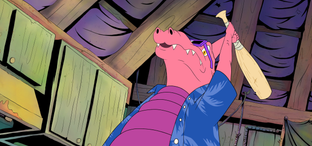
The game doesn't excel in enemy variety or design either. At the start, you meet one type of haint—a clump of tree roots with anthropomorphic features, whose attacks can still be distinguished and telegraphed. But as you progress, increasingly vague clusters of roots of various shapes and sizes appear, whose behavior is sometimes impossible to anticipate. The developers ran out of imagination about halfway through the game—after that, no new enemies appear at all.
It seems the authors decided to complete the repetition bingo card, and at the same time chose a battle theme that, unlike the wonderfully selected tracks in story scenes, doesn't match what is happening on screen at all and never changes throughout the entire game.
Beautiful Southern Gothic
If anyone deserves praise for variety, it's the artists. And certainly not for the heavily advertised stop-motion. Yes, the graphics don't shine with cutting-edge technology, and the abundance of muddy textures can be overwhelming even in corridor locations.
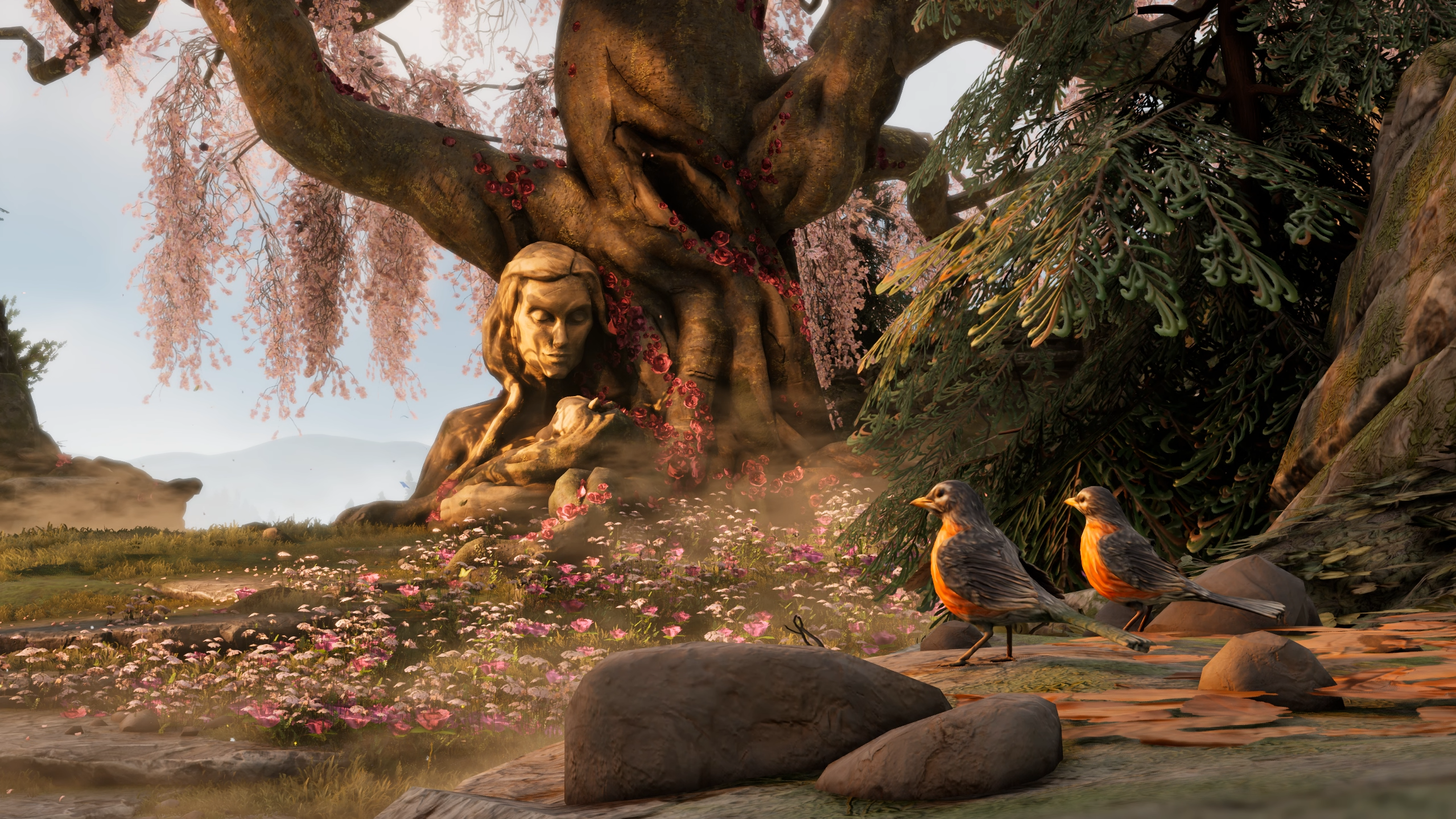
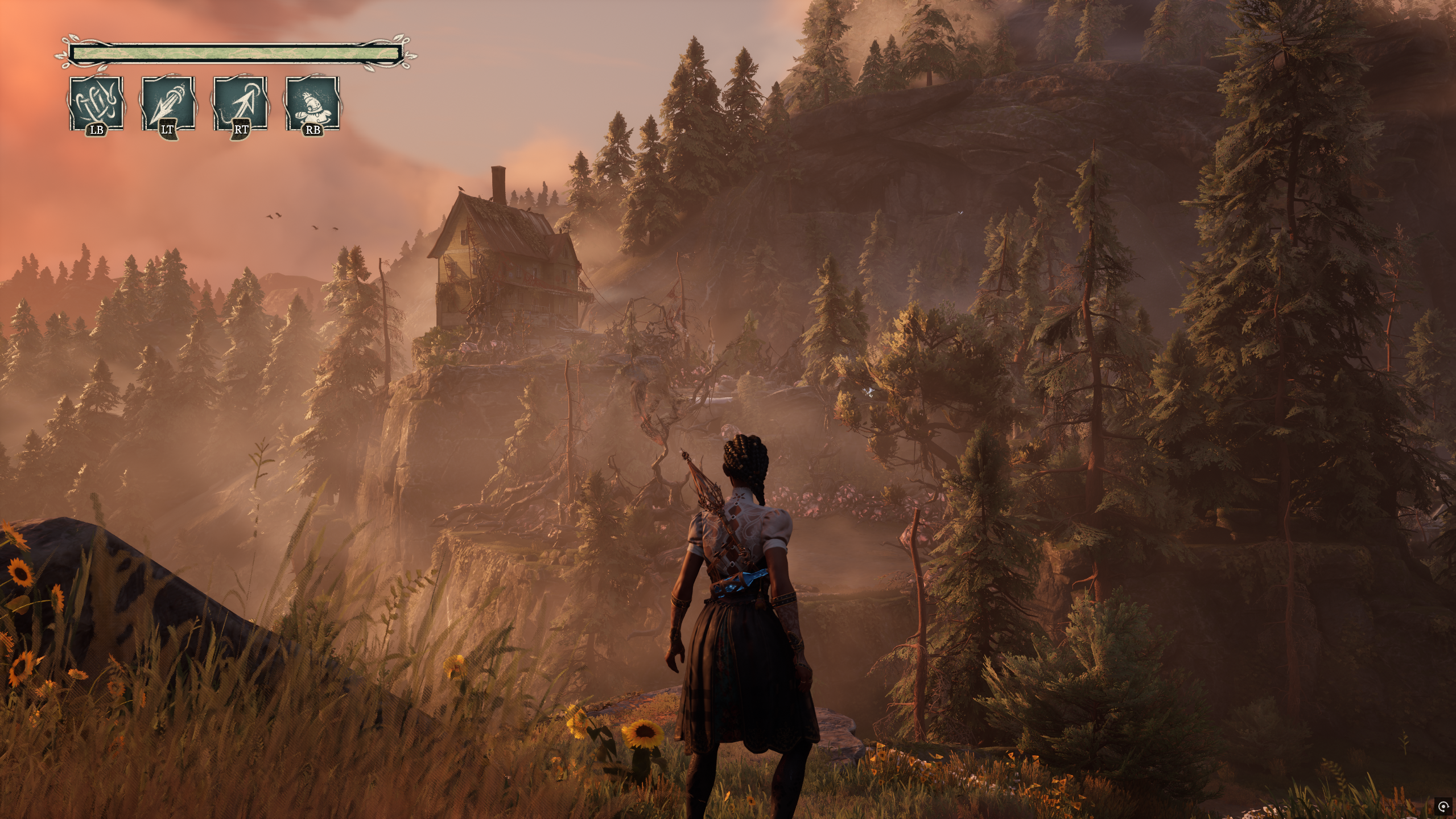
Yet the visual style—and, crucially, a level of variety rare for this game—shines through the intricately detailed and whimsical scenery. Combined with quality lighting work, it largely creates the unique atmosphere of a Southern Gothic fairy tale.
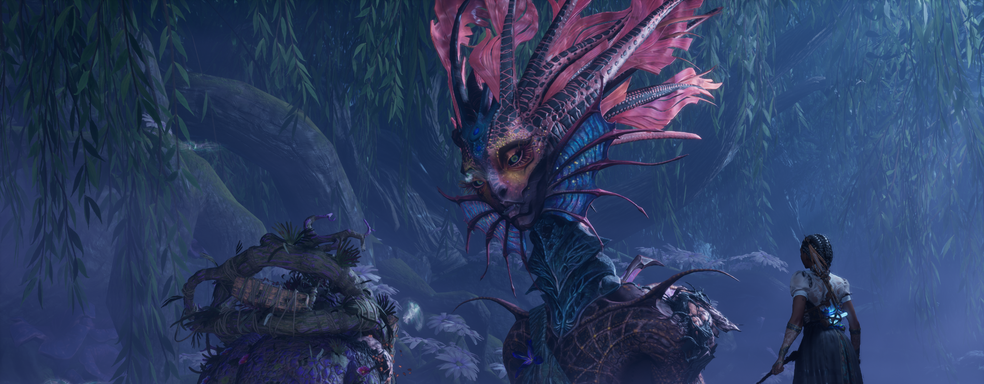
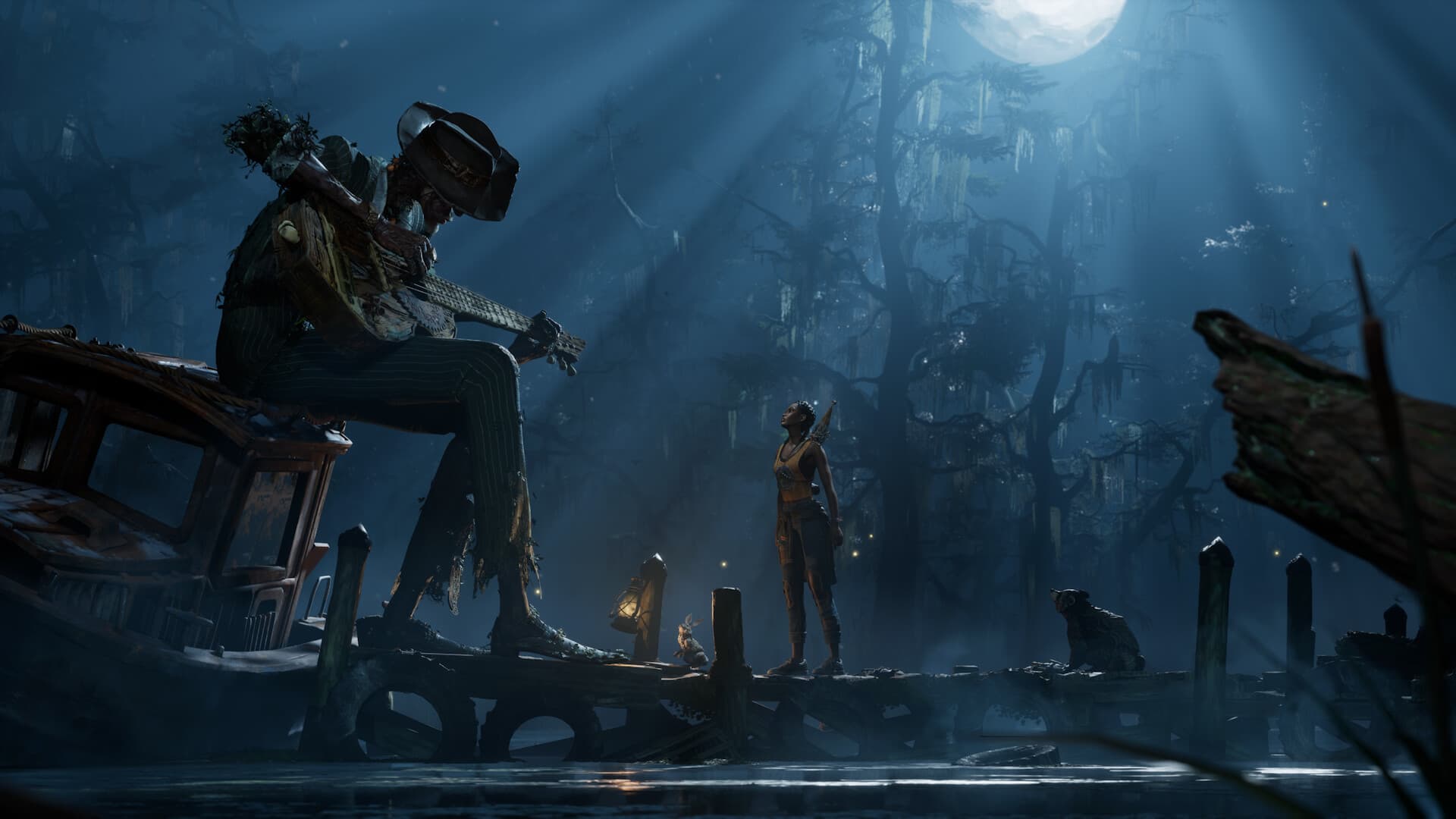
Throughout the entire journey, Hazel is accompanied by a giant mythical Catfish, who clearly says less than he knows. Everywhere, there is lush vegetation, flowers, critters like foxes and amusing raccoons, giant peaches, houses entangled in roots, traces of time in the interiors of formerly inhabited spaces, and even an entire town floating on debris.
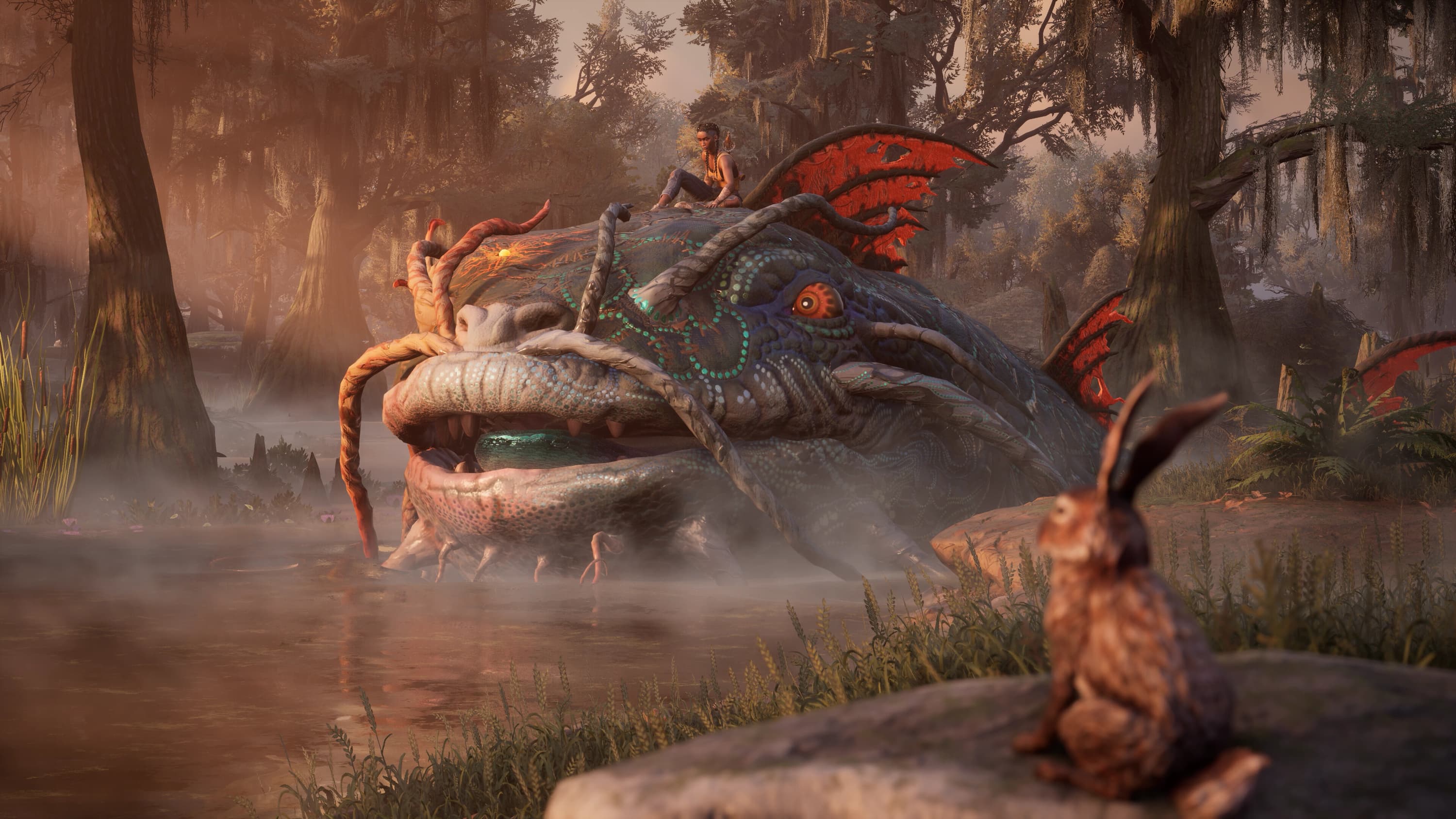
It seems they put the most effort into the environment—yet the world still mostly feels lifeless, because the scenery remains just that, and interaction with it is kept to a minimum.
The stop-motion in cutscenes looks organic, but in gameplay, it constantly felt less like an artistic choice and more like performance issues—none of which actually occurred throughout the entire playthrough. After about ten minutes, I turned the effect off in the settings. Soon, however, I realized the animations were originally crafted with this style in mind: without it, the heroine moves and fights awkwardly, if not downright clumsily. Turning the setting back on, I eventually grew accustomed to it—and by the end, could no longer imagine the game any other way.
Diagnosis
South of Midnight is neither a failure nor a masterpiece. It is an extremely uneven game that evokes mixed emotions. During my playthrough, I went through all the stages of grief. It feels as though the developers shouldn't have made an action platformer in the first place, as the active gameplay suffocates in monotony. There are many potentially interesting elements intended to turn the project into something more than an interactive fairy tale, but none feel truly polished and refined—which is why the combat grows tiresome by the fifth hour.
At the same time, the game thankfully does not devolve into moralizing. The theme of slavery is conveyed through imagery and metaphors rather than heavy-handedly, as is common nowadays. All characters are in their proper places, without excesses for the sake of representation. Moreover, it is the original setting, the dark fairy-tale atmosphere, the soundtrack, and the story that keep the game from completely falling apart. Thanks to them, even negative impressions of unrefined mechanics fade, and you push through the second half with a firm desire to reach the credits—though you might want to lower the difficulty to spend less time in combat. Just as I did.
Is South of Midnight worth your attention? Perhaps—if you are drawn to the magical realism of the American South. But be prepared for the fact that beyond this, the game simply has nothing to surprise you with—it's just an okay game, without pretensions to anything greater. I wouldn't unequivocally recommend playing it. If you have Game Pass, the game is available with the subscription: download it, boot it up—within the first two hours, it shows almost everything it has to offer, aside from unlocking magic upgrades. Perhaps this Southern Gothic will be to your liking.
Pro
- Original setting
- Fairy-tale atmosphere
- Interesting visual solutions
- Catchy soundtrack
Contra
- Repetitive combat
- Poor enemy design
- A beautiful yet lifeless world
- Lazy level and mechanics design
***
The rights to all images in this article belong to Compulsion Games / Xbox Game Studios. Pictures. iXBT Games uses them for informational and research purposes, and does not claim ownership of them.
Never miss our newsAdd this site to your preferred sources to see us more oftenAdd on Google