Deconstructing Half-Life 2. Why games like this aren't made anymore after 20 years
Translated with AI from the Russian original.
Twenty years have passed since the release of Half-Life 2. In 2004, the high bar set by the game seemed like just another stepping stone toward future incredible projects. But it turned out that not only surpassing, but merely reaching that standard proved extraordinarily difficult for developers. Although attempts to make such games continue, only a select few manage to achieve comparable results. This article is a deconstruction of Half-Life 2.
We analyze the plot, atmosphere, gameplay, technical achievements, and impact on the industry, taking a detailed look at individual elements of the game, evaluating their quality and significance, as well as trying to understand how they interact with each other to shape a cohesive experience. Our goal is to understand why the game became such an important work in the history of video games and why modern games are made differently.
Plot
Setting and story
A sci-fi setting in games of the 1990s and 2000s was more the norm than the exception. Both Half-Life installments followed this trend, but unlike most games of that era, they rested on a solid scientific foundation. Works labeled as science fiction are often fantasy stories dressed in futuristic scenery. True science fiction, however, is based on ideas, hypotheses, and assumptions that alter the world familiar to us while remaining compatible with a scientific worldview.
The Half-Life series stands out because its narrative core is built on scientific concepts. Perhaps the only non-scientific element is how Gordon Freeman, a physicist armed with just a crowbar, managed to change the world first in the Black Mesa facility and then in City 17. In all other respects, the plot and lore of the games are meticulously crafted, creating the atmosphere of a plausible world.
Of course, one could ignore the story and focus exclusively on gameplay. In that case, however, you would miss out on a significant part of the enjoyment of Half-Life 2. While in the early Doom games the entire plot was contained in a small text file in the game directory—an approach followed by many projects—Valve showed the importance of story even in the shooter genre. The first Half-Life was a revolution in this respect. By the time the second installment was released, many developers were already modeling their work on its achievements.
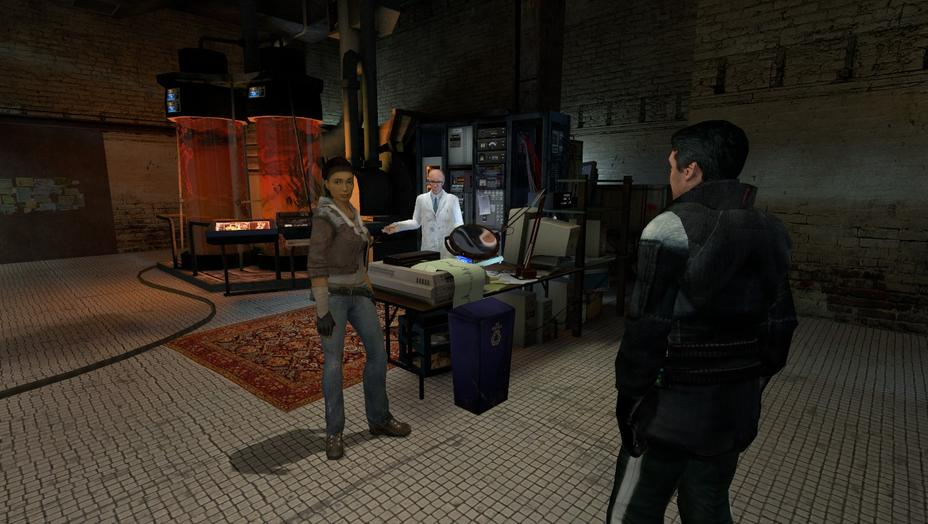
Yet Half-Life 2 also found ways to surprise in its storytelling. The second installment continues Gordon Freeman’s story in an unexpected manner, building upon the events of the original. Despite visual differences, the game fits harmoniously into the overarching universe, introducing new details and unraveling mysteries of the past. Half-Life 2 preserves the spirit of the original while delving deeper into exploring the aftermath of the events at Black Mesa and demonstrating how they reshaped humanity’s future.
This approach to narrative and world-building makes the Half-Life series an outstanding representative of the sci-fi genre in video games, where every detail matters and contributes to immersing the player in a unique universe.
The narrative delivery is arranged very skillfully. The player does not need to scour locations searching for notes or audio logs to absorb the atmosphere of the world. Much becomes clear from dialogue and cutscenes that occur both with the protagonist’s direct involvement and just off his main path. The ability to craft a story in such a way while leaving the protagonist silent enhances immersion in the gameplay, testifying to the developers’ mastery.
The game’s characters do not feel like cardboard cutouts. They are shown with their own weaknesses and strengths; their emotions look genuine and heartfelt. All characters are motivated: even the antagonists are not “evil” just for the sake of it, but act according to their own convictions, even if their actions run counter to social norms. Looking at their actions from their perspective, one can understand their motives, even without agreeing with their choices.
The secondary characters are exceptionally well crafted, with Alyx Vance standing out in particular. Her natural demeanor and inner grace made her one of gamers’ favorite characters. It is no surprise that she was given the lead role in Half-Life: Alyx—an honor well deserved.
Special credit goes to the atmosphere crafted by the developers of Half-Life 2. Throughout the game, the writers immerse the player in diverse environments with varying moods. For instance, the ghost town of Ravenholm, infested with zombies, is one of the finest locations, creating incredible suspense on par with the best horror works. Or crossing the river under a railway bridge: visually not as terrifying, but capable of sending shivers down the spine of anyone afraid of heights, especially when having to retreat while fighting off enemies.
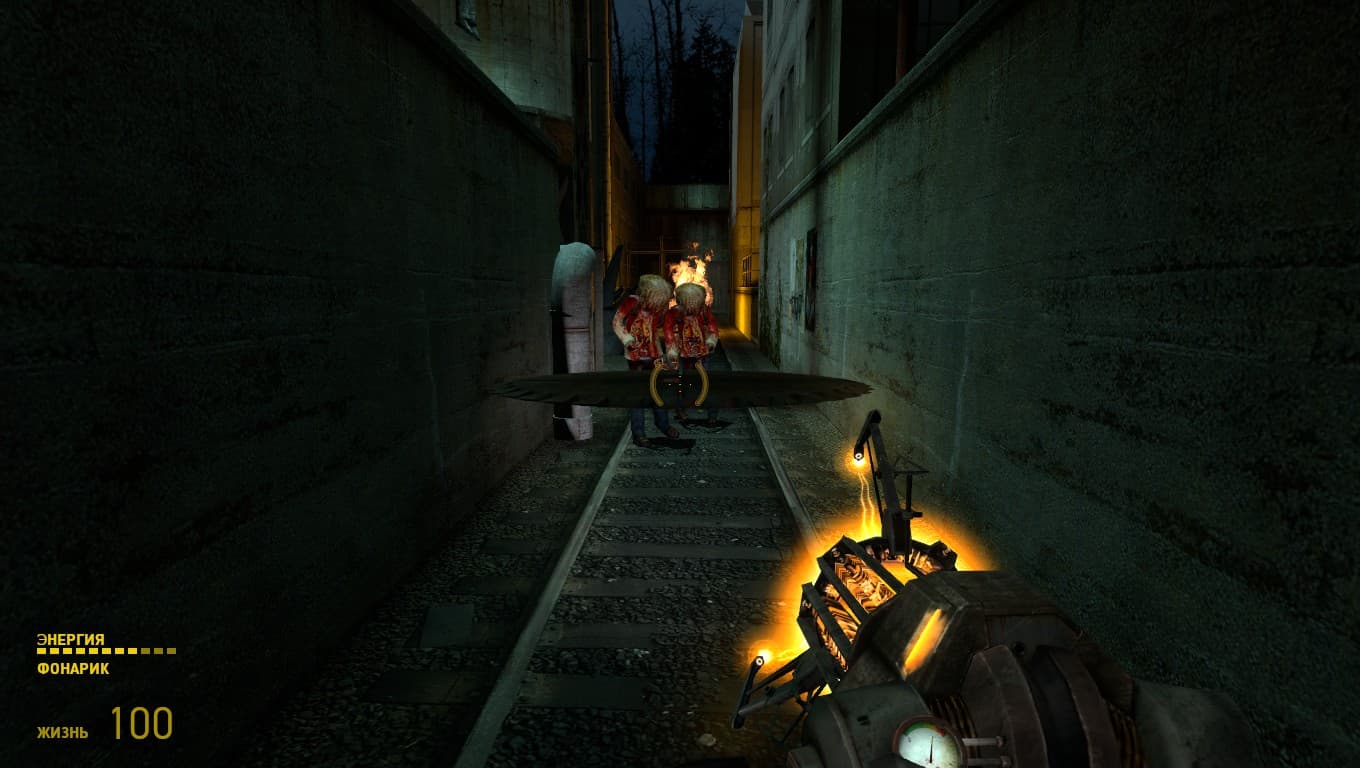
There are chapters with the feel of a rollicking action flick or a road movie, as well as levels built like puzzles. Traveling through the world of Half-Life 2, you constantly face new situations, are confronted with fresh challenges, and through small vignettes encountered along the way, an astonishing sci-fi novel unfolds that is impossible to put down.
Only by experiencing everything from start to finish—through various trials and emotional journeys—does one realize that the plot of Half-Life 2 does not exist in isolation. Every chapter and every event is crafted so that gameplay enhances the story’s impressions, drawing the player even deeper into the atmosphere of this unique world.
Gameplay
Shooter
Half-Life 2 technically belongs to the first-person shooter genre. The game features all the standard hallmarks of the genre: gun combat and a first-person perspective letting the player view the world through the protagonist’s eyes. However, upon closer inspection, it becomes clear that shooter elements are just one component of the game. In fact, many players consider this part far from its strongest aspect. Some claim: “it just doesn’t feel right.”
Feelings about gameplay are subjective, as game perception hinges on player experience and expectations. Perhaps by modern standards, the gunplay mechanics feel somewhat dated and simplified. While preparing this article, my daughter, watching the playthrough with keen interest, asked: “Dad, don’t you know how to play shooters? Why aren’t you aiming down sights with the right mouse button instead of hip-firing?” I had to explain to the young gamer that Half-Life 2 simply lacked that feature, which gained widespread adoption later thanks to the popularity of the Call of Duty series.
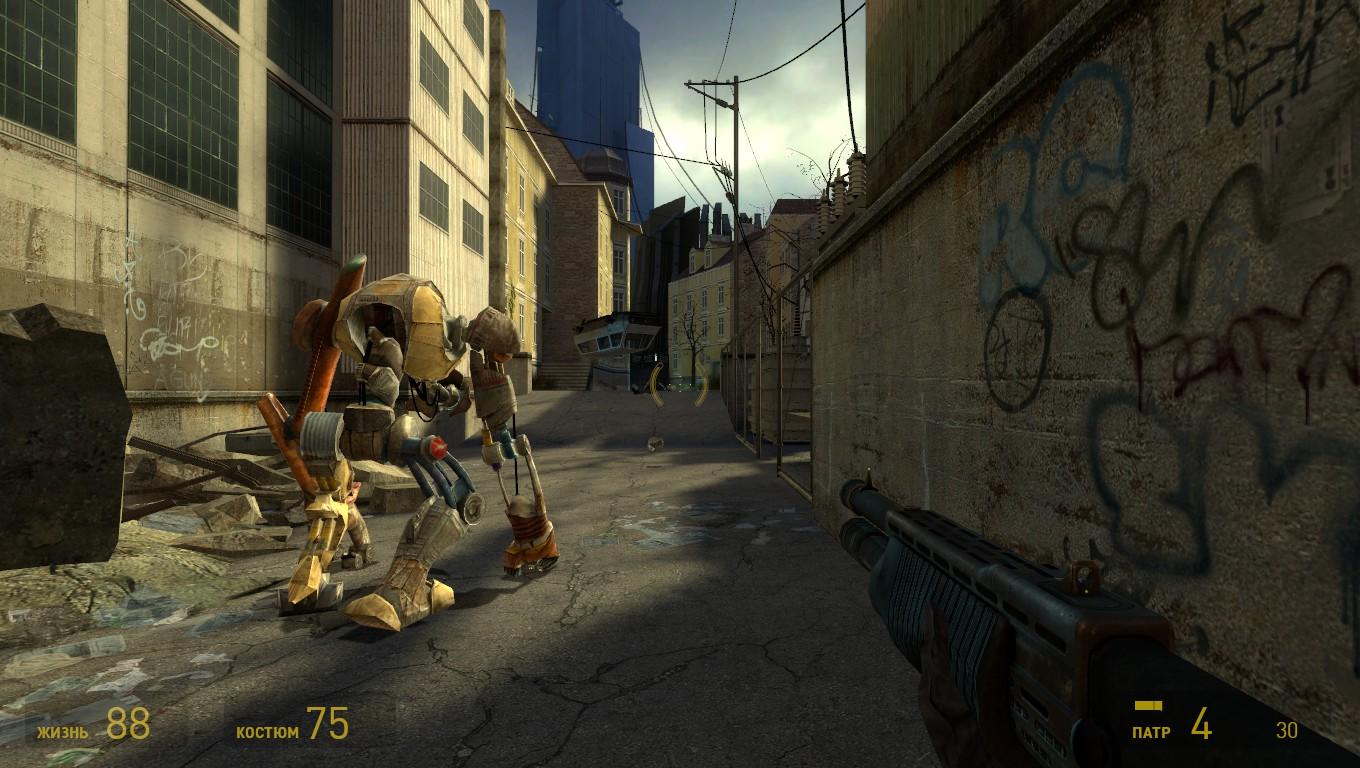
The game lacks weapon progression systems or the ability to attach modifications, like attachments to improve stats. Instead, the player receives a fixed arsenal that gradually expands over the course of the campaign. This approach adds challenge and intrigue, requiring adaptation to the quirks of each new weapon type.
When picking up a new weapon for the first time, the player must adjust to its distinct traits, factoring in parameters such as effective range, firepower, and reload speed. This helps avoid situations where “bullets fly everywhere without hitting anything.” Such an approach makes the game more tactical, forcing the player to choose the right weapon for each specific encounter. As mastery develops, there is real satisfaction in knowing that success depends on player skill rather than weapon upgrades.
For 2004, Half-Life 2 was thoroughly modern. The player had a choice of several weapon types: pistols, submachine guns, shotguns, rocket launchers, and grenades. At times, one had to use stationary turrets or vehicle weapons in combat.
It is important to note that Valve released popular multiplayer shooters on the Half-Life engine, such as Counter-Strike and Counter-Strike: Source. These titles can hardly be called mediocre, confirming the developers’ high level of craftsmanship. The shooting mechanics in Half-Life 2 differed from other 2004 games, such as Doom 3. This was likely a deliberate decision by the developers, allowing them to attract not only traditional shooter fans, but also players looking for a more varied and profound gaming experience.
The Gravity Gun deserves special mention. Introduced for the first time in Half-Life 2, it proved such a successful concept that it was later adopted in numerous other projects. This tool served not only as a formidable weapon, but was also actively used to solve puzzles and navigate obstacles.
The Gravity Gun’s operating principle is simple: it allows pulling objects toward the player and then launching them with immense force. It could be used to hurl a wide variety of items, from paint cans to dumpsters. However, circular saw blades or energy spheres dealt the greatest damage. Few enemies could survive such a blow. This unique feature made the Gravity Gun one of the game’s most memorable elements.
Puzzles
Both episodes of Half-Life 2 made history in the gaming industry by significantly expanding the boundaries of the shooter genre, adding not only a well-developed story, but also puzzle elements. The developers at Valve possess a keen knack for designing such mechanics, as brilliantly demonstrated by the 2007 release of Portal—one of the greatest puzzle games of all time.
Although the puzzles in Half-Life 2 are not as complex as those in Portal, the solutions to some are not immediately obvious and require careful attention. The developers do not hold your hand: in levels, it is not always clear right away how to proceed, even when it is obvious where you need to go. At times, this can be frustrating, such as when wandering around an enclosed space for ten minutes trying in vain to find the solution. The game provides no hints, so in moments like these it is best to take a break, step away, and return with a fresh perspective. It is precisely those sudden flashes of insight that bring genuine satisfaction, turning the playthrough into a true adventure.
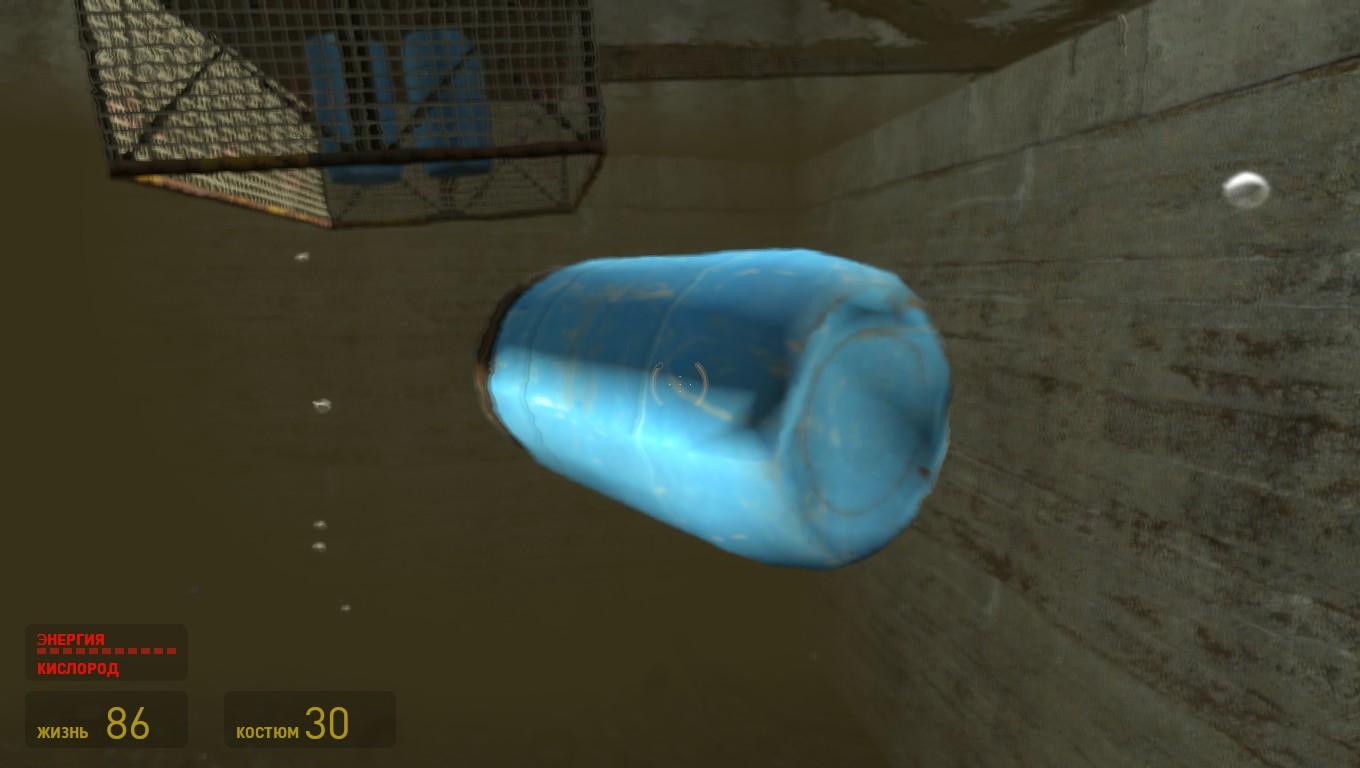
Puzzles solved with the Gravity Gun or using physical principles stand out in particular. Valve licensed the Havok physics engine, first introduced in 2000, and successfully integrated it into Steam. Perhaps in no other mainstream game has a physics engine been utilized as skillfully as in Half-Life 2.
Some of the game’s puzzles could serve as ideal visual aids in physics classes due to the realism of object interactions. Principles such as buoyant force (Archimedes' principle), gravity, and the use of levers and pulleys are all at play. Even 20 years after release, these puzzles feel fresh and innovative. To this day, few in the gaming industry have managed to reach such a level of physics implementation.
Vehicles
Over the course of Half-Life 2, the player drives vehicles twice. First, Gordon Freeman escapes City 17 via the canals on an airboat catamaran, and later returns to the city along Highway 17 behind the wheel of a buggy. These chapters could have been merely interesting gameplay variations had the Valve team not approached them with exceptional ingenuity.
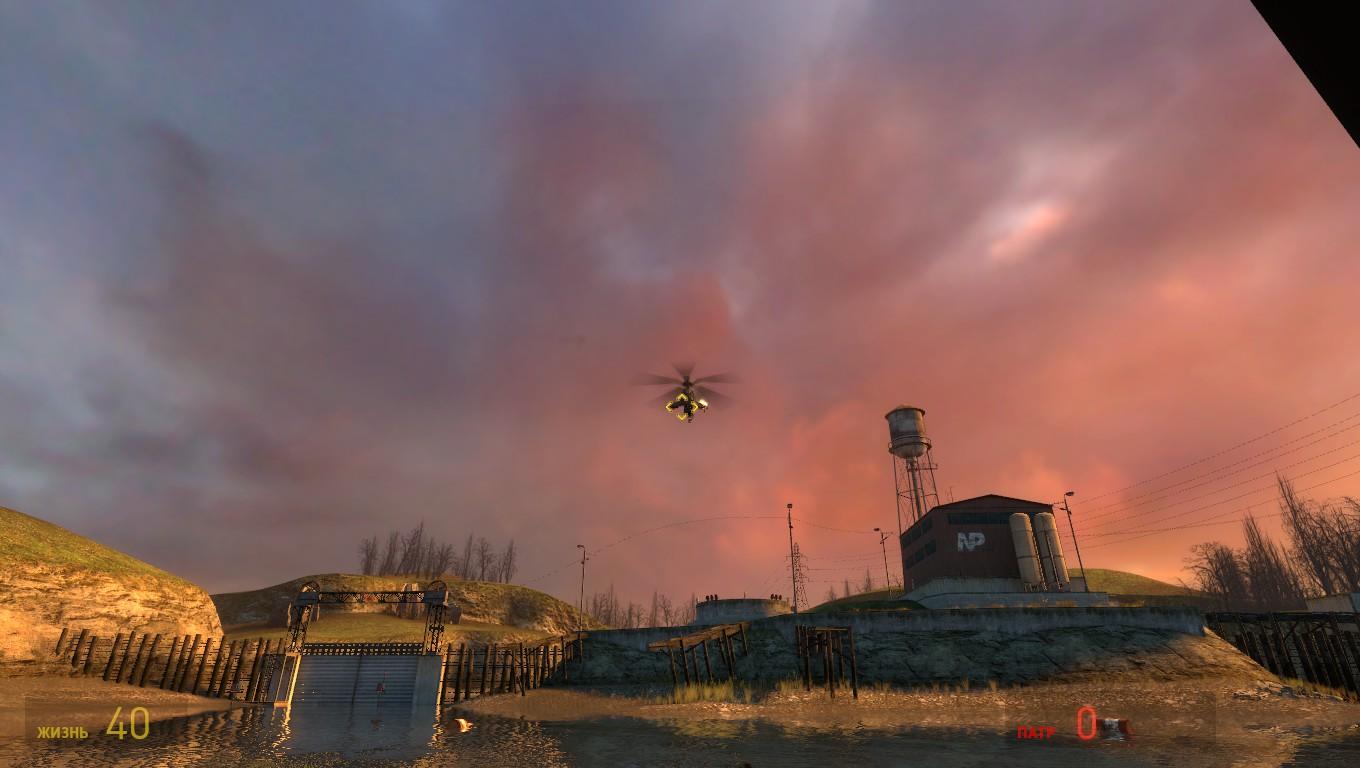
During the canal journey, the player is pursued by a helicopter—a powerful and dangerous adversary. Skillful airboat handling becomes key to survival for both the player and Gordon Freeman. Even on easy and normal difficulties, Half-Life 2 does not allow you to let your guard down. By the end of this chapter, hatred for the enemy chopper reaches its peak. Mounting a powerful weapon onto the airboat turns the final encounter into a climax where the player enters a duel fully fueled with determination to win.
The airboat duel with the helicopter is one of the game’s finest moments, unfolding in a picturesque arena bathed in sunset light.
The buggy ride may not elicit emotions as intense as piloting the airboat, but it remains memorable thanks to original gameplay sequences. Particularly memorable are moments when the buggy alternates between carrying the player and needing to be transported itself. You constantly have to clear the road using the Gravity Gun, and if the vehicle flips on a sharp turn, it must be righted using that very same gun. This adds entertaining nuances to the gameplay.
Such seemingly minor details highlight how meticulously Valve’s developers considered every part of the game, turning standard gameplay elements into unforgettable adventures.
Technology
Even in 2024, Half-Life 2 does not appear archaic. Of course, textures could be more detailed and varied, and models could use higher polygon counts. Facial animation already pales in comparison to modern top-tier projects. Yet thanks to outstanding work by artists and designers, the game still looks respectable even 20 years later.
The history of the engine behind the game begins with the original Quake. By the time the first Half-Life launched in 1998, programmers had overhauled the engine substantially. When developing the sequel, Valve considered licensing the id Tech 3 engine (Quake III), but it soon became clear that it did not meet their needs. By 2004, at the time of Half-Life 2’s release, the company had developed its own fully fledged engine—Source.
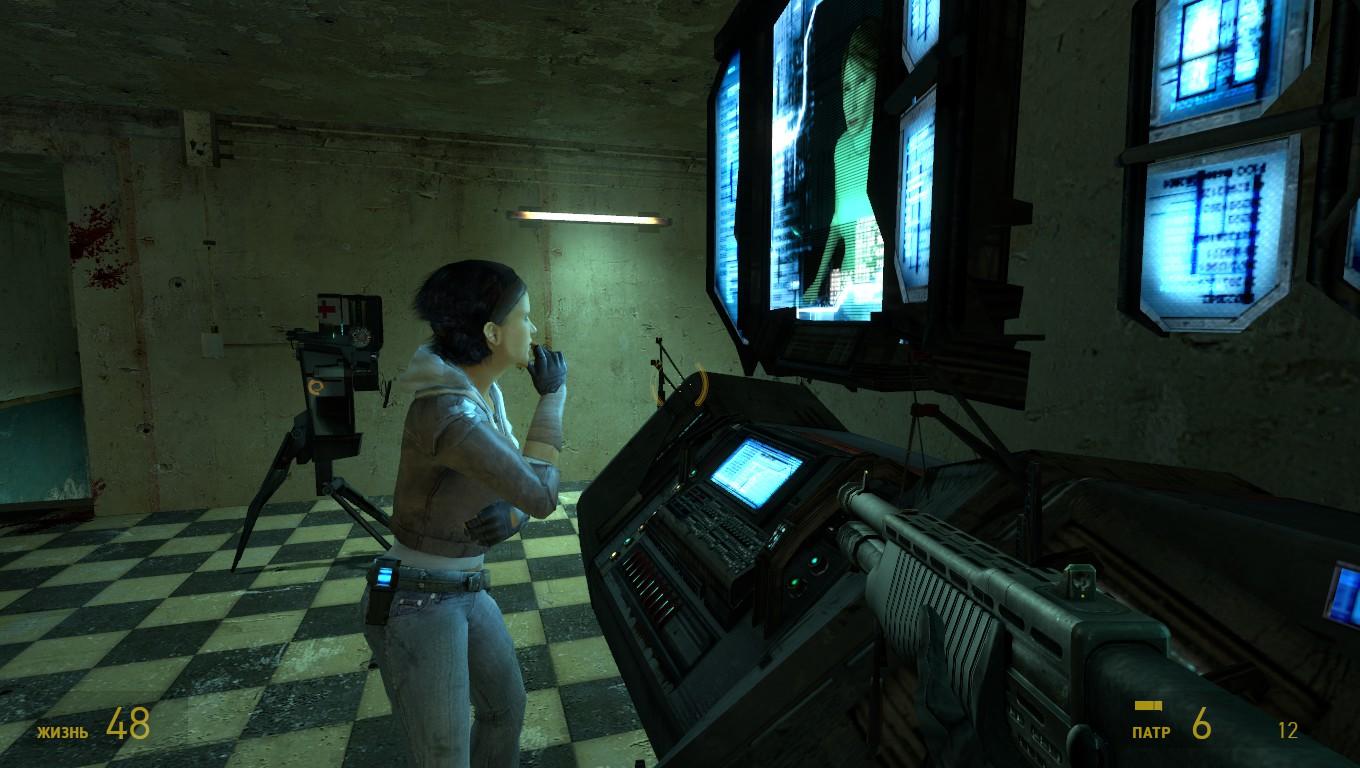
At the time of release, the Source engine surpassed competitors in several respects while matching or only slightly trailing in others. For example, it featured realistic facial and skeletal animation, enabling complex choreographed sequences. A modified version of the Havok physics engine allowed for engaging puzzles and showcased interactivity and partial destructibility out of reach for many modern big-budget titles.
The engine’s limitations were cleverly concealed by smart design choices. The game features almost no large open spaces. Half-Life 2 is a corridor shooter, with those corridors often being quite narrow. However, this is not conspicuous. The writers place the protagonist in situations where he must run through tight passages or move along a shoreline. The world surrounding these corridors is far from static. We hear various events unfolding: a helicopter approaching, or an armored personnel carrier pulling up on the embankment above the canal, deploying enemies with whom we engage in combat. It is striking how simple solutions can reshape how a game is perceived.
Analysis
In an article from the 2000s dedicated to Half-Life 2, Gabe Newell is quoted as saying: “Why spend four years of your life making something that isn’t innovative and is essentially pointless?” These words, in my view, best capture the mindset with which Valve approached the game’s development.
This principle extends beyond the technical side of the project to every facet of Half-Life 2. There is arguably not a single element that Valve’s team did not think through down to the smallest detail: be it the narrative, characters, or gameplay—all of it was executed at the highest technical standard, delivering a genuinely innovative product so ahead of its time that projects like it remain rare today. The exceptions only prove Half-Life 2’s uniqueness.
It is worth emphasizing that such meticulous craftsmanship demands not just time and significant financial investment, but also monumental effort, with no guarantees of success. During the development of Half-Life 2, Valve was a team of like-minded partners striving to create something meaningful, to leave their mark on history. And they succeeded.
Similar studios exist today. Take Larian, for example, who released Baldur’s Gate III. Yet such teams are becoming fewer. They rarely withstand the temptation of being absorbed into a major corporation for the sake of apparent comfort and stability. The reality, however, turns out to be far less rosy.
Today, numerous reports emerge from Western studios detailing grueling working conditions, poor compensation, and toxic workplace environments. The leadership of publicly traded gaming corporations focuses on market capitalization, mergers, and acquisitions, as well as hunting for successful projects and studios that can be bought on the cheap. Press releases are rife with empty promises and grandiose claims.
One gets the feeling that creativity and the pursuit of excellence have died within corporations. What the modern Western industry has excelled at, unlike “grandpa” Gabe Newell, is churning out useless products that consume far more than the four years spent developing Half-Life 2.
* * *
All image rights in this article belong to Valve.
Never miss our newsAdd this site to your preferred sources to see us more oftenAdd on Google