Arknights: Endfield Review. Anime Factorio Versus Routine
Translated with AI from the Russian original.
Arknights: Endfield stays afloat thanks to one brilliant decision - logistics and production in the spirit of Factorio. Electrifying alien wastelands, building chains, and optimizing infrastructure here turns out to be far more interesting than taking part in prolonged battles against yet another wave of enemies. This is what makes the game stand out from other formulaic gacha projects.
Story and World-Building
Arknights: Endfield begins with the protagonist, Endmin, being pulled out of an otherworldly space and returned to Talos II, a planet being developed by the company Endfield. Endmin himself once stood at its origins, so when he meets the company employees, they express intense excitement that he cannot share: years beyond reality have stripped him of his memory.
Further events unfold on the same Talos II, where the interests of many factions intersect. Endfield is only one of them, though one of the most influential. Not everyone accepts its vision of the planet's future, and it is around this conflict that the main plot is built.
The premise does not claim originality, but it has potential. Different factions, an exoplanet, many characters — there is more than enough material for development. Although Arknights is a gacha game, and that means the story faces constraints such as a seasonal structure and the need to introduce new heroes with every update, even within such limits it is possible to create an interesting narrative. Of course, not on the level of Mass Effect 2 or Cyberpunk 2077 — no one expects that from an action RPG or a jRPG. A compelling story in the spirit of Final Fantasy or the Tales series would be quite enough.
Unfortunately, Arknights: Endfield does not reach even that level. The plot of the main and side quests — not to mention the daily assignments — remains purely functional. Its task is to move the heroes from point A to point B, deliver yet another batch of dull dialogue, invite you to solve a puzzle or fight some enemies. There are no moral dilemmas, no ambiguous decisions here. There are no lively, memorable dialogues either. At the same time, there is formally a lot of content — reading all the text will take quite a bit of time. It is completely unclear why.

This is an unfortunate misstep by the developers, because the world of Arknights: Endfield turned out to be fairly appealing and believable. Although the genre is presented as "science fiction," the word "science" should not be taken too literally — the game is much closer to military sci-fi, and at times even fantasy in the trappings of future technology. Nevertheless, the world as a whole looks convincing.
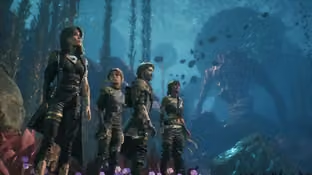
Surprisingly, the style of the original Arknights has been preserved organically despite the genre shift. The events of the games take place in the same universe — and that is palpable. Even when the sun shines over the world, the color palette remains cold, and the atmosphere — slightly gloomy. Production complexes, as in reality, look monumental: they inspire awe with their thought-out design, but at the same time are slightly intimidating in their scale.
Perhaps the mood will change as the game develops, but for now everything is handled with extreme care: style, atmosphere, character design — all elements work in the same vein.

The world itself in the game is semi-open, — with a hint of openness. It is divided into large locations connected by long and narrow "corridors." Each zone looks distinct and follows its own level-design logic: the central plains are built up with industrial complexes, a deep quarry is organized around a giant crane that allows movement between its tiers, and the mines form tangled labyrinths where the way forward is not always obvious. And while the world looks convincing visually, interest in exploring it depends directly on how well thought-out and engaging the gameplay is.
Gameplay
In gameplay terms, the developers managed to surprise. Open-world or semi-open-world action RPGs traditionally rest on two pillars — combat systems and world exploration. But Arknights: Endfield adds a third element to them — the construction of production complexes in the spirit of Factorio or, given the game's genre affiliation, Dyson Sphere Program. Let us begin with this mechanic.
The scale of automated production complexes in Arknights, of course, cannot compare with games built entirely around such systems, but that is not required here. In Endfield they are only one element of the gameplay, but one implemented with real care.
Each large location includes a separate zone for building a complex. The location itself contains resource extraction sites — primarily ore. It is mined, sent for processing to the complex's workshops, and eventually yields finished products — from enriched and crushed ore to deeply processed goods, including medical supplies, energy sources, or materials for crafting equipment. Most of the finished products are sold to local residents, and the currency earned is directed toward further character and infrastructure development.

You can tinker with production chains for a long time and with great pleasure, trying to use limited space as efficiently as possible and build a stable cycle from extraction to end product. For those who do not enjoy this kind of element, there are ready-made blueprints: just apply a template and the complex works autonomously — all that remains is to collect finished resources from time to time. And for maximum efficiency, special codes let you load blueprints from true Excel spreadsheet gurus, gaining access to the most efficient "factory" at every stage of progression.
But the production mechanic gives the game more than just an extra gameplay layer. In projects like this, game worlds traditionally remain static: life within them is concentrated only where the player is, while the landscape itself barely changes as you move toward the finale. Only a few games allow you to directly intervene in the environment, transforming a wasteland into something new and functional. In such moments you feel like a demiurge — fans of Minecraft, Terraria, or that same Factorio will understand me perfectly.
In Arknights: Endfield this also works, albeit on a more modest scale. Step by step, we change individual parts of the planet and make them suitable for the lives of local inhabitants. These changes are not global, but they are tangible: the world ceases to be a static backdrop. Even in unchangeable territories, you can leave a mark — lay power lines or deploy a transport network to move more quickly between points.
Moreover, in this world you are not alone. Other players share their structures — defensive fortifications and transport hubs — and they appear right on your map. This is how the asymmetric multiplayer works, echoing ideas once promoted by Hideo Kojima in Death Stranding.
As for the traditional components — exploration and combat — Arknights: Endfield handles them competently, but they are barely memorable. There is a feeling that the developers lacked either the skill, or the time, or the desire to fully polish these mechanics. If you compare each element with its counterparts from other games, you notice rough edges, missed opportunities, and straightforward borrowings.
The puzzles, for example, are simple and repetitive and migrate from one location to another: you need to arrange figures in a "Tetris" style so that the colored cells vertically and horizontally match the given numbers, or find three "lights" within a ten-meter radius to open a chest. Complex and expressive spatial puzzles where different mechanics work together are hardly encountered. Rare hints at them usually end with needing to turn the correct generator on or off. Yes, they have not become worse than in other projects — but no step forward has been made here either.
Exploration of locations quickly devolves into banal area sweeping. Some quests force you to return to the same sections several times: a large outpost on the central plain, for example, has to be cleared three times — first during free exploration, then twice more in different quests. You can write this off as a gameplay convention, but the impression remains unpleasant. In general, exploring the world is not boring, but it does not produce any wow effect: everything is familiar and predictable — vacuum up resources, clear outposts.

The combat system as a whole is built logically, but the pacing is weak. It is not difficult to learn. The game greets you with familiar operator roles (damage, tank, support), elemental interactions (fire, ice, and so on), as well as interesting techniques such as character combos. However, battles unfold slowly — the operators themselves are unhurried, and the enemies are also excessively durable. During exploration this is still tolerable, but during grinding it quickly turns into torture.
The developers tried to compensate for the lack of real dynamism with special effects. As a result, combat scenes quickly turn into visual mush on the screen: it is hard to make out what exactly is happening, but everything is constantly flashing and burning.
Grinding is a separate issue. Why spend time on monotonous and drawn-out fights for resource farming when you can fuss with an APC or a farm instead (yes, there is one too)? The main problem here is the length of battles: even six-star, well-developed operators take one and a half to two minutes to deal with enemies in dungeons. That is a long time! And until your energy runs out, you have to repeat it again and again. Every day.
This grind becomes exhausting after just a few dozen hours spent in Arknights: Endfield after release. And what will happen in a month? In a year? This is, after all, a long-running project. One might object that competitors are built the same way. But not quite.
Comparison with Competitors
Just five years ago, Arknights: Endfield simply would not have had any competitors in the mobile market. But Genshin Impact changed the rules of the game. And today GI still remains relevant, even if the finale of its main story arc is already close. In that time, HoYoverse released Honkai: Star Rail and Zenless Zone Zero; there were also successful attempts to copy the Genshin formula — such as Wuthering Waves — and failed ones, like Tower of Fantasy. Not to mention dozens of derivative projects in the Genshin "style" with auto-battles, auto-running, and other simplifications.
Against this backdrop, Arknights: Endfield looks not just decent but genuinely good, — though largely thanks to its key finding: the construction of little "factories." In other respects, the game has problems.

The pace of battles in Endfield, for example, looks simply "nonexistent" against Zenless Zone Zero. In ZZZ, a group of fighters dismantles a pack of ordinary enemies in a matter of seconds, or at worst a couple of dozen. Two or three minutes there are reserved for bosses at most. Compared with Endfield, it is night and day. Wuthering Waves also feels noticeably more dynamic. In Genshin Impact, the average tempo is comparable to Endfield, but with proper use of elemental reactions, battles end much faster.
But in Endfield you have to spend a long time whittling enemies down with "clubs in the form of swords" (no blood or dismemberment — you simply beat opponents with big metal cudgels). Yes, this is a gameplay convention, but if the fights moved faster, it probably would not stand out so much.
Exploration and puzzles in Genshin Impact are a separate form of art. Some quest puzzles unfold across vast spaces and force you to think, fight, and literally search for the solution "with your feet" at the same time. In Honkai: Star Rail, the developers work skillfully with puzzles, using not only space but also time — and that is exactly how they achieve the wow effect. Offering players "Tetris" in 2026? Even the primitive rhythm minigame with instrument repair in Zenless Zone Zero looks more interesting.
We will not separately criticize the story in comparison with competitors. Lately, just about everyone has managed to fail in this field. If HoYoverse projects really did stand out at launch with dense and engaging stories, now, working on an assembly line, practically all competitors deliver the same average level of narrative — right down to borrowing individual story arcs from one game to another and back again.

One might get the impression that Arknights: Endfield is not the most successful game, carried only by an unusual combination of genres. But that is not entirely true. Of course, if you break down the individual elements, other projects will surpass it here and there. However, a game is not a set of disconnected mechanics, but their combination. And although some elements in Endfield are implemented more weakly, that does not make them bad in themselves. Taken together, they form the image of a pleasant game that is enjoyable and interesting to play — despite all its shortcomings.
Besides, unlike many modern Western games, Endfield launches not as a minimally viable product, or MVP, but as a full release with several dozen hours of content — including main and side quests. And all of it works at a respectable technical level.
Technical Condition
The game delivers a good level of graphics by smartphone standards. Unfortunately, that comes at a price: on an inexpensive budget phone, you most likely will not be able to play Arknights: Endfield. A smartphone with Snapdragon 778G can handle the project only on minimum settings, even though the device had no trouble with other mobile games. At the same time, Endfield does not burn through the battery or turn the smartphone into a space heater the way Wuthering Waves once did.
Editor's note. I launched Endfield on a regular budget smartphone and, contrary to my fears, was pleased with the optimization. A conventional "best bang for your buck" model like the Poco X7 Pro already lets you run the game at maximum or near-maximum settings with 60 frames per second — without the feeling that you are holding a red-hot frying pan.
The game's sound and music are present — and that is about all that can be said. There are no memorable moments here. It is doubtful that we will ever hear in Arknights: Endfield a soundtrack on the level of Genshin Impact or Honkai: Star Rail.
On Android, throughout the entire testing period there were almost no crashes or connection issues — only isolated cases, and even those could not be confidently linked to the game itself. Perhaps the cause was external factors, such as connection quality or background processes.
Verdict
Arknights: Endfield offers an intriguing hybrid of action combat and logistics in the spirit of Factorio. This combination is where the project's main value lies: production complexes do not function as a decorative "gimmick," but as a well-thought-out gameplay element that provides a sense of creation rare for the genre.
The world is sustained in the franchise's recognizable slightly gloomy aesthetic, the project is technically stable, and at release it offers dozens of hours of content without feeling unfinished.
However, behind this foundation lie systemic problems that begin to irritate over time: drawn-out battles, primitive puzzles, exploration reduced to mechanically sweeping locations, and a plot that serves only as a formal excuse for moving between points.
The gacha mechanic also deserves separate mention. The chase for rare operators can be expensive — especially for players prone to impulsive spending. If you notice problems controlling your expenses, it is better to stay away from the game.
Nevertheless, Arknights: Endfield is a worthy project capable of captivating players for a long time. What saves it is that it does not try to copy the HoYoverse formula verbatim. Its unique construction mechanic sets its own rhythm and motivation, different from endless farming. One should not expect a breakthrough in narrative or combat from Endfield. But as a balanced hybrid, the project deserves attention.
The main question is longevity: will the game withstand a year of routine grinding, or will the novelty effect of the production complexes dissolve into the monotony of daily tasks. For now, Arknights: Endfield is an appealing, occasionally messy, but honest game. For the mobile market of early 2026, that is enough. Whether it will still be enough by the end of the year, when new major projects may enter the market, time will tell.
Pro
- A combination of action combat and the construction of production complexes in the spirit of Factorio;
- A sense of being a "demiurge" — the ability to transform local sections of the world by laying infrastructure;
- Asymmetric multiplayer with other players' structures on your map;
- The consistent style of the Arknights universe;
- Dozens of hours of content at release without a sense of incompleteness in a free-to-play game;
- Stable technical execution.
Contra
- Manipulative gacha mechanics;
- Drawn-out battles — low dynamism and "thick-skinned" enemies;
- Primitive puzzles;
- Mechanical exploration of locations;
- Functional plot and weak dialogue;
- Relatively high demands on mobile hardware.
Never miss our newsAdd this site to your preferred sources to see us more oftenAdd on Google