Dreaming on the Road to Hell. Review of the anime "Cyberpunk: Edgerunners"
Translated with AI from the Russian original.
"Cyberpunks are known not for their quiet lives, but for their death in the spotlight." Three years ago, Studio Trigger unleashed its entire arsenal of signature style and neon palette on viewers - and showed in practice what this phrase means. On September 13, 2022, the anime "Cyberpunk: Edgerunners" was released on Netflix, and we still haven't given it its due. Today, we are correcting this injustice - returning the debt to a cruel, but in its own way beautiful story about where dreams lead in Night City.
Welcome to Night City
The events of "Cyberpunk: Edgerunners" unfold a year before the plot of Cyberpunk 2077 from CD Projekt RED, in a shared universe created by Mike Pondsmith. We find ourselves again in Night City - a metropolis drowned in corruption, banditry, debauchery, and obsession with cyber implants.
But, with the exception of a couple of cameos and a generous seasoning of fan service, there is almost no direct connection between the projects. Therefore, you can get acquainted with them in any order: the anime works as a standalone story, even if you have never been to this city before.
The main character is a teenager from the poor district of Santo Domingo, David Martinez. He studies at the prestigious academy of the "Arasaka" corporation - one of the six megacorps that hold the city in an iron fist. David was able to get there only thanks to the superhuman efforts of his mother, Gloria, who works in three shifts to give her son a chance to escape poverty.
David manages to show good results, but his life is still full of hardships: due to poverty, he uses pirated software, earns extra money by selling illegal braindances with the deaths of cyberpsychos, and endures taunts from wealthy classmates.
But in Night City, dreams collapse in an instant. A tragic accident takes Gloria's life, depriving her son of his last support and hope.

Left alone with the ruthless reality, David takes a desperate step - implants the "Sandevistan" military implant into his body, granting superhuman speed and reaction. His extraordinary resistance to stress attracts the attention of "Arasaka."
But this implant also has an owner on the streets: the leader of a gang of cyberpunks with whom Gloria collaborated. Learning about her death, he takes the young man under his wing. Thus begins David's path into the criminal underworld, where yesterday's schoolboy tries to survive and find his place in the sun.
Despite the familiar motif of the "chosen" teenager who has embarked on a slippery path, this story is devoid of heroic pathos. Against the backdrop of a shining, high-tech future, a tragedy unfolds of a small person who is pushed to the edge by monstrous social inequality.
Everything is according to the canons of the cyberpunk genre: high tech, low life - the highest technologies against the backdrop of a negligible quality of life. Night City beckons with neon lights, but behind this facade yawns an abyss, where it is easy to fall if you are "running on the edge."

Balance on the Edge
The story in "Edgerunners" also balances on the edge - between dizzying action and personal drama. At first glance, it may seem that the series relies on shootouts, hyperviolence, and outrageous scenes - fortunately, the 18+ rating allows the authors not to be shy: here are beautiful female forms, perversions of all kinds, and exploding heads with torn limbs almost every few minutes.
But at the center of the narrative is still the story of David - a teenager burdened by the past, who, trying to find himself, goes through a series of trials to prove his right to life. He is vulnerable, loses his bearings, and gradually ceases to be himself, clinging to other people's dreams and ideas about life.
Sometimes the pace seems uneven: the timeskip in the middle of the season emphasizes the changes in the characters, but they are shown more in jerks than in gradual development. Perhaps I would like more attention to detail, but globally the central idea is clearly built and brought to an end.

And yet, behind this darkness, the authors leave the viewer with hope. In a world where chrome and money rule, only connections between people have value. Love, friendship, loyalty - simple, almost banal things, but they are what keep a person from finally falling into the abyss. And although David embarks on a criminal path, in his soul he remains a simple boy, through whom a whole gallery of bright characters is revealed, who have become a real decoration of the series.
Lucy is a first-class netrunner, whose skills were born from a difficult past in captivity at "Arasaka". On the outside, she is cold and independent, but getting to know David allows her to open up. In him, she sees a kindred spirit, the same fugitive dreaming of freedom.
Their relationship makes her vulnerable, but it is they who become the heart of the story - the last spark of warmth in a ruthless city. This spark, in turn, feeds David himself, preventing him from finally falling into the abyss.

Among the other members of the gang, its leader stands out - Maine. For David, he quickly turns not just into a "boss", but into a foster father and mentor. But at the same time, Maine is a living warning about where running on the edge leads. All his life he has strived to break through higher and for this he implanted more and more new implants into his body.
Each modification made him stronger, but at the same time distanced him from himself, pushing him towards cyberpsychosis. In David's eyes, Maine is both a role model and an ominous shadow of the future that awaits any cyberpunk who has exchanged his soul for chrome.

Let's not forget (and this is impossible) the fan favorite - Rebecca, a concentrate of madness and energy of chaos with poisonous green hair, like a living zombie. She loves selected profanity and big guns, which sharply contrasts with her miniature figure.
Rebecca has the same crazy brother Pilar with cybernetic and overly mischievous hands, but his story is cut short stupidly and rapidly - as it should be in Night City. After that, she transfers all her care and devotion to David, although he does not reciprocate, being completely absorbed in Lucy.
It is rumored that CDPR was initially against such a caricatured "anime" character, but Trigger insisted on its own - and as a result, Rebecca became one of the brightest and most beloved heroines of the series.

Among the other participants are Dorio, Maine's partner and lover, perhaps the most "empty" character in the story; Falco, the driver and almost the most "normal" person in this crazy city; and Kiwi, a netrunner in a mask, hiding her true motives under it.
Separately, it is worth mentioning Faraday - a charismatic fixer, whose three cybernetic eyes reflect his multi-layered game. He negotiates with corporations, gives assignments to Maine's gang, and weaves his own intrigues, remaining an ally exactly as long as it is beneficial to him. This multi-eyedness directly symbolizes his duplicity (or even triplicity), making him one of the key figures in the story.

And, finally, the legendary Adam Smasher - a deadly machine of "Arasaka". In the anime, he appears much more powerful and intimidating than in the game: a cold and inevitable chrome "crusher", ready to wipe everything alive to dust on command. He seems to embody Night City itself - an indifferent titan, against which street legends seem like just grains of sand.
There are other images - ripper Doc, corporates, random residents of the streets. Most of them are schematic or caricatured, but together they form the very ensemble where brightness is more important than depth. All the necessary characters get their share of attention, and even purely functional figures are remembered - you unexpectedly feel sympathy for some.
It can't be otherwise in Night City. It is these people who create the colorful mosaic of the metropolis, which to some extent becomes the main character - a sparkling and alluring predator, ready to grind anyone who is too carried away by running on the edge.

Neon Monster
The creators meticulously and lovingly transferred Night City from the game to the screen: from the Arasaka Tower to Pacifica and the poor district of Santo Domingo. But this is not just a background - the city here acts as an independent antagonist. It tempts with freedom and glory, and then tramples hopes, turning them into blood and ashes.
Its cynical laws become the cause of Gloria's tragedy, whom the "Trauma Team" did not help due to lack of insurance, and it is they who push the heroes to ups and downs.
The concept of "gray morality" is especially clearly manifested in "Edgerunners": there is not a single unambiguously good character here. Even David's mother, who dreamed of a bright future for her son, is forced to make deals with bandits for this. And the city is also to blame for this, which pushes people to a choice without a choice.
Against this background, the contrast of the "grayness" of morality with the image of the city, emphasized by the visuals performed by Studio Trigger, is especially noticeable.

The character design here is beyond praise: each of the main and even secondary ones has details that immediately stick in the memory - whether it's Lucy's snow-white hair, David's yellow jacket, Kiwi's mask, or Pilar's cybernetic hands. That is why even the most functional figures are able to be remembered - if not by character, then at least by image.
Each action scene is a riot of colors, chaotic, but at the same time verified camera movement and a burst of adrenaline. The series is not shy about hyperbolizing violence or showing the stratification of personality on the verge of cyberpsychosis, saturating each frame with tension. Shootouts and chases rivet attention, and the visualization of "Sandevistan" is simple, but effective: the world freezes while David glides through it at supersonic speed, leaving a glowing trail.

But along with this thorough study of the action, the studio had to save on the rest. City landscapes sometimes fall out of the general style, resembling processed screenshots from the game, although you can't accuse Trigger of directly using CGI - the picture still exudes style and does not look sterile, like many modern anime with 2D and 3D. Savings are also noticeable in the dialogues: the characters are often shown from the back or limited to a static plan with a voice-over. But you can't call it a minus - as soon as the action starts, the viewer without hesitation accepts this compromise.
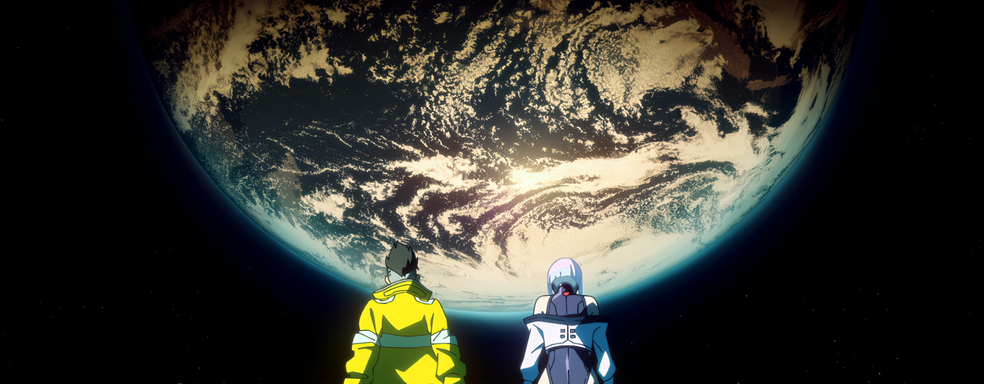
Nevertheless, even in quiet moments without action, the authors do not let go of the viewer's attention, creating enchanting scenes - most often romantic ones. What is the walk of David and Lucy on the Moon in braindance or their joint moment against the background of a rising rocket under the track Little Stranger by Dawid Podsiadło worth. This must be seen.
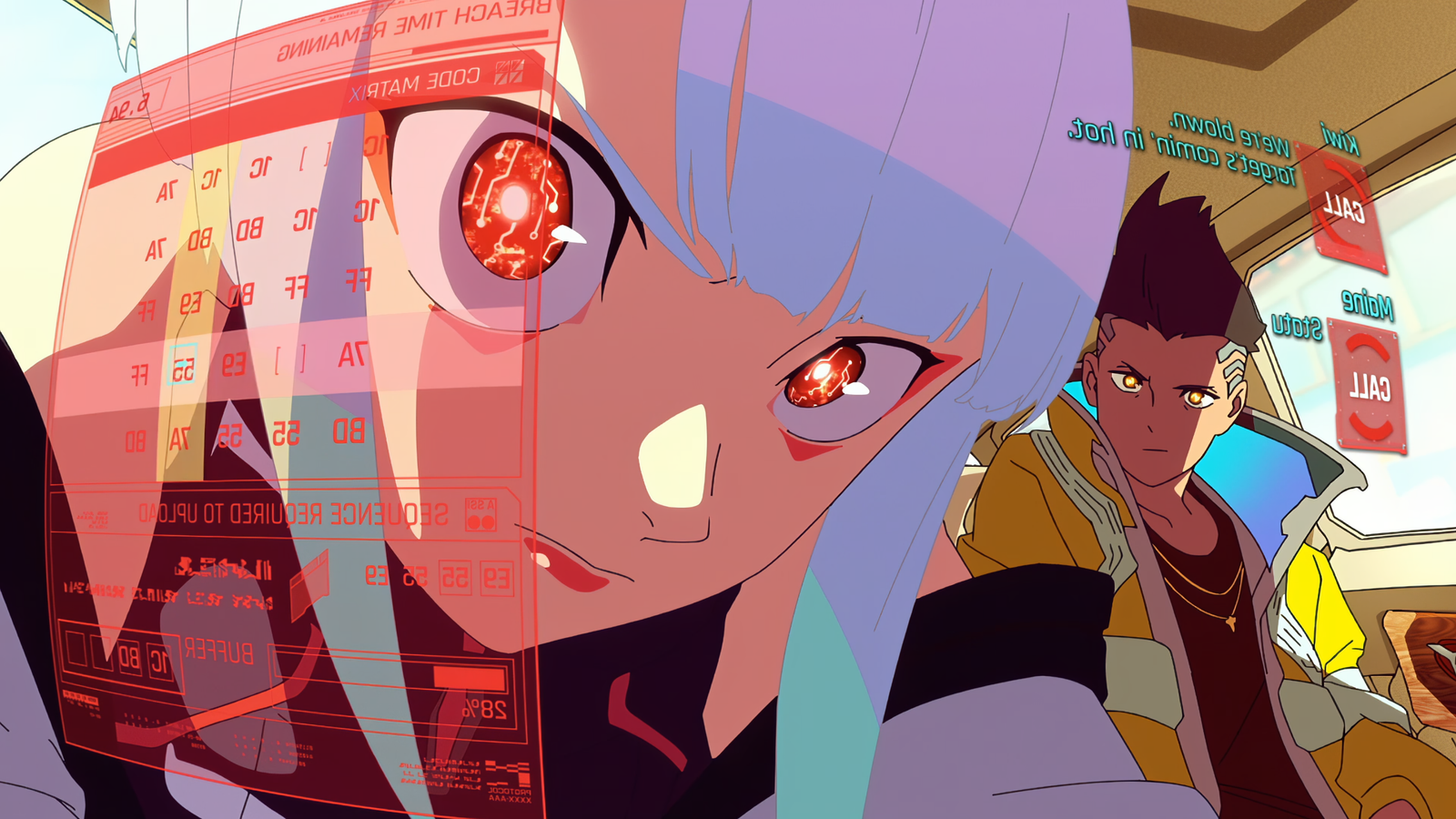
In addition, the series is replete with details, and fan service can be drawn here with spoons. Recognizable streets from Cyberpunk 2077, models of weapons and cars, advertising billboards, interfaces, in-game map and mini-game for hacking, familiar combat soundtrack - all this is organically built into the narrative and creates a feeling of a living, holistic unity of the animated and game world.
By the way, everything is in complete order with audio design here - Night City breathes and sounds juicy and plausible. But questions arise to the hyped participation of Akira Yamaoka. His contribution turned out to be rather symbolic: perhaps it was he who determined which tracks and at what moments should sound - and this is also important. But you will not hear Yamaoka's original compositions directly here.
But "Edgerunners" will introduce you to several songs that have become symbols of the series. The opening This Fffire by the British group Franz Ferdinand - a cheerful indie rock, whose chorus sounds like a warning and prediction, contrasts with the ending Let You Down by Dawid Podsiadło, perfectly picking up the bitter aftertaste after the series. And the final chord is I Really Want to Stay at Your House by Rosa Walton - a track that has turned into a real anthem of the relationship between David and Lucy and broke a lot of hearts, like the previously mentioned Little Stranger.
At first viewing, it may seem that some compositions do not always sound appropriate, entering into dissonance with what is happening on the screen. But over time you realize: this is done deliberately to emphasize contrasts and prepare the viewer for emotional shocks. And even knowing the ending, the story touches again, because, unlike cyberpsychos, the authors managed to carry the main thing to the last credits - humanity.

Diagnosis
Like many great cyberpunk stories, "Edgerunners" speaks to the viewer about the value of humanity in the face of ruthless progress. But it does this not through global metaphors or philosophical reasoning, but through a down-to-earth story of a small person who has encountered the system. The story of a kind of Icarus who flew too close to the sun.
Yes, the theme of "man versus machine" is not new here and is not revealed as deeply as in the classics of the genre. But the strength of "Edgerunners" is not in the originality of ideas, but in how they are presented: extremely frankly and emotionally, in the form that only animation is capable of. This is not reasoning about the fate of mankind, but the specific fates of specific people, whose dreams and feelings are ruthlessly torn apart by the city.
Three years later, "Edgerunners" is still one of the best game adaptations, albeit made more "based on". Of course, this is not a perfect work: it has a jerky pace, schematic characters, and compromises of animation. But all this is drowned in how alive and emotional experience this story gives. It reminds: even on the very edge, human connections and humanity matter. No matter how banal it sounds, it is such "banal" things that we most often forget.
Never miss our newsAdd this site to your preferred sources to see us more oftenAdd on Google