This Game Will Drive You Crazy. A Review of the Depressing NOT-Souls-like Hell is Us
Translated with AI from the Russian original.
The new project from Rogue Factor studio and Jonathan Jacques-Belletête - the man who defined the visual style of Deus Ex: Human Revolution and Mankind Divided - throws players into the heart of earthly hell, created by human hands. The game more than lives up to its name, but even before its release, it had already been labeled with many dubious tags - from "Souls-like" to "horror." In this review, we'll explore what this project really is and who should pay attention to it.
Hell is Us
The game takes place in 1993 in the fictional country of Hadea, which closed itself off from the outside world many years ago - for reasons that are revealed as the story progresses. For the past three years, a civil war has been raging between two groups - the Sabinians and the Palomists, sparked by religious differences. The main character, Remy Letam, was secretly taken out of the country as a child to give him a chance at a normal life. Years later, posing as a peacemaker, he returns to his homeland - in the midst of the fighting, hoping to find his long-lost parents.
Or rather, the player experiences Remy's memories - in the present, he is chained to a chair in an interrogation room, where he is being questioned by a strange creature resembling a hybrid of a "gray" alien and a regular at a roadside diner (you can imagine your favorite). The Executor injects Remy with truth serum - and we embark on a dark journey through the labyrinths of his memory.
Remy's homeland greets him not with maternal embraces, but with devastation and oppressive landscapes - the result of years of war. Everywhere there are ruins, burned houses, and car wrecks. Shell craters stand next to bodies abandoned on the roads and hanging on makeshift scaffolds. The developers do not hesitate to demonstrate the monstrous fruits of human hatred and ambition, generously doused in the blood of innocents.

Our first "acquaintance" is an elderly man who lost three children on the battlefields. And in one of the settlements, we meet a schoolteacher who just yesterday was helping to hang "infidel" Sabinians, and today she herself is a prisoner - with an unenviable fate, which is easy to guess from the chains by the bed and the scattered packages of rubber products No. 2.
And there is also a city where every resident has had their hand cut off. It's especially scary when children are among them. A chthonic sense of hopelessness permeates this world. Just seeing a small backpack lying near the swing - and the body of its owner a few meters away, hurrying home from school - sends shivers down your spine, even if the game timer has long passed twenty hours.
Hell is Us is full of such scenes: together with Remy, the player learns about the fates of ordinary people on both sides of the front. This is a world where morality has long ceased to be gray - and has acquired a shade of congealed blood, exposing the most terrible ideas about human cruelty. But the most terrible thing is that, thanks to the peculiarities of game design, which we will talk about a little later, it will not be possible to pass by. The developers seem to be telling you: "Go and see."

Bitter Lessons of History
The search for parents is only the first step to the ancient secrets of Hadea, without which the invasion of the Hollow Ones - the local "white walkers" - cannot be stopped. They appeared suddenly, just three weeks before our arrival, emerging from temporal loops where scenes of war crimes are played out again and again. The new danger did not help the warring factions unite, on the contrary - it became a convenient excuse to accuse each other of colluding with "demons" who came from outside. Of course, the main character, whose family is closely connected with the Order of Fola, which has been guarding the forbidden secrets of Hadea for centuries, will have to stop this madness.
Here I will slightly shatter possible expectations. If you expect a thorough, multi-layered plot from Hell is Us - there is a high chance of disappointment. There are only a few sentences, a handful of meager cutscenes, a couple of standard "plot twists" and an empty main character, weakly reacting to the horror around him. Even the efforts of Elias Toufexis, who gave him his voice, only occasionally give the image a shadow of emotion. In fairness, the authors explain the hero's emotional detachment in the plot - but this does not make him less boring.
The plot in Hell is Us serves primarily as a mandatory motivation: a pretext for immersion in the hell created by people, and acquaintance with the history of the fictional state... for a couple of thousand years with a tail, albeit fragmentarily. No, this is not a joke. The game allows you to feel like a real Doctor Jones - only instead of crystal skulls, you will find real ones, and instead of shining treasures - children's shoes. Unworn. Exploration here becomes the cornerstone of the gaming experience, and in terms of the amount of texts, notes and lore, Hell is Us will easily outshine the conditional Dark Souls and Silent Hill combined.

The lore and stories of other people, and not the main character himself, become the real motivation for exploring the world - and the entire design of Hell is Us is built on this aspect. There is no map, no route tracking, no familiar quest markers, witcher sense and other delights of modern games - only an ordinary compass to navigate the cardinal directions. The game fundamentally refuses to lead the player by the hand, relying only on his attentiveness. NPCs give only hints, directions or visual landmarks, and then everything depends on your memory and observation.
For example, a grieving father, hugging his daughter's corpse, bitterly complains that he doesn't even have personal belongings to bury her according to all the traditions. Later, you find a letter from his wife and the child's personal belongings - and it's up to you whether you remember that man and return to him.
Or a grandmother with a baby, hiding in the basement, complains that the milk has run out, and without it the child cries, attracting the attention of soldiers. To help them escape, you need to remember where you saw the milk before and bring it. If this is not done, the ending of the story will be extremely bleak.
Such "good deeds" are not just side quests, but a way to immerse yourself in the world. Here you really have to listen and remember. Hell is Us often throws up items or details that have no use yet. You come across a strange key, an unknown symbol or a locked door - and only hours later you understand where exactly they lead.
Therefore, a notebook and pen, or at least notes in your phone, are your main tools in this game, no joke. Either you will write notes yourself, or you will inevitably go to "Google" - there is no other way.

That's what I meant when I talked about "game design features." Hell is Us forces you to look around, listen to every line, compare details and keep even the most insignificant details in your head. Exploration here is not the usual running around markers, but a real investigation, where any omission can cost someone's life.
At the same time, the main puzzles are noticeably simpler than the side ones, and you don't have to write down a lot to solve them. The hero has a tablet where key clues are automatically recorded - character names, found documents, items and notes about "good deeds." This is a kind of investigation log, in which a chain of connections between characters and events is gradually built. It helps not to get lost, but outside the main line you are left to your own devices.
However, to get the full picture, you need to get as many fragments of the mosaic as possible - and together with the journalist Tanya, put the history of the state into a single whole. It is she who combines the materials you find into long chronicles, sometimes covering several centuries. However, I repeat and clarify: the main plot cannot be failed or somehow spoiled - there is no variability here, but the question is how many people you will at least try to help on your way to the final credits.

Classic Genre
The puzzles here are quite archetypal: searching for keys or missing elements for locks and mechanisms, which usually does not cause problems - except for remembering where to apply the next key, because you saw the appropriate door or chest several hours ago.
There are also more interesting, although no less traditional challenges: comparing symbols in found records, deciphering hints in diaries, searching for answers in the environment. Often the solution is literally in front of your eyes - in the next room, on the wall in the form of a drawing or photograph, or at the foot of a statue. But sometimes, to get to the truth, you have to compare disparate fragments scattered across different locations.
That's why you start noticing unusual details in the environment - and involuntarily start looking at all the hell that is unfolding around you.

Here the design of the locations is fully revealed. Hell is Us does not offer a complete open world, but divides the country into several large maze zones, connected by trips on an armored personnel carrier with loading.
Each zone is thought out to the smallest detail - from winding and intersecting corridors with many shortcuts and hidden places to an abundance of competently placed visual landmarks that help not to get lost and find the right route. Especially considering that NPCs often mention these landmarks in dialogues.
The level design here is great - no joke. The world seems large and complex, but at the same time it is difficult to really get lost in it. Yes, in terms of structure, Hell is Us is more corridor-like than truly open, but the feeling of limitation almost never arises - the space is organized so competently that you simply do not feel trapped.

To some extent, the game can be compared to Metroidvanias: only instead of new abilities, there are keys and artifacts. You will often have to go back to get to where you couldn't before - especially closer to the finale or after the credits, if you, like me, decide to stay for another ten hours to explore the remaining places and help those who can still be helped.
Each location in Hell is Us has its own character and mood. The rural suburb, riddled with trenches and dugouts, is replaced by the ruins of ancient temples; the swampy plains hide a network of catacombs, and behind the doors of the old library are secret laboratories.
Everything is fine with visual diversity here: each new location seems to refer to different layers of the history of Hadea. The player literally goes through eras - from ancient legends to traces of modern wars and sinister scientific experiments.
At the same time, it is worth noting the excellent optimization - by the standards of Unreal Engine 5, this is almost a rarity. On my RTX 4070 Super in 1440p and on ultra settings, the game consistently held 60 frames per second - without any NVIDIA "black magic". Loading occurred only once, and even then in one specific location.

The sound design complements the overall picture: it not only supports the atmosphere, but also changes with the landscapes. Somewhere there is a screeching ambient sound that causes anxiety and physical discomfort; somewhere wind instruments, temple chants or ethnic motifs enter, singing about antiquity and giving the event mystery. Often all this is intertwined into a single sound canvas, emphasizing that the history of Hadea is a weaving of many destinies and eras.
Sometimes the sound becomes your guide: the murmur of water, the ringing of bells, female screams or a child's cry can hint at where to move. But such audio cues are rare and work more as atmospheric touches than as a full-fledged game tool.
By this point, it should already be clear: Hell is Us is a real quest on steroids, where atmosphere and exploration come to the fore. But don't forget - we are here not only for archaeological excavations and walks through picturesque swamps.
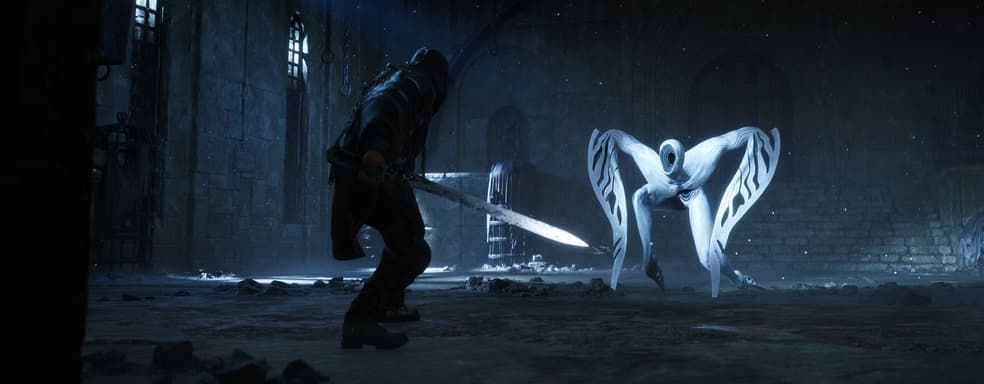
The world of Hadea is teeming with creatures that cannot be ignored, no matter how impressive and frightening its landscapes may be. The Hollow Ones and their companions desperately interfere with the investigation. So, it's time to get the sword, equip the drone - and talk about the combat system. Why so late? You'll understand now.

"Souls-like" for Brains
Battles here act more as an auxiliary element, designed not to let the player feel too comfortable when exploring tombs and ruins. Formally, in Hell is Us you can really find a lot of signs of "Souls-like": a dark setting of a half-dead world and familiar melee mechanics.
However, the key feature of the genre - an aggressive environment and spectacular bosses that test the player's strength - is simply absent in this game. If you call Hell is Us "Souls-like", then only an unsuccessful one, with a combat system implemented strangely and sparingly, as if it was screwed on at the last moment and never managed to be brought to mind.
The key feature of the combat system in Hell is Us is the close connection between health and stamina. The more damage the hero takes, the less energy he has for strikes and dodges. The maximum stamina reserve is equal to the current health level and is restored only to this limit. In other words, losing HP directly reduces Remy's combat potential.
At the same time, the developers have introduced an interesting recovery mechanism. By striking, the hero accumulates white energy particles around him. If you press the button in time, they turn into health - restoring both HP and stamina. This is a kind of analogue of the "Ki pulse" from Nioh or the health return system from Bloodborne, only with manual activation.

Ordinary weapons are powerless against the "white walkers", so the hero fights with cold weapons forged from their remains. The arsenal includes swords, axes and polearms with different styles and obvious pros and cons. Weapons are upgraded as they are used, which slightly interferes with experimenting, but consumables for improvement compensate for this.
Each weapon can be assigned an emotional effect - rage, horror, grief or happiness - and up to three symbols can be installed, working as local magic. They give active abilities: attraction, arson, traps, healing, shields, stealth and other useful effects.
There is also a drone that can be equipped with modules: for example, to distract the enemy, a temporary "rebound" with infinite evasion, a ram or an air attack. The system is complemented by armor with passive bonuses, relics with abilities and consumables that enhance protection or drive opponents out of combat.
On paper, all this looks like a flexible, aggressive and tactically rich combat system. But in practice, you almost never have to use this entire arsenal.

The problem is that this entire ingenious arsenal is designed for a game where enemies would be diverse and require different approaches. In Hell is Us, opponents are divided into a couple or three archetypes: conditional "infantrymen" with melee or ranged attacks, slightly more powerful "fat men" and rare mini-bosses, who look exactly the same - only larger and hit harder.
Many enemies can summon an abstract something connected to them by an umbilical cord - until you destroy this revived "Minecraft", the enemy himself is invulnerable. But this is perceived as just another punching bag - nothing more.
If you count truly unique opponents, there are only six types here - including four "final bosses" who look like ordinary enemies increased in size. They are unhurried, act primitively and are easily clicked with simple strikes followed by the restoration of the white health bar - at any level of difficulty, including the maximum.
What's there, there are practically no boss battles in the usual sense. In the first battle, you run in the dark, looking for three screaming (literally) pillars and deal with a crowd of ordinary enemies - then repeat this cycle twice more, dodging moving walls. In the second "boss fight" you just fight off waves of ordinary opponents. And in the third... you beat the same enemies as in the first hours of the game, only grown several times.

Yes, while you only have a sword and a drone without abilities, you can't really roam around. But you will almost never meet more than two or three opponents at the same time, and quite quickly the enemies begin to feel just like obstacles on the way to the goal - without even trying to challenge the player.
Difficulty spikes occur only when transitioning to a new act, when you sometimes have to press evasion or block, completely negating damage due to stamina, or parry strikes - with a fairly lenient reaction window, which the reddening enemy warns about in advance.
Nevertheless, there is an opportunity for a challenge: in the settings, you can manually increase the difficulty above the maximum - up to 180% health and 200% damage for enemies. Yes, the hero dies faster, the enemies - longer, but even at such numbers I continued to climb on the rampage and almost did not die thanks to the effects of equipment.
Enemies in the game are reborn, but only if you leave the location with an active temporal loop, and then return. Over time, you will learn to close them, and then the killed will remain dead forever.

There is also no penalty for death by default: the hero is reborn with a full inventory, and the solved puzzles are not rolled back, even if you have not saved for a long time. This is explained by the fact that he does not experience events, but only remembers them.
Death is a lie that broke into the story due to the weakening of the truth serum. Yes, you can manually enable the loss of weapon experience and resources, but in a game where enemies are monotonous and do not require adaptation or tactics... it is not very clear why.
Nevertheless, I dare to note: the battles here do not annoy, do not irritate and generally successfully cope with their task - to occupy the hands and slightly entertain the player between puzzles. I am not the biggest fan of purebred quests, so even simple battles helped me not to get tired of running around and riddles, allowing me to delve deeper into the sad history of Hadea.
It's just that the game almost never requires you to use the entire available arsenal, and pressing abilities for the sake of a spectacular animation is not the best argument in defense of the combat system. If this is a "Souls-like", then one that tests not combat skills and reaction, but attention and intelligence. And, you know, there is something charming about it.

Diagnosis
I want to talk about this game - and talk a lot. Hell is Us is an undeniably unique author's project, memorable for its atmosphere of "Hell on Earth", a free approach to research and respect for the mental abilities of the player. Despite the status of an AA release, from the point of view of the quest, this is a full-fledged AAA project: with deep mythology, many details, puzzles and exciting exploration.
At the same time, the main plot and combat system rather feel like formalities designed to attract a wider audience - spoiler: this did not work, as evidenced by the eloquent statistics in Steam. However, I will not blindly recommend the game to everyone.
First of all, Hell is Us should be paid attention to by those who like quests and thoughtful, unhurried exploration without unnecessary hints and simplifications. Moreover, the already simple battles here can be simplified even more with the help of the difficulty slider. But fans of combat action have absolutely nothing to do here: there are much more worthy contenders for your personal time in the industry.
Pro
- Atmospheric world
- Deep lore
- Variety of locations
- Interesting puzzles
- Excellent optimization
Contra
- Formal plot
- Empty main character
- Raw combat system
- Monotonous opponents
Never miss our newsAdd this site to your preferred sources to see us more oftenAdd on Google