Built a military airbase, got a farm instead: what makes Ground of Aces appealing [early access]
Translated with AI from the Russian original.
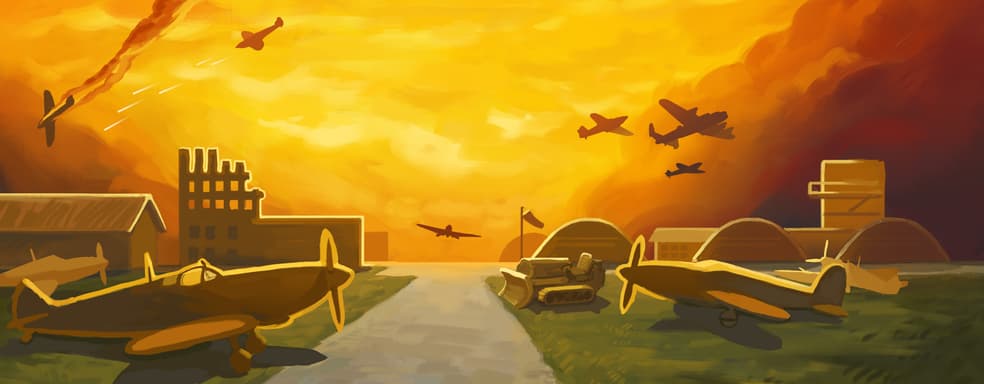
In Ground of Aces, the player is given a military airbase and a small team of professionals. With their help, you need to organize the base's operations in order to take part in World War II. Success on missions determines whether the airbase earns honor and glory or is shut down in disgrace.
At the start, the game greets you with a visually pleasing main menu, designed as the office of the future manager of a military airbase. Audio cassettes, stamps, and a model airplane are scattered across the desk. The option design resembles colorful file folders. Here you need to choose one of three plots of land available in England to use for military needs. The choice affects resource availability and the convenience of building the runway (RWY).
Command assigns you a group of specialists: engineers, medics, cooks. In practice, these are the "peasants" from strategy games, doing anything except their direct duties: gathering and processing resources, working in the vegetable garden, hauling materials from the warehouse to the construction site. Workers have health, fatigue, morale, and confidence meters — if these indicators are not maintained at the proper level, productivity will drop. If overall morale falls, the game ends in failure.
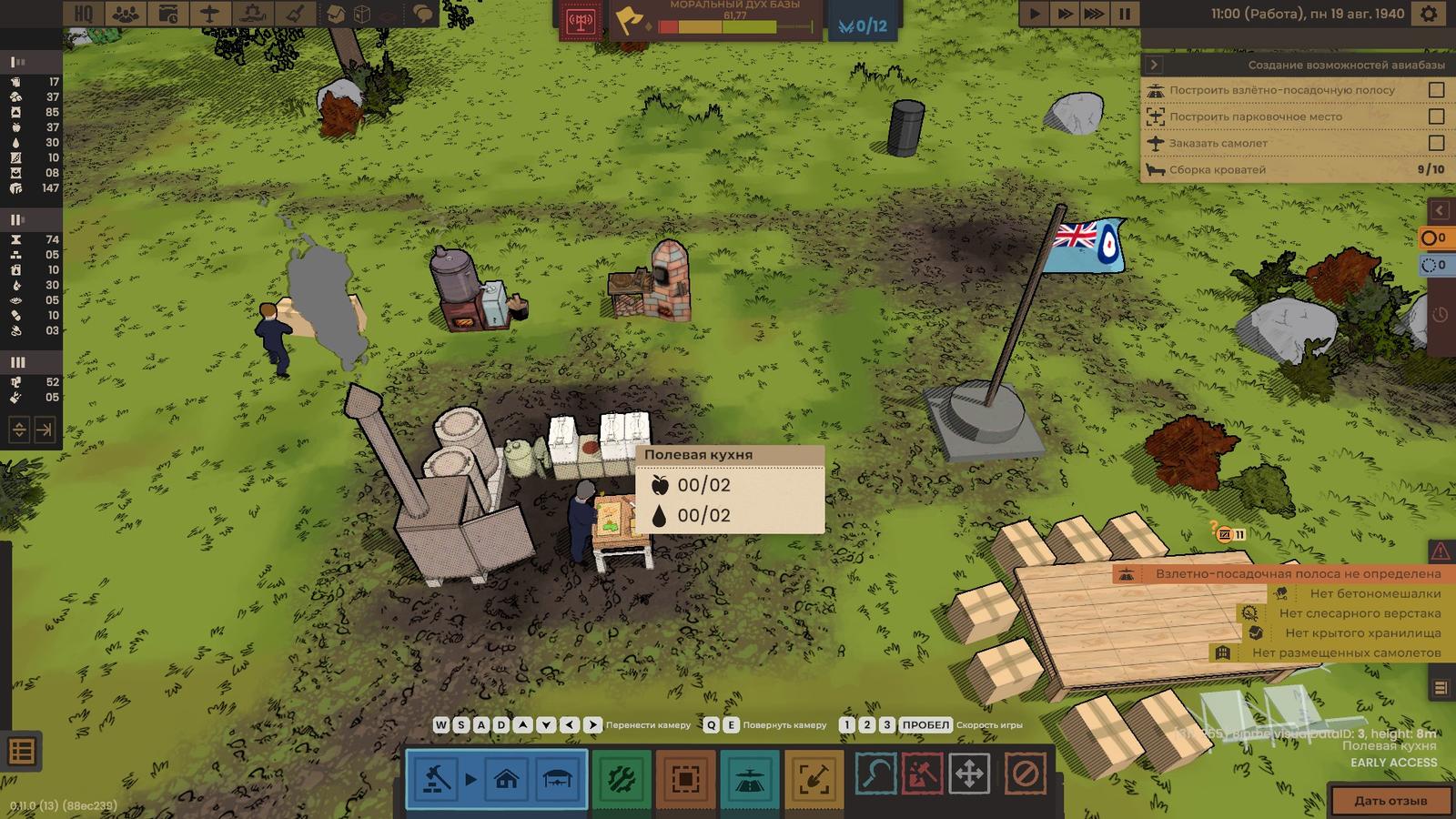
During the day, workers handle their assigned tasks, and at night they rest. You need to regulate their schedule so they have time to work, have fun, and get enough sleep. Various events happen from time to time: a worker gets injured or sees a spider and runs around screaming. If you're lucky, some craftsman will look at the work done and cheer up.
Nature provides everything necessary for life: wood, sand, clay, food, water, medicinal herbs. At workbenches, resources are processed into planks, bricks, cement, medicine, parts, ammunition, and electronics. Collected seeds are planted in the garden so that ripe crops can be cooked or processed into preserves. Metal and tarpaulin are created out of thin air — I dare not complain about that convention.
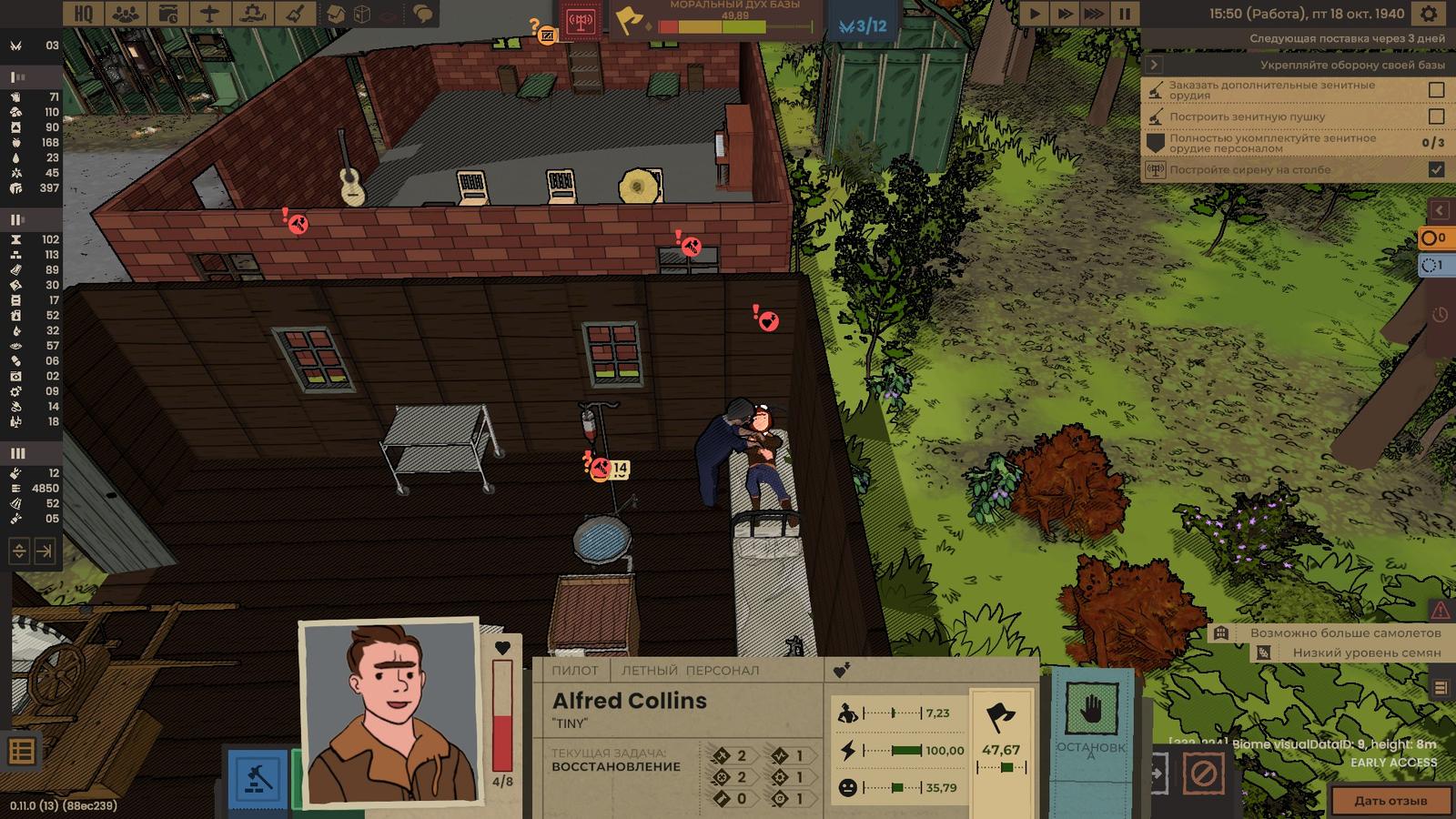
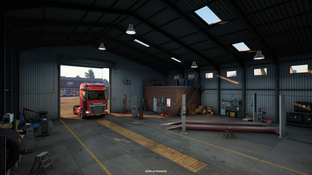
Collected and crafted resources are used to construct buildings. The convenient building mechanic lets you choose the size and contents of structures yourself. Floors, walls, windows, and roofs are assembled from tarpaulin, bricks, or concrete. All that remains is to choose the purpose of the finished building:
- A residential building contains chairs and beds — this is where workers rest, eat, and sleep.
- In the hospital, the wounded recover faster.
- Equipment is produced in the workshop.
- In the training hall, pilots improve their qualifications on special simulators.
- In an entertainment venue, morale can be raised with posters, a radio, a guitar, and a piano.
- In storage, resources spoil more slowly; spoiled resources turn into trash that takes up space.
I combined the hospital and the training hall — so that the harsh masculine groans and the smell of sweat would motivate patients to get discharged sooner.
By the fifth hour of play, it turned out I had done everything in reverse order. I should have built the runway and aircraft parking right away, and then acquired a plane. For missions completed by the pilot, command rewards you with resources that help develop the airbase under enemy bombing. By the time I finally built the runway, my airbase was already developed and completely self-sufficient.
At the beginning, a simple and weak aircraft is available, and it must carry out missions: intercept bombers, take part in competitions, deliver a birthday cake to the celebrant. After returning, the aircraft needs repairs and its fuel and ammunition supplies need replenishing. If the pilot is wounded on assignment, he will be laid up in the hospital for several days.
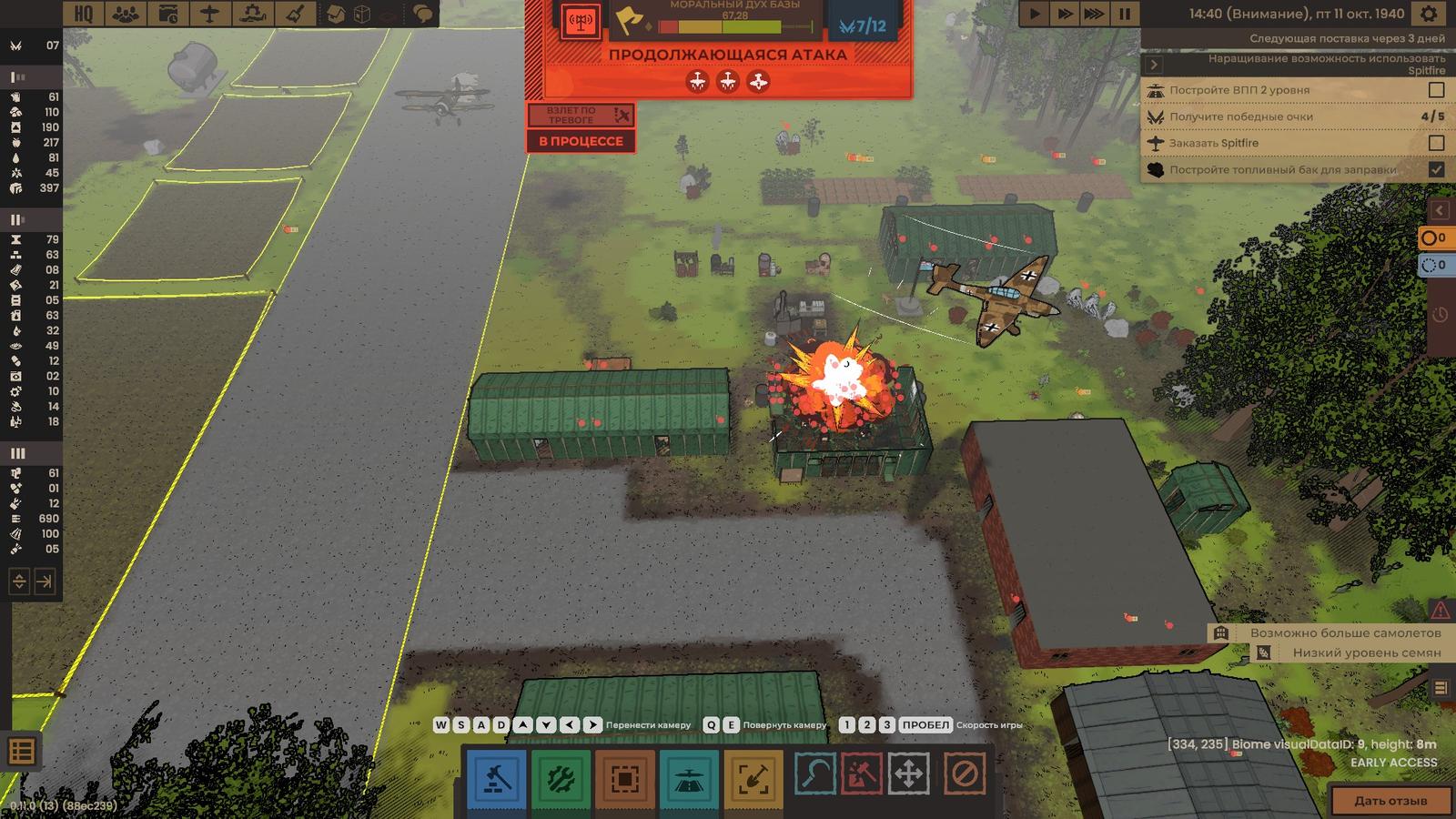
Over time, it becomes possible to upgrade the runway or build an additional one, as well as increase the number of parking spaces. Successful missions reward you with victory points, which are spent on acquiring new aircraft and specialists. The aircraft correspond to World War II-era prototypes and differ in characteristics, crew size, and armament. If you fail or ignore too many missions, you will receive fewer resources from command.
In the later stages, missions are issued frequently. You need to keep several aircraft in reserve — in case one mission is assigned right after another. Periodically, the enemy bombs the airbase: you need to scramble the pilots to repel the attack. Anti-aircraft guns can be used for defense, but their benefit is almost unnoticeable. Buildings destroyed during bombardments will have to be rebuilt. Some of the resulting debris is not cleared away by the workers — it will continue to be an eyesore even after repairs.
Diagnosis
At the moment, Ground of Aces is a solid farm simulator with a military slant. It is engaging to gather and process resources, take care of the vegetable garden, and tend to the workers' needs. Without the threat of constant bombardment, the game turns out to be very relaxing.
The idea of managing World War II-era aircraft is interesting, but it lacks refinement and content. I want to play as new factions sooner and see more consequences from mission outcomes: if you successfully raid an enemy base, your own base should be attacked less often. More failures should produce the opposite effect.
Never miss our newsAdd this site to your preferred sources to see us more oftenAdd on Google