It will devour all your time. Vampire Crawlers Review
Translated with AI from the Russian original.
Pure dopamine, subtly "eating up" tens of hours of your time. Behind archaic sprites and angular dungeons lies a bold evolution, where the ability to adapt your deck on the fly to the whims of randomness becomes the key to victory. Let's figure out why a project with graphics from the last century is more captivating than many modern hits.
It's almost impossible to avoid mentioning Vampire Survivors when talking about Vampire Crawlers. Especially since the full name of the game is Vampire Crawlers: The Turbo Wildcard from Vampire Survivors. Many things have indeed carried over from its predecessor: characters, weapons and their upgrade system, enemies, locations. Even the microscopic "plot" about searching for a vampire is taken from there. But Vampire Crawlers is a completely different game. It's unlikely to spawn an entire subgenre, but...
Vampire Crawlers takes all the best from the genre, discards the unnecessary, and offers us to play a pure concentrate. The developer seems to say: "Collect a deck. You don't need a plot. 'You are looking for a vampire' – and that's enough. The fact that you won't find him shouldn't bother you. You don't need 'juicy' detailed graphics – readable card descriptions are enough. After all, you don't need convoluted mechanics. Just play the cards you are dealt. Because that's what you collected the deck for."
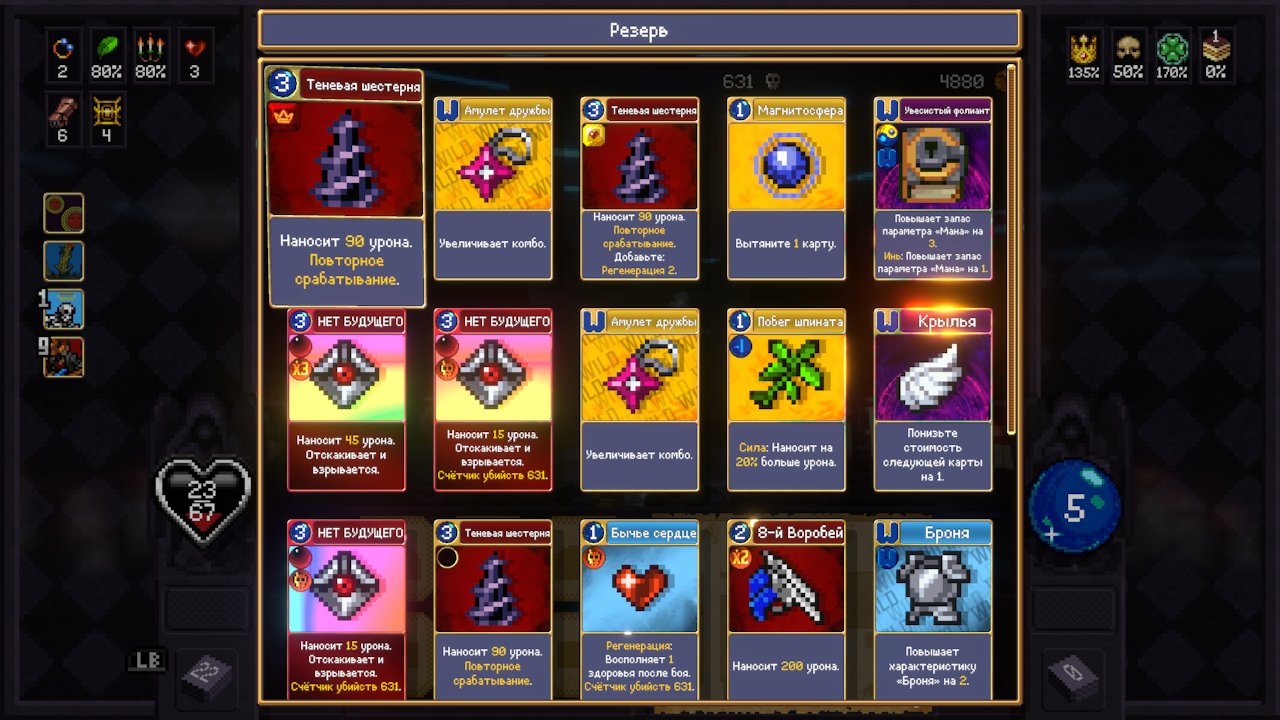
And it works. "Just collecting a deck" turns out to be not so simple in practice. At least, at high difficulty levels. At the start, you have access to health (which you need to preserve until the end of the run), mana (spent on playing cards each turn), and a set of colored cards: red (attack), blue (defense), purple (mana manipulation), and yellow (attribute modification). While you wander through the enchanted forest at the initial difficulty, it really seems that everything is elementary.
We kill monsters, level up, and gradually expand our deck. But if you try to pass a higher difficulty level with the same simple build, your health melts away before your eyes. And then you have to figure out: which cards are really needed in hand, how to build the sequence of plays to have enough mana, and which elements create synergy, allowing cards to evolve.
Combinations familiar from Vampire Survivors (yes, I couldn't resist again), which turn basic weapons into something much more powerful, also work here. White and black doves, lightning ring with duplicator, cross and clover... We won't list them all.
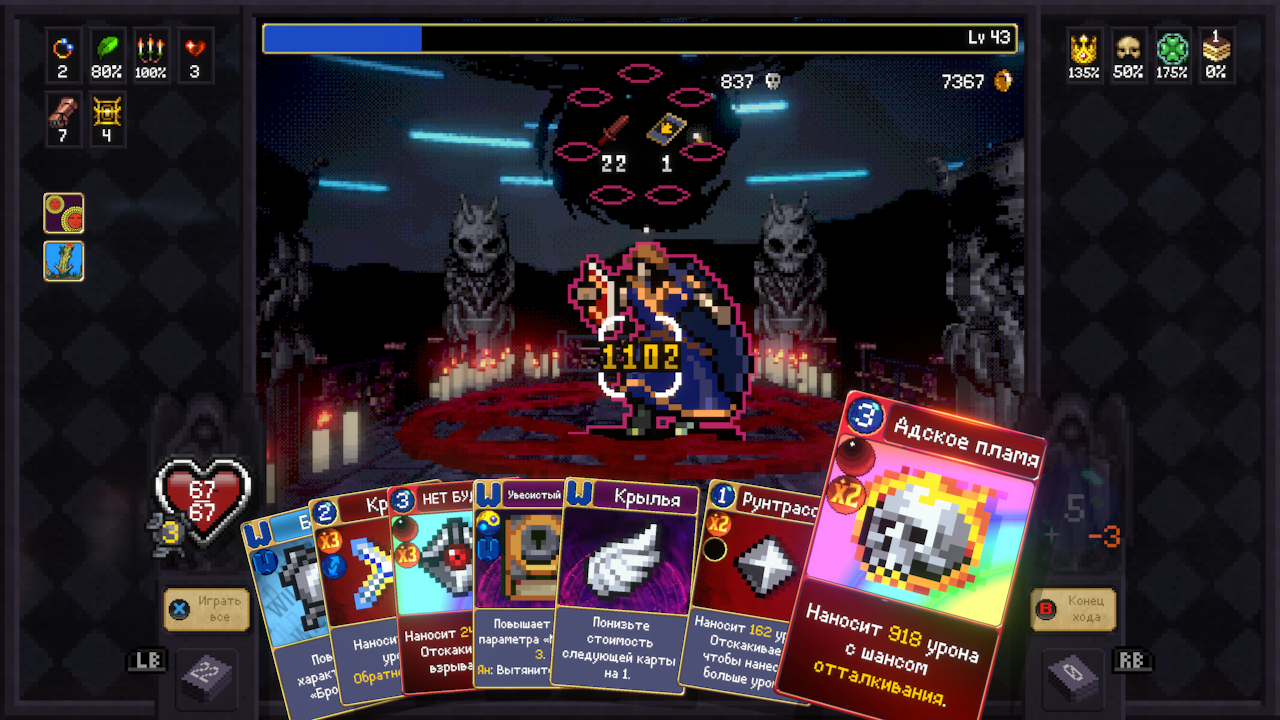
In addition, many cards have a special slot (their number can later be increased in the Forge), where you can insert a gem. The card literally transforms from this. Gems repeat the main color scheme of the cards, and their combinations with cards create a huge number of new effects.
If you approach deck building thoughtfully, sometimes you manage to assemble such powerful builds that the difficulty level loses all meaning.
Yes, randomness plays a huge role in roguelikes, and it's not at all certain that you'll be able to repeat a successful card combination you once found. But there's a charm to it. When developers claim that every run is unique, many often dissemble: the number of truly working builds is usually small. But not in Vampire Crawlers.
Here, it's almost always possible to assemble a viable deck. Even if it doesn't work exactly as you planned, if you don't rely on chance when choosing cards, the game offers many tactical solutions within several clear strategies. There are essentially four of them. Emphasis on attack: the enemy simply doesn't have time to respond — you destroy them sooner. Emphasis on defense: the enemy cannot break through your shield, and if they do, health quickly recovers. Emphasis on characteristics: you level up so quickly and become so resilient that it no longer matters which cards come into your hand. And finally, emphasis on economy: farm gold.
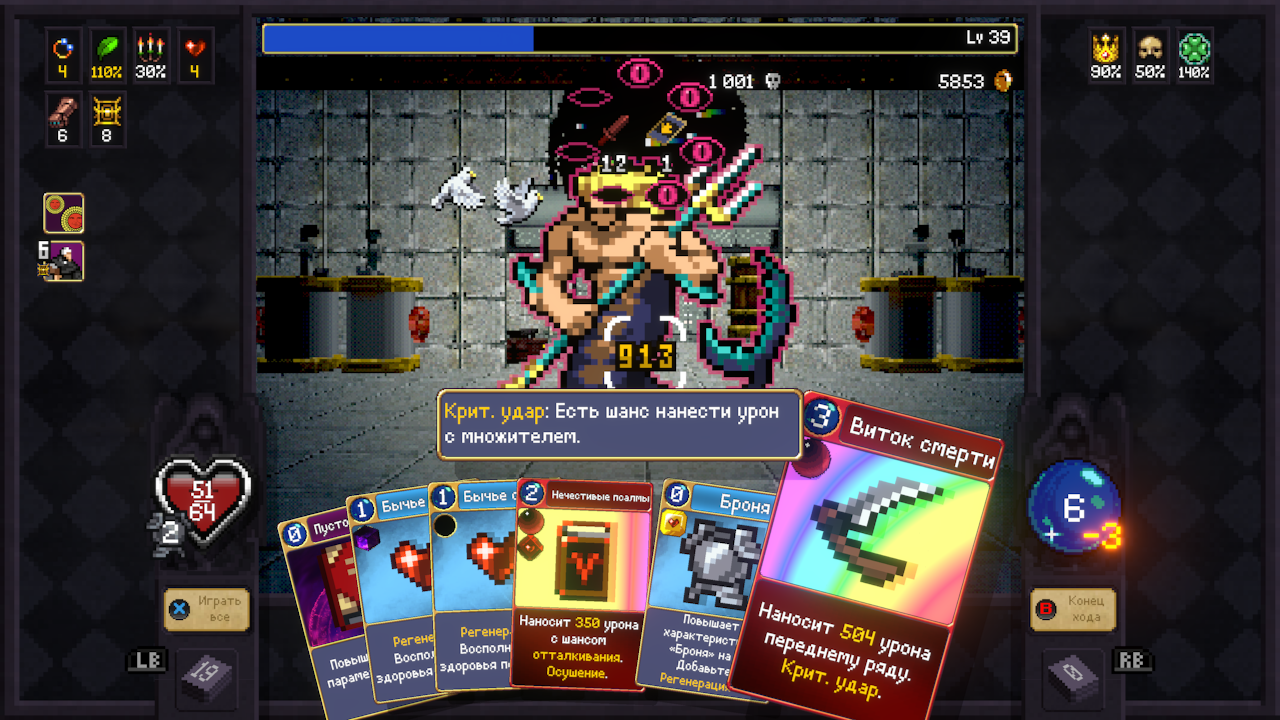
And if you see that the necessary cards aren't coming, and there's an imbalance in the deck, don't be afraid to change your strategy and adapt your tactics. In my runs, there were several moments when it seemed that the game was already lost: health at zero, hand full of seemingly useless cards. But as soon as I let go of stubbornness, stopped banging my head against the wall, and took a card into my deck that I initially flat-out refused to see, everything changed instantly. An unexpected element allowed me to radically restructure the course of the battle. In the end, fighting through the last waves to the boss and defeating him, you say to yourself: "This is not at all the build I planned... but it worked!"
And that's what Vampire Crawlers is truly good at.
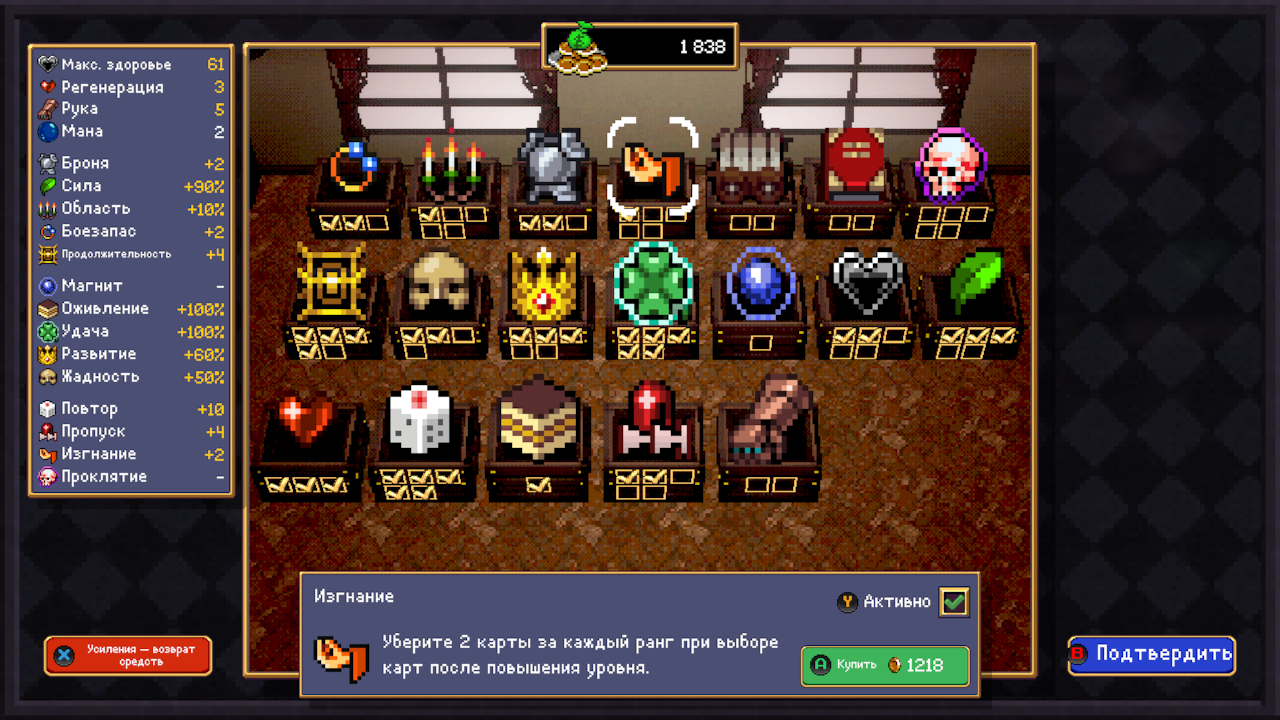
By the way, about farming gold. As in Vampire Survivors, you still need to get to the full disclosure of the game content. It's not enough to unlock a new hero — you need to buy him. Leveling up, without which it will be extremely difficult at high difficulty levels, also costs money. Add new slots for gems in the Forge? Again, for a fee. Go to the jeweler and change the rarity of stones to the desired one? Also for gold. In short, a lot of gold is needed. A lot. So you'll have to go down into the dungeons again and again and farm, farm, farm. Fortunately, the process itself only becomes more exciting from this.
Visually, the game resembles a warm greeting from classic role-playing games of the early 1990s. The same "grid-based" 3D environment, the same flat sprites of enemies rushing in waves, the same deliberately crude pixel graphics.
And, frankly, it's a bit disappointing. You look at the neat graphics of Slay the Spire II — your eyes rejoice. You look at Vampire Crawlers — your eye involuntarily twitches. However, to be fair: when you compare the prices of these games, everything falls into place.
Diagnosis
Vampire Crawlers seems endless. And it's not just about the amount of content, although there really is a lot of it. The secret lies in the colossal number of combinations of cards, gems, and random events that make you descend into already completed dungeons again and again. Of course, everything comes to an end, and sooner or later the game will get boring. But we are talking about tens of hours of exciting gameplay. Future add-ons will only add another dozen hours to them.
This project is an excellent deck-building dungeon crawler that can keep you hooked for a long time. Judging by personal statistics, Vampire Crawlers "devoured" a full day and a half of a week since its release. And judging by reviews on Steam, there are players for whom this game has taken half their lives.
And yet... no matter how you look at it, the visuals remain its main stumbling block. Yes, the gameplay is addictive, yes, successful builds generate pure dopamine in your head, but looking at these angular corridors, ugly sprites, and giant pixels is an acquired taste.
Even if it's conscious minimalism, the picture contrasts too sharply with the depth of the gameplay. The result is an unusually addictive game wrapped in frankly weak graphics. But if you are willing to overlook this for the sake of perfect card combinations, Vampire Crawlers will reward you handsomely.
Pro
- Deep and flexible deck-building system
- High replayability
- Successful symbiosis with Vampire Survivors mechanics
- Excellent value for money and content
- Engaging and captivating
Contra
- Primitive graphics
- Slightly drawn-out progression
- High entry barrier at difficult levels
Never miss our newsAdd this site to your preferred sources to see us more oftenAdd on Google