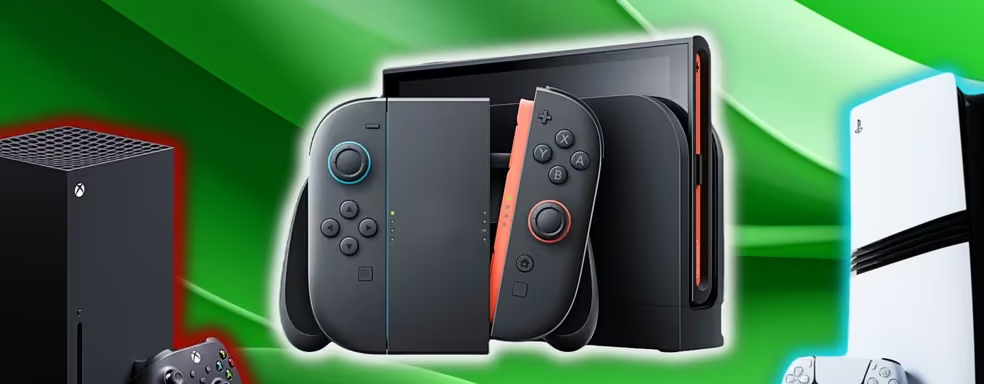
Console market expects a nearly 20% crash in 2026, experts predict
Translated with AI from the Russian original.
The decline will completely offset last year's growth.
The global video game console market is experiencing a significant downturn. According to a new study by S&P Global Market Intelligence Kagan, in 2026, shipments of home gaming systems from Sony, Microsoft, and Nintendo will decrease by 19.5% to 33.9 million units.
Analysts attribute the decline primarily to the ongoing crisis in the RAM and storage market, which has forced manufacturers to significantly increase console prices. As a result, devices have become less accessible to the mass consumer.
The decline will completely offset last year's growth, when the launch of the Nintendo Switch 2 boosted global shipments by 13.5% to 42.1 million consoles.
According to S&P's forecast, the decline will continue in the coming years: by 2027, shipments could fall to approximately 27.1 million units, after which the market will gradually recover and reach 37.4 million by 2030.
S&P Global Market Intelligence analyst Neil Barbour believes that recovery is only possible if component shortages ease by 2028. This would allow Sony and Microsoft to release a new generation of consoles priced between $600 and $800.
Currently, the market faces several problems at once: consoles are either too old or too expensive for the average buyer, major game releases are infrequent, and the economic situation offers no hope for price reductions.
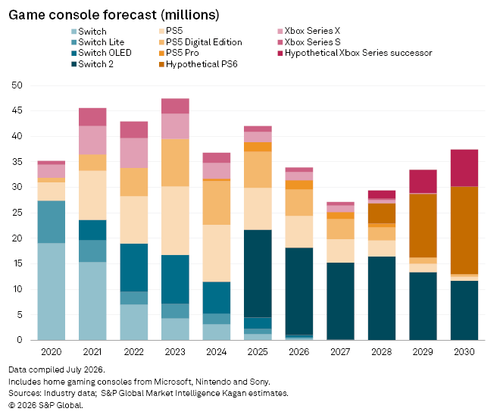
In 2025, PlayStation 5 shipments totaled 17.1 million consoles, down 15.2% from the previous year. In 2026, S&P expects a further decline to 13.2 million units.
The situation for Microsoft looks even more challenging. Last year, the company shipped only 3.2 million Xbox Series X|S consoles, which was the lowest annual figure in S&P's history. In the first quarter of 2026, quarterly shipments fell below 500,000 units for the first time.
According to analysts' forecasts, in 2026, Xbox Series X|S sales will decrease to 2.5 million consoles, after which the current lineup will practically disappear from the market.
S&P expects Nintendo Switch 2 sales in 2026 to reach 17.1 million units, comparable to the second year of sales for the original Switch and Wii.
At the same time, Nintendo itself forecasts a 16.9% decline in Switch 2 sales to 16.5 million consoles in the second fiscal year after launch.
Never miss our newsAdd this site to your preferred sources to see us more oftenAdd on Google