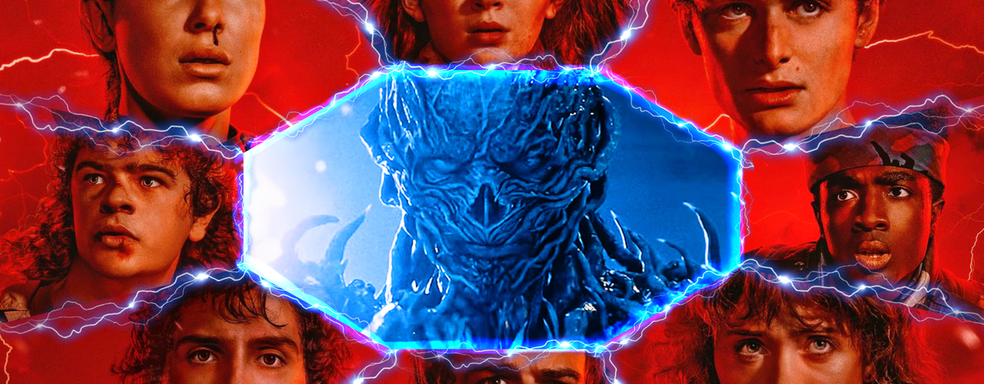
This is not "Game of Thrones": How "Stranger Things" saved its finale. Analysis
Translated with AI from the Russian original.
The requirements for the finale of Netflix's main hit were impossible: the authors were expected to perform a miracle, but they were afraid of a catastrophe on the scale of Westeros. The fifth season was neither. This is a story about how to abandon radical gestures for the sake of loyalty to the characters, and why a "safe" finale is sometimes better than a resounding failure.
A Journey Ten Years Long
For almost ten years, "Stranger Things" has been balancing on the edge of a mass hit and a personal story — and this is what allowed a risky genre experiment, which not everyone believed in at the announcement stage, to turn into one of the main television phenomena of its time.
The hype around the series raised local economies, brought Dungeons & Dragons back into the mainstream even before Baldur’s Gate 3, and at the same time split the audience in half: while some dismissed it due to the overabundance of noise, others sat their families in front of the screens and mentally made lists of characters, at the mere thought of whose death the Duffer brothers had to look around anxiously.
The authors divided the final, fifth season into three volumes, turning the farewell to the story into a drawn-out process. This decision immediately sets a special optics of perception: each block feels not like another set of episodes designed to force the viewer to deposit money for two months of Netflix subscription (at least, not only for this), but as an independent stage on the way to the finale — with its own dramatic task and emotional weight.

We have already talked in detail about the first volume — episodes from the first to the fourth — in a separate article, so here it is enough to record its role. This block hardly moves the plot forward. It prepares the ground. The story cautiously enters a new phase and makes it clear that we are no longer talking about children's adventures, but about a chronicle of growing up, where the accumulated consequences have climbed onto the neck in such a crowd that it begins to crack at the seams.
Hawkins lives in a state of military quarantine, the old heroes are stuck in an emotional "groundhog day", and Vecna's presence is felt even in those scenes where he is not in the frame. The series shows Dustin's growing up after Eddie's death, puts Eleven through grueling training in an attempt to earn Hopper's trust and prepare for the decisive battle — and increasingly molds Will into one of the key points of the entire story.
At the same time, the authors pull the Wheelers family from the periphery. Nancy is pushed to a more active position, Karen gets perhaps the strongest and most memorable scene in all five seasons, and through Holly and her classmate Derek, the motif of the succession of generations is introduced into the narrative — especially noticeable against the background of the grown-up heroes. The story looks back more and more often, collecting tense, not fully spoken relationships within the team and the motives of the early seasons into a single narrative.
This text is final and contains SPOILERS for the entire fifth season. Next, we will consistently analyze the finale to understand how the series came to its climax, which decisions really worked, where the authors had to compromise, and whether "Stranger Things" managed to avoid the fate that befell too many big series on the home stretch.

Myths and Meat Grinder
By the end of the series, the question of mythology ceases to be optional. The fifth season finally answers the main question: what is the Upside Down really is — and this answer differs markedly from what viewers have believed for almost ten years. Until now, both the heroes and the audience have clung to a convenient and simple picture, saying that this is a parallel dimension, a dark reflection of Hawkins, frozen in time and densely populated with unsightly creatures.
It turns out that the Upside Down is not a separate world at all, but a wormhole: an unstable bridge between our reality and another dimension, which the guys, out of habit, relying on the terminology of Dungeons & Dragons, call the Abyss. It is the Abyss that becomes the original source of evil — the home of the Mind Flayer, demogorgons and all the filth that has been climbing into Hawkins for many years.
At the same time, formally, the Upside Down is an artificial construction. In the past, Eleven banished Henry Creel not at all to where everyone used to think, but to the Abyss. The Upside Down arose later — as a side effect of Brenner's intervention and Eleven's repeated mental contact with Henry. The scientists, of course, did not stop the process, but on the contrary, helped to stabilize it, turning a dangerous fault into a more or less working gateway — in the name of democracy and their own interests. How else could it be.

Dealing with the structure of the world, the series at the same time finally places accents in the figure of Henry Creel. There are no sensations here for attentive fans who conscientiously do their "homework" on studying the fandom: it was clear from the play "Stranger Things: The First Shadow" that Henry received his abilities after contact with the Mind Flayer. This fact has caused concern from the very beginning — and, I confess, I breathed a sigh of relief when it became clear that the authors deliberately refused to turn Henry into a victim of external influence. Enough of villains who became evil not of their own free will — this is too convenient and too spineless a decision.
Having received his powers, Henry was not broken or rewritten. His view of the world did not become distorted — it simply became sharper. People appeared before him broken, cruel and intolerant of any otherness, and it is this conviction, and not the influence of the Mind Flayer, that becomes the foundation of all his motivation. Henry doesn't want chaos for the sake of chaos. He wants to rewrite reality, cleanse it and bring it to the form he considers correct. The Upside Down and the Abyss are just a tool for him.

At the same time, the authors deliberately do not turn the finale into a lore encyclopedia. Yes, questions remain — about the nature of the Mind Flayer, which, apparently, is not able to exist without Henry and uses him as an anchor and source of energy; about the stability of the "bridge"; about how the heroes generally exist on the other side and breathe foreign air, as if in an alpine village.
It was possible to go the way of maximum chewing and finally bury the intrigue under explanations. But the series consciously stops earlier. It gives exactly as much information as is needed for the mythology to finally form into a coherent system — and nothing more.
The same Kali returns not to reveal herself, but, as in the second season, to fulfill a specific plot task, reminding us: not every character is obliged to develop at all. Sometimes it is enough to be in the right place at the right time.
A similar approach works in the culmination. The final battle turns out to be unexpectedly fast — spectacular, well-coordinated and structured so that each participant has their own role. The team acts as a single mechanism, uses everything it has learned over the years, and quite quickly puts an end to the confrontation with Vecna and the Mind Flayer.

But the battle here is important not only as an adrenaline attraction. It works as an emotional denouement. At the moment when Joyce, waving an ax, cuts off Vecna's head, the series sews in a montage of flashbacks — a reminder of what the heroes have gone through in all seasons. For me, as a person who has gone this way consistently since the first season, these scenes hit no less accurately than Joyce's ax, crashing down on the antagonist's neck. And when the head falls, there is a feeling that all the nightmares that he spawned are collapsing with it. This is the very catharsis that the story has been leading to for years.
Against this background, the attitude of the fifth season to action in general is especially clearly visible. There is not so much of it here, but each scene works accurately and to the point. From the tense episodes of the first volume — including the demogorgons and the awakening of Will's abilities — to the final attack, the series focuses not on quantity, but on meaningfulness. There are almost no empty collisions, but there is a constant feeling of risk — as if no one has plot armor. Although in the end it turns out to be stronger than it seemed, these scenes create tension honestly.
Therefore, the quick closure of the action line does not feel like an understatement. On the contrary, it emphasizes the main priority of the season. The victory over evil here is not the end of the story, but a condition that frees up space for something really important. Because the Duffer brothers' interest has always been in another plane — in the characters.

Chatting During the Plague
It is here that the series enters the thinnest ice of the final season — the need to simultaneously move the plot forward and close the internal conflicts of the characters that have accumulated over the years. The second volume consciously chooses the path of conversations, pauses "for breath" and attempts to say what has remained between the lines for too long. In critical moments, the heroes again and again prefer not to run further, but to stop and say something important — and this sometimes looks clumsy, awkward and even annoying. But exactly as much as justified. Because if not now, then when?
Episodes from the fifth to the seventh literally clear the emotional field before the finale. This is not a waste of time, but a clearing of debris. One of the most painful examples is the conflict between Dustin and Steve around Eddie Munson. After his death, Dustin moves away from the team, and this gap hangs in the air for a long time, until it breaks out at the most "appropriate" moment — when the laboratory begins to literally collapse, and not only someone's life is at stake, but the potential destruction of everything. Everything in general!

At this moment, Steve hits Dustin where it hurts the most, aloud formulating the doubt that he had been running from since the fourth season: wasn't Eddie's sacrifice in vain? Didn't he "overplay" the hero, rushing into battle without a plan and without a chance? Dustin, on the contrary, fiercely defends the memory of a friend whom the city first slandered and then conveniently wrote off as a monster.
Their argument about the price of sacrifice becomes one of the emotional peaks of the season. Steve is right in his own way: Eddie really went where there was no chance. But Dustin just as fairly insists on another thing — Eddie consciously sacrificed himself, buying time for his friends, albeit not enough. To devalue such an act means not understanding that heroism almost always goes hand in hand with tragedy, and to deny a person the right to be a hero simply because he lost.
By the finale, Steve accepts this logic, and the two best friends finally reconcile, cementing it with their signature formula: You die. I die. A phrase that returns the series to its foundation — friendship and willingness to be there even when the world is falling apart. It's all the more обидно that this moment was almost shamelessly ruined by the "official" localization: their "together until the end" sounds logical, but betrays a misunderstanding of how iconic this moment is — both for the duo of characters and for the fans who have gone all the way with them.

In parallel, the series unravels the love triangle of Nancy — Jonathan — Steve. Nancy finally speaks out about her ambitions and fear of getting stuck in the past, and Jonathan stops being an eternal compromise, dangling like a well-known substance in an ice hole. This line closes not in the spirit of "everything became good," which fan camps hoped for, but in a much more adult logic: everything became honest — and now you can move on.
This thought is emphasized by the scene in which Nancy and Jonathan literally risk drowning, mired in the quagmire of a collapsing world. Everything freezes at the point of their emotional catharsis. The scene seems protracted, and not all viewers immediately read it as a moment of parting. But in the context of the season, this is indicative. The fifth season generally often prefers to say important things aloud, even if it hurts the pace. The desire to close emotional debts here outweighs the accuracy of the presentation.
The final point in this knot is put later — at the moment when Steve falls from the radio tower and Jonathan pulls him out at the last moment. It is not a person who flies into the abyss, but the tension between them — metaphorically, of course. It is after this that they truly speak out their positions for the first time, including about Nancy. This is one of the last internal conflicts that the series consciously closes before the finale.
For Steve himself, this scene becomes a long-awaited moment of vulnerability. He has always been an emotionally closed character, hiding his fear of loneliness behind bravado and self-deprecation. The fifth season allows him to admit this weakness, and it is through it that Steve gains inner stability.

Special attention in the fifth season is paid to Will Byers — and this is absolutely natural. His personal drama has been going on since the first episode, sometimes almost imperceptibly, but it has always been the hidden nerve of the whole story. In the penultimate episode, symbolically titled "The Bridge," Will finally sorts himself out and opens up to his loved ones, admitting that all this time he felt "different" — and not only because of his connection with the Upside Down.
It was this scene in the seventh episode that became a stumbling block and provoked a wave of irritated comments in the spirit of "Netflix is at it again." Against the background of unfulfilled expectations for the scale of the finale and answers to lore questions, it turned out to be a convenient target for general discontent. But if you look at the series as a whole, nothing sudden happened here. Will's personal drama has been consistently developing from the very beginning, and the creators simply could not ignore it in the finale without betraying the character.
Yes, the implementation of the scene is controversial and sometimes seems protracted — especially in the context of the impending culmination (how many times am I saying this in relation to the fifth season?). But it is necessary. Without it, Will's story would have remained unfinished. At the same time, the series avoids the simplest and most dangerous solution — it does not turn this line into a universal explanation of Will's connection with Vecna and the Upside Down, does not reduce mythology to one personal trait. Fortunately, this does not happen.

At this stage, the series does not bypass the protracted conflict between Hopper and Eleven. He seems to be there and on her side, but he still doesn't fully trust her — and this crack has been going on for more than one season. Hopper habitually tries to hold on, protect, control, because otherwise he is afraid. Only the price of such "protection" turns out to be too high. In moments when Eleven needs support, she receives doubt. In moments when she needs space, — caring shackles.
The fifth season teaches Hopper to let go, and Eleven — to act not out of a sense of duty, but out of inner confidence. It is from this state that her final decision grows.
Having freed herself not only from external threats, but also from the constant pressure of expectations, Eleven finally gets the right to choose. Here, the Duffer brothers' tightrope walking really reaches its peak. In fact, we get "Schrödinger's Eleven" with an open ending, in which she can be both alive and dead at the same time.
After the final battle, the series shows how Eleven makes the decision to which Kali had previously pushed her, and remains "on the other side" in order to remove the burden of responsibility primarily from her friends. She understands: the hunt for her will not end with the death of Vecna, nor with the destruction of the Upside Down.

At the same time, in the epilogue, Mike, acting in the usual role of dungeon master, voices an alternative version — as if Eleven had actually escaped, staging her death with the help of an illusion created by Kali before her death. And I am inclined to this option. The farewell of Eleven and Mike in the mental space looks logically dubious, given that at that moment the ability jammers were directed at her. If this contact did occur, then, most likely, Odi was physically in another place.
After the denouement, we are shown Eleven wandering alone through green, almost Icelandic landscapes — away from Hawkins, portals, monsters and the military. Here she finds a new home — or, at least, a new starting point.
The authors deliberately remove Eleven away from the rest — without killing the character, but also without leaving him inside the usual space of history. The Duffer brothers have repeatedly said that Odi's presence next to her friends inevitably turns her into the center of any threat and any new story. To put an end to it, it was necessary to take her out of the equation.
And yet there is a compromise here. It seems that the authors simply did not dare to kill the character in order to slam the door with a loud crash. Yes, this leaves room for a possible return — which looks especially cunning against the background of talk about spin-offs and assurances that this particular story is completed once and for all. But what would Odi's death have given in fact? Another shock element, which, if desired, would be easily canceled in the future — with the help of a dozen scriptural ways of "resurrection."
As a result, we get a neat and, perhaps, the most honest option possible. The finale is difficult to call bold, but it looks correct — both in relation to the character and in relation to the viewer.

Farewell to youth
The final epilogue gives a minimal idea of the fate of the survivors. A year and a half passes, spring 1989 comes, and the heroes graduate from school, finally saying goodbye to childhood. Mike, Will, Dustin, Lucas, and even Max, who formally lost eighteen months of life due to a coma, receive diplomas. Dustin puts on a small performance in memory of Eddie Manson — tears off his mantle and shows off a Hellfire Lives T-shirt. Everyone who lived to see this spring gathers in the frame: friends, parents, surviving adults and children.
The past eighteen months, however, remain almost completely behind the scenes — and the attentive viewer inevitably has questions. What happened to Dr. Kay? Why did none of the heroes end up behind bars — especially Hopper and Nancy, who not only saved lives, but also had quite specific corpses of soldiers behind them? There are many possible explanations: total secrecy, hushed-up cases, a tacit deal with the state, or recognition that the world could not be saved otherwise. But the series deliberately does not indicate any of them.

Nevertheless, the older characters get a logical continuation of their stories. Hopper and Joyce decide to leave Hawkins, leaving a city with which too much pain is associated. Nancy begins a career in journalism, Jonathan goes to study directing, Robin goes to college. Steve stays in Hawkins and works as a coach for the school baseball team. Their meeting at the graduation of the younger ones emphasizes a simple fact: the paths diverged, but the connection between them remained. This is not a dramatic farewell, but a natural result of growing up.
That's why this moment works so warmly. It not only continues the heroes' farewell to the audience, squeezing the last tears out of the viewer, but also grabs with its honesty. It's a farewell to youth, familiar to those who once left school, left their hometown, not yet realizing how much everything changes at that moment.

The final game of Dungeons & Dragons closes the circle. The story began with it — and through it, the series says goodbye to this world. Mike once again acts as the dungeon master and speaks about possible future scenarios, allowing the viewer to look a little beyond the final credits. We understand that Max and Lucas stay together, Will finds his place, Dustin doesn't lose touch with his friends, and Mike himself finally takes on the role of narrator and keeper of this story.
It is important that the series does not insist on the only correct version of the future. It does not turn the epilogue into a catalog of "what happened next" and does not fix the fates of the characters forever. Instead, "Stranger Things" leaves room for life off-screen, emphasizing that the story of Hawkins is over, but the lives of its characters do not end there. The final emphasis is on continuity — the younger ones, Holly Wheeler and her friends, who have yet to tell their stories, are already descending into the basement.
The authors choose a kind, humane intonation, leaving the characters alive and with prospects. These decisions can be called cautious — and such claims are understandable. But the problem here is not so much in the decisions themselves, but in how exactly they were implemented. And further discussion about the finale almost inevitably boils down to a comparison that the series, by and large, did not deserve.

This is not "Game of Thrones"
Comparisons with "Game of Thrones" began to surface long before the release of the fifth season — and this was inevitable. Watching a big story spectacularly fall apart on the last kilometer left too deep a mark in the collective memory of viewers. The finale of "Game of Thrones" became a real trauma for serial lovers, and since then this fear has been automatically projected onto any major project that has lived to its conclusion.
However, in the case of "Stranger Things," such a comparison is initially lame — for several fundamental reasons.
Here we are dealing with the author's finale of his own story. The Duffer brothers came up with this world, developed it, and brought it to an end themselves — without the need to urgently close someone else's unfinished saga. Here you simply can't stomp your foot and exclaim indignantly: "Martin would have done better!" Therefore, a significant part of the criticism, served with foam at the mouth, actually misses the target — not because the finale is perfect, but because it is about something else entirely.
In "Game of Thrones," the finale crossed out the very logic of the world and the characters. Many years of arcs were cut short, motivations were rewritten retroactively, and key decisions looked not like the culmination of the path, but like an arbitrary set of moves. It was not a controversial finale, but a collapse of the entire concept.

Nothing like this happens with "Stranger Things." The series does not abandon its own rules, does not betray the characters, and does not reassemble them for the sake of a spectacular twist. On the contrary, all key decisions logically follow from who these characters were from the very beginning. The problem with the fifth season is not what was done, but how it was implemented.
The finale is obviously overloaded with tasks. The authors simultaneously close the mythology, set emotional points, summarize almost a decade of history, and try to maintain the pace. Hence the jerky rhythm and scenes in which the series too diligently speaks the obvious, violating the principle of "show, don't tell." Somewhere it is overloaded with dialogues, somewhere it is overly cautious, and somewhere it is clearly trying to sit on several chairs at once, sacrificing dynamics for the sake of feelings and depth for the sake of clarity.
These roughnesses are noticeable to the attentive viewer and are quite amenable to criticism. But turning them into "everything is lost" means consciously losing scale. No author's decision ultimately negates the work that the series has done for many years. With all the reservations, "Stranger Things" remains true to itself: it did not destroy its own world and did not devalue the path that the viewer went through with the characters for almost ten years. And in these times, this is already worthy of praise — albeit restrained.

Diagnosis
The fifth season of "Stranger Things" is not a finale in which everything came together, and not the case when you want to analyze each scene as a sample of dramatic skill. This is a finale that brought the story to an end without breaking it along the way. And in the long run, this, oddly enough, is already a serious achievement.
The Duffer brothers completed the story on their own terms. The final season brought together the key motifs of past years and brought them into one, albeit not ideal, but complete point. In terms of intonation, the series finally moved away from the adventures of "boys on bikes" and became the final chapter of a large fantasy story of growing up, which feels like a logical evolution that the project has been going to for more than one season.
"Stranger Things" will remain one of the key series of its era — not only as a symbol of streaming nostalgia for the 80s, but also as an example of a long-running story capable of uniting families and generations. For me — and, I am sure, for many viewers — this series has long ceased to be just an entertainment project on the screen. It was an almost decade-long ritual, part of personal life. It was watched by families, discussed at dinner, returned to old seasons, and grew up with the characters.
That is why the finale here does not have to be perfect. It must be honest. And "Stranger Things" coped with this task. This is a warm, calm, and slightly bitter farewell to a story that was important — for the characters, actors, authors, viewers, the most ardent fans, and the most ardent critics.
The point is put where it should have been — without betrayal of the characters, without betrayal of the viewer, and with the feeling that this whole NeverEnding Story was not in vain.
Never miss our newsAdd this site to your preferred sources to see us more oftenAdd on Google