Hardcore from 2016 or Old Stuff? Styx: Blades of Greed Preview
Translated with AI from the Russian original.
Nine years later, the industry's most sarcastic goblin returns, but seems to forget to check the calendar. We played the demo version of Styx: Blades of Greed and felt like we were in a time machine: it's still the same hardcore stealth from the mid-'10s. Is that bad? It depends on how much you missed games that don't forgive mistakes.
One of a Kind
The series of stealth adventures about the one and only talking goblin named Styx has always existed somewhere on the sidelines of the industry. It never took technologies, did not offer noticeable innovations, did not try to look like a "revolution" - and lived for a narrow circle of people who are ready to accept it with all its advantages and disadvantages. It seems that this will not change now: neither the developers nor the sarcastic green-skinned trickster, by and large, do not seek to move forward.
Two hours spent in the demo immediately show the essence of the project. The game deliberately follows the old formula, reproducing familiar techniques and mechanics instead of developing them further. This is not yet a verdict, but already a reason to take a closer look at the details - that's what we'll do now.
According to the developers, Blades of Greed should link the previous games in the Styx series and the more ancient Of Orcs and Men. The plot is presented through a frame structure: against the backdrop of the war, Styx retells his story to a group of young recruits, explaining how he ended up in the current point.

The story almost immediately goes into a flashback, which takes us to the last seconds of the final cut-scene of Styx: Shards of Darkness - on board the zeppelin, where the battle between Styx and Djaark is interrupted by the appearance of a golem.
The connection with the previous part is direct here, but formal. Who these characters are and what significance everything that happens has for the world - the answers to these questions are either implied or postponed for later. If you haven't played the previous parts, the game won't bother to explain.
Against this background, the developers' statements that knowledge of past games is optional sound quite sincere - but not for the reasons you would like. Formally, we are talking about preparing for a big war and weakening the human side, but the personal motivation of the greedy goblin remains extremely simple: to take advantage of the situation in his own interests.
Styx assembles a team, moves between locations and absorbs quartz - a rare and dangerous magical resource, around which the conflict is built. As a result, the story looks even simpler than the sequel, which was criticized for the same thing in its time. I'm in no hurry to draw final conclusions, but an alarming bell has already rung. Let's note this and admit the obvious: the series is primarily valued for its gameplay. Let's talk about it further.

Player and Space
The demo offers two story chapters. The first is a linear prologue with a simple task: to climb inside the golem and turn it off in order to get out of the city of dark elves Korrangar. During the level, the game consistently introduces the basic mechanics of movement - climbing on surfaces, jerks, sliding, double jumps and other elements of parkour, on which the entire further gameplay is built. The prologue leaves no room for improvisation and serves as training.
Then everything becomes noticeably more interesting. After the escape, the zeppelin crashes, crashing into the Wall - a cyclopean city-fortress of people. Here, Styx has to pull off a daring theft of a new aircraft and попутно assemble a team for further travel. At this stage, Blades of Greed for the first time gives you a feel for what the main game cycle will be like, and stops leading the player by the hand.
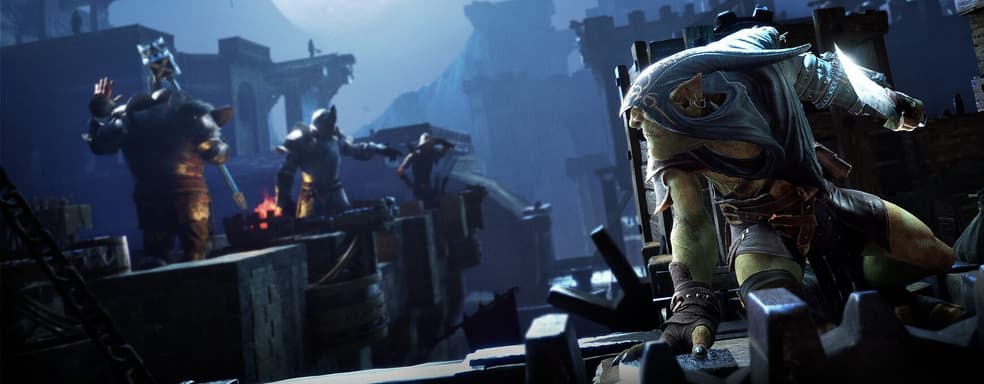
The Wall is not just a city, but a full-fledged vertical labyrinth. Docks, taverns, warehouses, refectories, residential premises and service areas add up to a multi-level space that is perceived as natural, although it is primarily designed as a playground that challenges our goblin.

The location of the current goal - whether it is a character or an object - is indicated only conditionally: we see the search area, but we do not know where it is located. Having received a landmark, the player has to independently explore the space, read the logic of the levels and decide how to get to the goal. As a result, every meter here turns into a small puzzle, where planning, attentiveness and patience are important.
At first, this can be confusing. Locations are deliberately devoid of bright visual accents, catchy landmarks and obvious "hints" in the spirit of yellow paint. The boundaries between interactive elements and pure decorations are not always read instantly - this requires getting used to, but at the same time works for immersion. Over time, the space begins to "read", and orientation becomes easier. An easy walk, however, will still not be: each location is filled to the brim with guards, and stealth comes to the rescue here.
Basic stealth is arranged extremely classically. Styx sneaks in the shadows, hides in secluded corners and closets, sneaks up on victims from behind, from above or from below - jumping out of the sewer grate and letting their blood with one precise blow - or simply carefully bypasses the guard without making contact.

At the same time, the guards behave attentively enough to constantly keep you in suspense. They patrol the territory, react to noise, raise the alarm because of the bodies found, talk to each other, willingly call for reinforcements and begin to comb the area at the slightest suspicion.
If the guard sees Styx going into the sewer, poisonous gas is released there without hesitation, forcing him to urgently change the route. This does not make opponents smart in the classical sense - if you hide in a safe place and sit it out, they will forget about you - but it makes you play carefully and not rely on chance.
Therefore, it is important to monitor the noise level by the indicator, the direction of the guards' gaze through the "amber gaze" (the local analogue of the witch's flair), extinguish light sources and take into account the type of surface. Steps on the carpet and other soft materials are muffled - this is critical, for example, if you are sneaking past a sleeping guard. Well, of course, you should not forget to hide the bodies or hide yourself in closets, chests or, pressed against the wall, dissolving in the shadows.
When this is not enough, the game offers a whole set of ways to intervene in the situation. The most obvious is distraction. You can throw bottles, creating noise, whistle, luring the guard to the desired point, or use darts to silently eliminate targets at a distance.
There are also more creative ways to deal with the threat at the locations. Somewhere you can drop a chandelier on the head of a gawking guard, somewhere - push the enemy from a height, and sometimes clear the way without direct contact at all. For example, in order to defeat large opponents, you can first poison the water, weakening them, and then finish them off with the usual stealth strike.

New Tricks of the Old Goblin
The game does not impose a single style of passage. I methodically cleared some sections, others passed, trying not to touch anyone at all. Quick saving is available by pressing one button outside the state of alarm - this, of course, provokes abuse, but at the same time encourages experiments, allowing you to try different approaches without severe punishment for mistakes.
And for this, in addition to the basic capabilities, Styx has magical abilities and gadgets in his arsenal, which significantly expand the tactical scope. They are divided into three branches.
The first is amber skills, which consume the corresponding scale. These are the classic skills of Styx, familiar from past parts: invisibility, clones, amber gaze, and so on. Invisibility is available from the start, and within the demo version I managed to unlock only the basic version of the clone, but even this set turned out to be enough to help out in crisis situations.
With pumping, the amber gaze will allow you to see opponents through walls, clones can be taught to eliminate enemies from ambush and immediately hide bodies, and invisibility - to work endlessly, while Styx does not move. This will allow you to set up ambushes literally on a level place. It will not be possible to test all this in practice in the demo, but the potential of such skills is read without difficulty.
There are also controversial decisions in this branch. For example, the ability to automatically hide the body after an ambush kill is прокачивается separately — for the clone and for Styx himself. This division seems illogical and is perceived more as an artificial limitation.

The second branch of skills is related to quartz and remains at the level of promises in the demo version. Quartz here acts as a separate resource and is responsible for more aggressive and effective abilities, which, according to the developers' idea, should significantly expand Styx's capabilities beyond the usual stealth.
Among them are mind control, allowing you to temporarily подчинять opponents; a temporary shift with a slowdown of the surrounding world; a kinetic strike that throws enemies and objects back; as well as "goblin reflexes", activating automatic evasion of attacks and projectiles.
All these abilities have their own talents and look potentially interesting on paper — especially if you rely on the experience of using similar skills in other games like Dishonored. But it is not yet possible to assess how actively the game will push for their use based on the demo version.
The third branch is responsible for consumables, gadgets, and quality of life improvements. Here, access is opened to crafting vials with acid and acid mines, allowing you to eliminate the target and immediately dissolve the corpse — useful in situations where there is no time to mess with bodies. In the same branch, the effects of potions for янтарных abilities, the volume of carried consumables, the speed of lockpicking, and other utilitarian мелочи are прокачиваются.
They do not look critical, but significantly reduce the number of situations where one mistake ends in instant death, especially given that even on the "normal" difficulty, Styx's survivability, after being discovered by guards, is extremely low.

As before, Styx is poorly adapted to open confrontation. Formally, he has dodges in different directions — they can even be pressed in the timing of the opponent's swing, getting a window for instant killing. Thanks to this, you can still somehow cope with one enemy. But if two come out on you — and even from different sides — the game will quickly remind you that you did not come here to fence.
However, you don't want to. The battles here are accompanied by twitchy animations, кривоватыми hitboxes, and other "joys" that unambiguously hint: melee is not so much an option as an emergency situation and punishment for failure.
As a result, when an opponent, for example, pulls a goblin out of cover by the scruff of the neck, there are exactly two options left — either run urgently, or stand still and wait for death. Fortunately, it only takes a couple of seconds: you can just start with the last save — благо even without manual saves they are frequent enough here.
Perhaps, with the opening of quartz abilities, it will be easier to find a way out of such situations: after all, attacking spells, talents for the chance of automatic evasion, other послабления and runes will appear in the arsenal. But for now, we have what we have.

Risk zones and comfort limits
Here it is already time to talk about the most controversial moments and risk zones. On the one hand, the developers really want to be praised for the design of locations and the level of freedom. Level design is creative and confidently supports different styles of passage — from neat stealth to methodical зачистки. Verticality plays a key role already in the demo version, and in the full game it is promised to be expanded with a hook-cat and a glider, which potentially will reveal the space even more.
On the other hand, even from the demo it is noticeable that this structure has limitations. Apparently, there will be only three zones globally, and with all the scale of the Wall, returning to already familiar areas, most likely, will have to be done more than once. This was a weak point of the sequel, and there is a risk that at a long distance, repeated use of the same locations will begin to tire — especially if the variability of tasks does not compensate for the use of the same decorations.
But the technical implementation is most alarming. Blades of Greed meets a strange, "noisy" picture: the effects of rain in the prologue flood the image with dirt even in native resolution and with active DLSS. Moreover, up to the "performance" mode, where the picture paradoxically becomes cleaner. In other weather conditions, high settings look noticeably better, but the first impression is already spoiled — and it only strengthens further.

The game as a whole looks visually outdated — not by age, but by execution. Despite Unreal Engine 5 under the hood, the lighting and shadows here are almost static and flat, the scenes lack depth, and the lack of clear volumetric shading only emphasizes the blurriness of textures.
This can be attributed to a conscious design decision — they say, light and shadow here are part of the gameplay logic — but the excuse is weak. Shards of Darkness nine years ago on Unreal Engine 4 managed to look more expressive and atmospheric.
Perhaps the reason lies in optimization. The demo easily holds about 100 frames per second on RTX 4070 Super in 1440p with DLSS in "quality" mode, and it feels like Lumen and Nanite were deliberately abandoned in order not to hit performance. But what if all the necessary "checkmarks" are still activated in the full version? It's alarming.
There are also enough small technical roughnesses that do not break the passage, but constantly catch the eye. Periodic loading of textures "before your eyes" — especially in cutscenes with sharp transitions, when it seems that the scene simply does not have time to load. The cutscenes themselves are often twitchy, accompanied by microfreezes and flickering surfaces. It seems that this is already a chronic disease of Cyanide, because there were problems with cutscenes before.
The game itself destroys the immersion when Styx comments on what is happening at the wrong moment. For example, after a silent kill, you put the guard's body in a chest, and Styx loudly utters something like "well, that's it, cleaned up", although there is another opponent standing nearby, who logically should hear this. There is no reaction, however — the replica is script. In the same way, he can chat next to a sleeping enemy when you are just standing still.
This, of course, is not the set of problems that makes you want to abandon the passage, but it regularly reminds you that the game is still held on an honest word.

Verdict
All these мелочи separately are easy to attribute to a limited budget, features of the series or the usual "they will finish it later" — whichever is more convenient. But together they add up to the feeling that I talked about at the very beginning of the text. Styx: Blades of Greed does not look like a step forward, nor an attempt to rethink the series. This is топтание in place: reproduction of a familiar formula, reassembly of old ideas, small cosmetic improvements, a couple of new promises and the same crutches.
At the same time, I can't say that I was bored. On the contrary, the demo version perfectly holds interest due to strong level design, verticality and freedom of solutions. Styx still works well as a stealth puzzle, encouraging observation and creativity.
But beyond these strengths, it quickly becomes noticeable that the game offers almost nothing fundamentally new — neither mechanically, nor structurally, nor technically. At a long distance, this formula risks collapsing from monotony.
Perhaps the reason lies deeper: the series remains an almost unique example for the modern industry of relatively hardcore stealth without direct competitors — and therefore, without a real incentive for development.
In the end, the conclusions are simple. If you have warm feelings for the previous games in the series and they have not tired you, Blades of Greed can be taken without much doubt. If Styx's past adventures didn't grab you, this part is unlikely to change anything. This is a project strictly for its audience — for those who missed Styx and his sarcastic grumbling, and are also ready to turn a blind eye to the shortcomings and lazy approach of Cyanide.
Never miss our newsAdd this site to your preferred sources to see us more oftenAdd on Google