MIO: Memories in Orbit: a beautiful metroidvania that will break you at the finish line
Translated with AI from the Russian original.
MIO: Memories in Orbit mesmerizes with its visuals, polished design, and fair bosses. Up to the first credits, it is an almost perfect metroidvania. But the attempt to reach the "true ending" turns into a path that even Hornet would walk cursing and stumbling.
Deceptive beauty
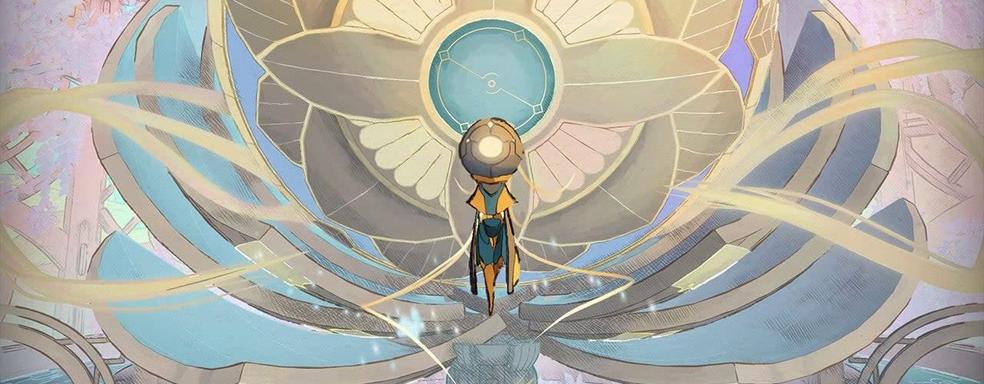
The first thing that stands out when getting acquainted with MIO: Memories in Orbit is its visual style. The new game from studio Douze Dixièmes greets you with expressive imagery reminiscent of animated pencil sketches generously colored with watercolor.
The pastel palette, soft lighting, and crisp, almost cel-shaded outlines create a warm and deceptively cozy atmosphere. It is reinforced by a melancholic soundtrack that does not press or escalate tension, but supports a state of calm, measured travel.
At the same time, the game world does not feel like a narrow "corridor," which often happens in metroidvanias. Thanks to the work with backgrounds, perspective, and the scale of the backdrops, locations look like parts of a huge complex rather than a set of tunnels. The Ark feels majestic and vast, especially in large zones like the Metropolis, where the space captivates and overwhelms with its gigantism, emphasizing just how small Mio is against the backdrop of monumental structures.

At first, that impression proves justified: we take control of the android Mio, who regains consciousness aboard an abandoned ark drifting through open space. Something has clearly gone wrong here: sections that once functioned have turned into ruins, engineering compartments have become overgrown with biomechanical vegetation, some rooms have flooded, while others are locked in ice.
MIO relies on the classic metroidvania formula. The ark is a sprawling labyrinthine world with many intersecting areas, shortcuts, and hidden zones that open up as new abilities are acquired. The world is built to encourage returning to familiar places, yet the game avoids petty sadism, at least most of the time.
The map opens up fairly quickly, after about a dozen deaths, during which you lose all accumulated "mother-of-pearl" (the local equivalent of souls), enriching the pond in the central hub and strengthening your bond with the ark. Once the map is unlocked, death no longer grants bonuses—you simply lose everything you earned permanently if you did not manage to convert the currency into a "solid" form that does not disappear.

The map automatically marks your entire traveled route, as well as all locked doors, without any need to do anything manually. Interesting discoveries you cannot access yet can also be marked—there are plenty of corresponding markers here, and they are free. The only downside is that the map updates only when resting at the local bonfires, the Watchers, so you will not be able to trace your path immediately in an unexplored area.
Although the ark is packed with secret passages and secrets, MIO almost never forces you into pixel hunting and does not require methodically tapping walls in search of hidden caches.
Some zones can be guessed from the environmental design, some are visible to the naked eye but inaccessible for one reason or another—because of water, grates, or a height you cannot yet reach. The game rarely hides something important in the middle of nowhere—more often it shows you the goal and suggests returning later with the right tool.

The energy of flow
A fairly standard set of metroidvania abilities helps with dealing with closed-off areas. Early on, Mio gets a double jump, then learns to pull herself toward enemies and special points with her tendrils, using them as a grappling hook, move along them like a mechanical octopus, and glide through the air.
There is no familiar dash here—its function is taken over by a dodge. It can be used while running to shift forward. The move is useful not only in combat, but also in exploration. For example, with its help you can slip through doors that automatically close as Mio approaches.
The use of these abilities is limited by an energy reserve, and this directly affects location design and platforming sections. During platforming sections, energy does not regenerate, so enemies and special environmental elements you can bounce off begin to play a double role.
They help you climb higher, get past a dangerous section, and restore your energy reserve—so that you can then use the grappling hook, gliding, and other abilities. As a result, you have to think about the sequence in which to use them, which adds depth without overloading the controls.

Importantly, within the main playthrough this approach works smoothly. The story-related and mandatory platforming segments in MIO almost always stay within moderate difficulty. They are short, clear, and rarely demand perfect execution.
The player usually has time to assess the situation, adjust the route, or even make a mistake. In the worst case, a fall sends you back to the beginning of the section and takes away one durability cell—your health.
It is the optional segments that become noticeably harder. These are mostly sections behind which modifiers with useful effects, additional upgrades, or currency for character development are hidden.
Here the game is no longer shy about raising the demands for precision and attentiveness, yet the risk is almost always proportionate to the reward. Especially since upgrades really are needed: the local fauna is reluctant to make contact and in most cases prefers to jump straight into a fight.

Perfect yourself or die
The ark is populated mostly by aggressive machines in the form of animals and insects (as in Guerrilla Games' Horizon series) and functional scientific and service-oriented robots. There is an abundance of mechanical mosquitoes, chameleons, squids, deer, and other creatures with clearly unfriendly intentions—the result of a systemic failure.
The variety of regular enemies is average: enough that you do not complain, but not enough to praise, and not enough to feel that the game is constantly throwing the same thing at you. During exploration, battles are encountered in measured portions. Even taking into account the resurrection of enemies after resting at the "bonfires," they are perceived more as a source of resources than as an irritating obstacle.
The exception is flying enemies—right up until the player learns to pull toward them and combine jumps with aerial attacks. This is easy enough to master.

The bosses here, however, really do deserve separate praise—first and foremost for their difficulty and the fairness of their design.
The difficulty rises evenly, with the exception of certain optional encounters. Bosses do not repeat, differ from one another visually and mechanically, and evolve as the player gains new abilities, testing the skills already learned.
No less important is the fairness. In MIO there is no collision damage—Mio takes damage only from attacks. This fundamentally changes the feel of fights and gives the developers freedom in design. The player focuses on patterns, timings, and positioning, rather than on trying not to touch the boss model by accident. Attacks are readable, animations are clear, and signals flash before strikes. Still, for a couple of bosses these signals blend into the palette and Mio's white attacks, making the moment of impact harder to read.

One obvious downside is the long run-backs after death. Most often this is a genre relic that only delays the next attempt and is not needed at all. However, there are successful exceptions, and the deer boss Nabuu is the clearest example.
The road to his arena serves as a kind of tutorial: if you learn to get through it without losing health, you will handle the boss as well, since a similar mechanic is used in the fight. If not, the boss simply will not yield, and there is logic in that, although a healing fountain before the arena still would not have hurt.
Despite this drawback, the boss fights themselves remain fair. Death at the hands of a boss is always the player's responsibility: failed to react to an attack, pressed the wrong buttons—the mistakes are obvious. If difficulties arise, the accessibility settings let you enable a function that gradually weakens the boss after each death, which in theory allows you to "push through" by sheer number of attempts.
In practice, the effect is either too mild or too stretched out—at least in test fights, I never felt a decisive difference. Most often victory comes not because of leniency, but because you yourself become better: you memorize the attacks, get rid of the franticness, and start controlling the fight more effectively.

Running in place disguised as progress
Of course, progress is not limited to personal skill alone. MIO offers plenty of ways to strengthen the heroine, and at first glance the system looks flexible.
Mio has a shared memory pool that is spent on installing modifiers. Damage boosts, increased survivability, mobility, and resource economy—all of it competes for shared slots in the distribution matrix. Memory is even spent on displaying the health bars of the heroine and enemies—almost like in Nier: Automata, so sometimes you can give it up to take an extra enhancement instead.
However, despite the presence of around forty modifiers, as well as the gradual expansion of the memory pool as you find the corresponding upgrades, you will not be able to put together explosive builds that radically change the gameplay.
Usually everything comes down to finding a balance between damage and survivability, because the bonuses here are of the "a little more damage at low durability," "a little more durability," or "a buff after a successful dodge or ability use" variety. Some modifications provide exclusively negative effects, freeing memory slots for something else—a variation on the risk-reward principle.

But at some point MIO does not just step on the same rake as Hollow Knight: Silksong—it bursts into the shed with that rake and starts cheerfully hopping from one to another. Formally, throughout the entire game you are improving, optimizing, and collecting something, but in practice you often do not become stronger—you are merely trying not to become weaker.
Increasing damage through absorbing the remains of robots like Mio is felt only after several upgrades, and mainly in relation to regular enemies. The shell's durability reserve also grows through collecting protection fragments, but here too you are more maintaining your current level than strengthening the character.
The reason is that, according to the story, Mio regularly loses part of her durability, while at the same time you are moving toward the finale, where enemies and bosses become noticeably stronger. As a result, upgrades work not for growth in strength, but for preserving it, which hurts the overall impression by the end of the game. Especially considering what comes next.

The path of pain and suffering
There are no standard ways to restore health in MIO—no estus, flasks, or medkits. Healing is available only at special fountains and requires spending resources. As the game progresses, you gain the ability to make it free with modifiers, but even that does not solve the problem—there is still no reliable way to restore health at any moment.
At the same time, final death sends the heroine back to the nearest save point, which is often far away—there are few checkpoints in the game overall. It is also additionally irritating that when quitting the game, Mio likewise returns to the last save point. As a result, if you get stuck in the middle of a difficult platforming segment, you simply do not want to close the game, so as not to have to replay the whole stretch later.
This feature becomes critical after getting the basic ending—or if you decide right away to go for the "true" one. To do so, you need to collect a number of key items and unlock an ability that lets you move through poisoned water.
Almost everything connected to this route is hidden behind extremely punishing platforming sections. Here MIO's balance shifts completely: platforming begins to dominate over everything else and turns the player's life into HELL.

The precise and generally player-friendly design that supported most of the game gives way to tests of reaction and endurance: long sections with no room for error; strict energy management; memorizing timings; and limited visibility. Any mistake sends you back, and learning is accompanied by dozens of deaths.
As a result, the playthrough turns into an exhausting marathon that feels harsher than Hollow Knight's most merciless sections—not because of technical difficulty, but because of the minimal chances to correct a mistake in the process. The game squeezes everything out of the player—morally and physically.
Some of these problems can be softened with accessibility settings. In easy mode, the game lets you restore one durability cell if you stand on the ground for a while, which at least makes it possible to attempt a difficult platforming section an unlimited number of times.
If desired, the same effect can also be obtained "fairly"—the corresponding modifier appears in the second half of the game and becomes almost mandatory if you want to carry the hair on your head all the way to the real finale.

Diagnosis
Despite all its charm and colorful presentation, MIO: Memories in Orbit deserves a place alongside the best representatives of the hardcore segment of metroidvanias.
It does not invent anything new, but it confidently executes the classics of the "new wave": exploration, platforming, and a heightened emphasis on difficult boss battles.
Comfortable, fair, beautiful, and engaging, it still stumbles near the curtain call, when progress feels less clear, upgrades increasingly work as an attempt to compensate for losses, and tooth-crushing platforming almost pushes everything else aside.
These flaws do not erase MIO's strengths, but they noticeably blur the impression for those who are used to completing such games 100% and are not ready to put up with questionable game design decisions.
But for those who are not afraid to go through the "paths of pain," it comes highly recommended. The game is definitely worth paying attention to and supporting, even if it has not yet managed to acquire its own army of devoted "clowns."
Never miss our newsAdd this site to your preferred sources to see us more oftenAdd on Google
![[STREAM] Ultimate Version - Cyberpunk 2077 Update 2.5](https://media.ixbt.games/fit-in/312x/ixbt-data/1730178/b6ca9a8e-de42-4e9a-b1aa-df5e519a7449.jpg)