Radar series review: (not) just another answer to "Stranger Things"
Soviet pioneers against an alien intelligence against the backdrop of Perestroika - the description sounds more like some kind of trash. But in fact, it turns out to be a serious science fiction representative. After the success of Atomic Heart, it became clear that fantastic stories set in Soviet reality can attract an audience. And although "Radar" lacks retrofuturism and dieselpunk, it does have a well-recreated 80s and a serious idea of what first contact might be like.
Problems of Russian Science Fiction
Finding real "geek content" in Russian cinema is quite a challenge. The industry churns out endless detective stories, sitcoms, and melodramas (that's not a typo), although it must be admitted, it's getting better at it. But the audience usually wants something else.
While Western audiences get both entertaining content with a serious scientific basis ("The Big Bang Theory", "Rick and Morty"), and even scientific dramas ("Oppenheimer"), in Russia, this is in such a nascent state and so derivative that there's almost nothing to watch "for the soul."
Science fiction is one option, but even with domestic science fiction, things are, to put it mildly, difficult. Of course, comedies about body swapping (mothers-in-law and sons-in-law, mothers and fathers, children and parents – screenwriters' imaginations run wild), funny stories about a gendered future, and a handful of fantastic action films regularly appear on screens. But sensible science fiction that provides food for thought is hard to find.
Filming science fiction is difficult, despite the fact that the genre is still strong in literature. The reason for this is the specifics of local film production. The way our producers and directors handle good literary material is best illustrated by the fate of Sergey Lukyanenko's adaptations. From "Dozory" and "Chernovik," only scraps remained in the films. Every time you watch this, you involuntarily ask yourself: if the original doesn't seem good enough to you, why not make an original film instead of mutilating the book?
It would seem that the series "Radar," based on Alexander Mirer's science fiction novella "Glavny Polden" (1969), should follow the same sad path. But "suddenly" a miracle happened. The creators were able to carefully transfer the text to the screen, adapting it for a modern audience and a new time period.
Who to thank for this – director Konstantin Smirnov ("Telokhraniteli", "Devushki s Makarovym") or the production team led by David Tsallaev and company ("Kholop", "Volchok") – is a matter of debate. But the fact remains: they succeeded. And for that, thanks to them.
From the 60s to the 80s
While in Alexander Mirer's original novella, the events unfolded in the USSR of the 1960s, the creators of the series deliberately moved the action to 1987 (the description everywhere mentions 1988, but in the final scene with the engineer, there is a specific timestamp – November 1987).
Perhaps this is a justified decision. The 80s are easier to film, as there are plenty of natural locations in modern Russia and Belarus, and viewers over forty will nostalgically remember their school years. This required a departure from the original, but if you evaluate the series as an independent product, the series did not lose out.
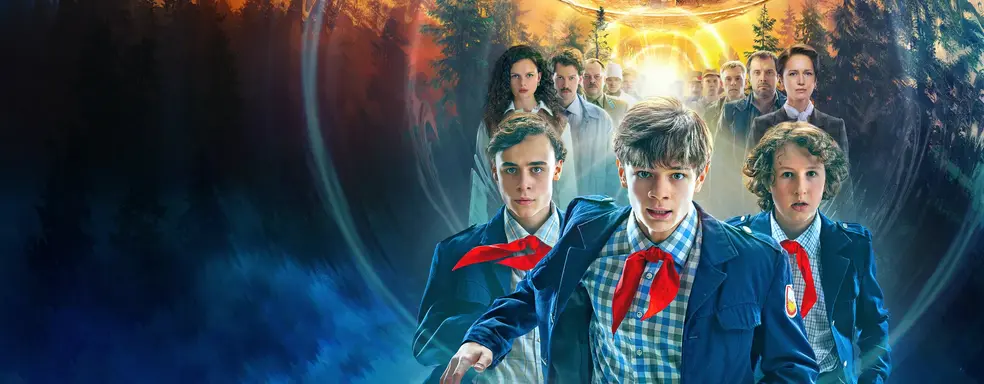
Events unfold in the small town of Radiogorsk, whose main purpose is a radar that monitors American missile launches. However, the military unit exists separately, and in the town, ordinary Soviet life of the Perestroika and Glasnost era goes on. If high school students have already felt the corrupting influence of the West and gladly succumb to it, organizing unauthorized rock concerts, then middle school pioneers dream of a trip to Artek – for this, they need to be the first to find a meteorite that fell in the vicinity.
But the meteorite turns out to be an alien ship capable of controlling people. Their goal is to capture the radar. And now the pioneers have to not just find the aliens, but stop an invasion that adults don't even suspect.
Russian Screenwriting School
The series is made in the genre of a science fiction thriller, and it must be admitted that the film crew did a good job. The viewer is gradually immersed in the events, building up tension that should reach its maximum by the finale. And the first four episodes, in which the invasion itself begins, are watched in one breath.
But closer to the end of the series, the tension slightly subsides, and the action sags. Some events and plotlines could either be removed entirely or shortened – the series would only benefit from this. Whole fragments make you want to fast-forward to find out how the heroes will get out of another predicament. Instead, we are presented with a lyrical line that ultimately leads nowhere.
There are no blatant plot devices, the characters' motivations and the sequence of events are generally logical. But some plotlines look strange and lead nowhere. For example, the gangster played by Alexander Ilyin (known for his role as Lobanov in "Interny"), under whose influence the main character's older brother falls, is a catalyst for many events in the first episodes. The character turned out to be unpleasant, somewhat frightening, well-written, but his story does not get a conclusion. What did the director and screenwriter want to show? What did this character ultimately come to? We are given a hint that something human remained in him, but nothing more.
This is perhaps the biggest unfinished storyline. There are, of course, smaller ones. The characters' parents, introduced at the beginning, some teachers – they don't come to anything by the end of the series. Or at best, they get crumpled endings to their arcs. Also, the problems of understanding between parents and children, conflicts between schoolchildren, declared in the first episodes, do not receive proper development.
Maybe it would have been better to show their development, rather than dragging it out in the middle of the series? How did a bully who extorted "kopecks" from a seventh-grader become a leader of the resistance? How did he come to such a life? And how do people feel about him? Is he a positive character? Negative? The authors don't give an answer. They don't emphasize. The father, who punished his son, and under the influence of aliens became one of the main antagonists, having freed himself from the intermediary (who controlled him), will he simply realize everything? For the son (one of the trio of main characters), accepting such a father becomes an event, and the scene where this happens is filmed powerfully. But why such a crumpled ending for the father? Where is the realization of the mistake? Where is any reflection? There is none. He was a bad dad, became a good one. That's not how it works.
This slightly spoils the impression of the finale, although the arcs of the main characters, even if dotted in places, are still closed. So, overall, it's interesting to follow both the characters and the plot during the viewing.
(Don't) Believe!
But, perhaps, the main advantage of the series is that, on the whole, you believe its world. You believe that on the screen is the USSR of the late eighties, you believe in the characters, you believe in the aliens. The trio of Matvey Kulagin, Georgy Pytyev, and Rostislav Kharin did a good job with their roles.
Of course, there were some flaws in the depiction of the 80s USSR. In fact, there's a lot to nitpick about.
Among the most obvious blunders are the car license plates. In the USSR, it was rare for cars from different regions to drive around in the same city. They were supposed to be registered at the place of residence. Most often, the series ST (Stavropol Krai) appears on screens, although there is taiga around the city. Here, the series KM (one of the early warning radar systems was located near the city of Pechora in the Komi Republic, in the 80s Komi ASSR), or Irkutsk, or Orenburg Oblast would be more appropriate. License plates for private individuals appear on police cars, and vice versa, on private cars, license plates intended for enterprises are visible.
And the radar itself looks like a radio telescope. For a technically savvy viewer, the appearance of an early warning radar system is no secret. Yes, a radio telescope looks more impressive. But still. Let it not be a radar then, but a deep space communication station located in the area of Galyonki village, Primorsky Krai. This particular station, by the way, fits perfectly into the series' setting.
In addition, local schoolchildren are dressed more in the fashion of the early 90s than 1987. Despite Perestroika, such clothes were not widely available, especially in a provincial town.
And the structure of local authorities is more reminiscent of modern Russia (where there is one city administration). But in the 80s, in addition to the city executive committee, there was also a party authority – the city party committee.
You can still look for artifacts in the frame among the furnishings and furniture, and in general, for the mid-80s, people had too many things in their apartments. The list can go on. You can nitpick for a long time.
You can, but you don't want to.
Overall, the depiction of that era is authentic, and if you lived in those times, you won't be able to avoid nostalgic memories while watching. Special thanks to the creators for not having any obvious "figs in their pockets" in the series. The USSR is neither glorified nor demonized. Perhaps some will be annoyed by the demonstration of commodity shortages in the grocery store, the demonstration of a "nesun" (petty thief) from a radio factory, but this is an honest look at the era without embellishment or blackening. Both problems were widespread at that time.
But what definitely spoiled the viewing experience were the spoilers on the preview images for the last episodes. We won't tell, as the clarification would already be a spoiler. But in general, Okko could have been more careful about such things. Shame.
It's very strange to see a 16+ age rating for the series. Both the book and the film are clearly aimed at a younger audience. However, what's surprising? In the USSR, third-graders were allowed to watch the film "Pirates of the 20th Century" (1979). And now this film has an 18+ rating. By the way, only one of the trio of main actors turned 16 this year. So, the others can't even watch the series they starred in?
Verdict
So yes, "Radar" is that very geek content that is so lacking in Russian cinema. A rare case when domestic science fiction not only exists but also works on several levels at once. By the way, even the special effects, though not numerous, look decent. For viewers over forty, this is a nostalgic journey into childhood. For teenagers, it's an exciting story about friendship and saving the world. For everyone else, it's just a good movie that you want to watch to the end.
And what is especially important – this is indeed science fiction, not just adventure fiction or fantasy. The series makes you think about what the first contact with an alien civilization might be like, what this contact will bring us, and what it will lead to. Of course, there isn't the same "math" as, for example, in "The Three-Body Problem" – a Chinese series based on Liu Cixin's novel. But "Radar" has its own strengths, besides the main question of the consequences of contact: questions of trust, of how we react to the unknown. And this is more than enough for the series to work as serious science fiction.
But as a film that works on many levels, "Radar" can attract not only science fiction lovers or nostalgic viewers. Those who simply appreciate good stories with human emotions will also find something for themselves here. Yes, the series has its rough edges: unfinished plotlines, factual errors in details, a strange age rating. But this does not hinder the main thing – "Radar" evokes emotions, makes you empathize with the characters and believe in their world. And that, perhaps, is the most important thing.
Never miss our newsAdd this site to your preferred sources to see us more oftenAdd on Google