Cyclical Hell in Japanese Style. A Review of "The Exit 8" Thriller
When Japanese developer Kotake Create released The Exit 8, it was hard to imagine that the seemingly simple "walking simulator" would turn into a whole franchise, spawn dozens of imitators, and even get a film adaptation. Genki Kawamura turned a paranoid walk through the subway in search of anomalies into a philosophical parable that received an eight-minute standing ovation at the Cannes Film Festival. Now the film has reached Russian cinemas. Is it worth the attention? Read our review.
Zero Corridor
The film opens with the sounds of Maurice Ravel's "Bolero" - a piece built on an unchanging rhythm and multiple repetitions of two themes. This major melody, deceptively simple and hypnotic, plays on the viewer's expectations: instead of the usual enthusiasm, it turns into an alarming anthem, foreshadowing the events to come and the immersion into cyclical hell.
The first-person camera transports the viewer to a crowded Tokyo subway car, packed with people rushing to work. The rhythmic hum of the human anthill is suddenly interrupted by the crying of a baby in the arms of a young mother - and one of the passengers snaps at her.
The main character, played by Kazunari Ninomiya, remains nameless. He silently takes out his headphones, indifferently watches the quarrel in the car, and immediately retreats back into himself, hiding in the noise of "Bolero". But reality breaks through with a phone call: his ex-girlfriend (Nana Komatsu) reports that she is pregnant and in the hospital, not knowing what to do next. The hero is knocked out of his usual shell and, along with anxiety, feels suffocated - not only from the tightness of the subway, but also from increasing asthma attacks.
In an attempt to get out, he begins to notice strange things. The subway corridors repeat, signs and posters flash again and again, and the steps of an oncoming man sound suspiciously familiar.
There is a Way Out
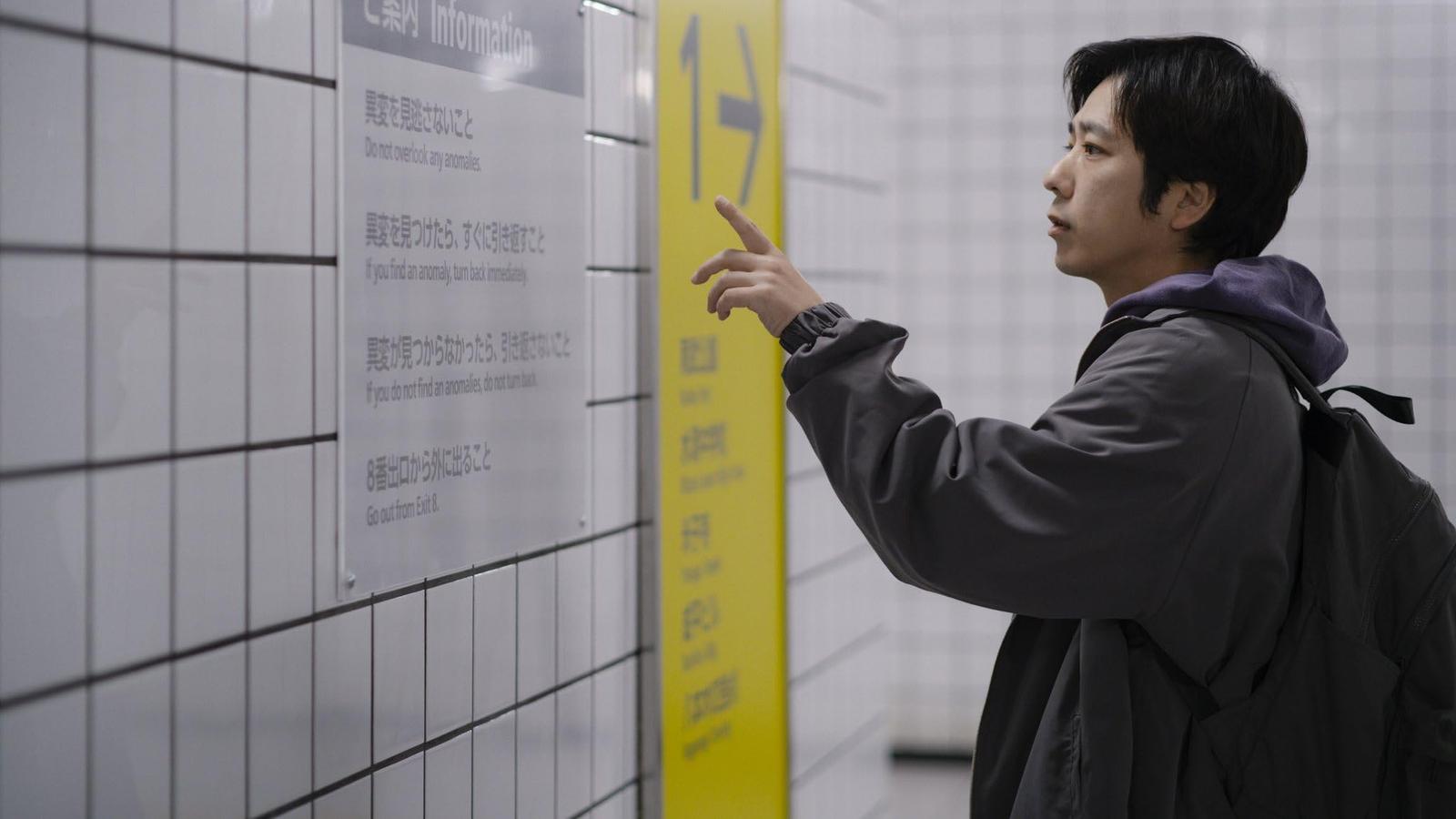
As in the game, the hero finds himself in a closed subway corridor, which turns into a prison and torture chamber of the "Lost Man" for him. To break free, you need to follow simple rules: if you notice an anomaly - turn back, if everything is in order - go forward. A mistake returns you to the beginning, and the right choice brings you closer to the cherished exit number eight.
Kawamura remains true to the minimalism of the game and focuses not on external horrors, but on the paranoia of perception. The first-person shooting, stylized as a body cam, initially creates an effect of involvement, but as soon as the "game" begins - the perspective shifts, and the viewer turns into an observer who notices anomalies before the main character.
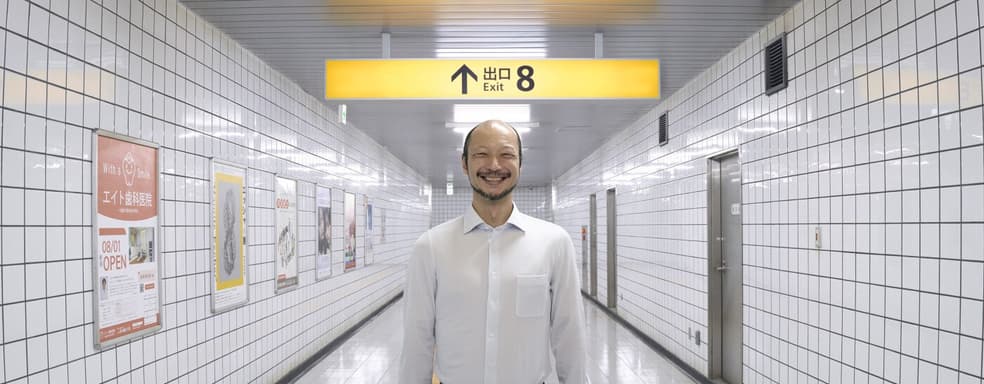
Dentist. Escher. Notary. Beauty salon. Man. Clinic. The first cycles are fascinating with their novelty: the viewer, along with the hero, peers into posters, doors, ventilation grilles, trying not to miss the slightest anomaly. But the film deliberately keeps a slow pace, and by the middle it becomes clear - "The Exit 8" is not going to speed up for the sake of entertainment. Because of this, the rhythm noticeably sags, risking alienating those who came for screamers and other "scarecrows".
If you are not a fan of methodical introspection and are far from art-house cinema, you will probably get bored in the middle - this is worth considering when deciding whether to watch.
And yet, the visuals and sound turn monotony into an artistic device. The sterile corridor puts pressure on the viewer no less than on the hero, and the white noise amplifies this pressure, only occasionally interrupted by the clear steps of the "Walking Man", echoing in the head.
Yes, there are a couple of screamers here that can slightly cheer you up. But the picture uses these images to push the viewer to think: "what does all this mean anyway?"

Anomalies Inside You
In addition to the "Walking Man", familiar from the game and personifying office slavery and everyday routine, the "Boy" (Naru Asanuma) also appears in this border space. His image reminds of the hero's lost childhood and at the same time of what he risks depriving his unborn son of.
The Exit 8 is arranged so that every detail has a double meaning. The subway corridor is not just a decoration, but a symbol of everyday hell, where people follow the same route day after day.
Repetition turns into punishment, and "anomalies" become rare failures that make you wonder: is the world broken or is something wrong with the hero himself? The subway corridor becomes a metaphor for his fear of fatherhood and growing up, the inability to make decisions and the eternal attempts to escape from himself and reality. The way out of the trap lies not in noticing mistakes around, but in admitting your own.
At first glance, Ninomiya's role seems almost empty: few words, minimum emotions. You might think that any actor of the appropriate age and type could have played it. But with each new cycle, the hero changes and eventually goes through a path resembling different stages of acceptance.
Ninomiya's play is built on sharp changes - from detached isolation to outbursts of despair and physical breakdown. Thanks to this, the "Lost Man" ceases to be an abstraction and turns into a mirror for everyone who has ever been stuck in their own corridors.
Diagnosis
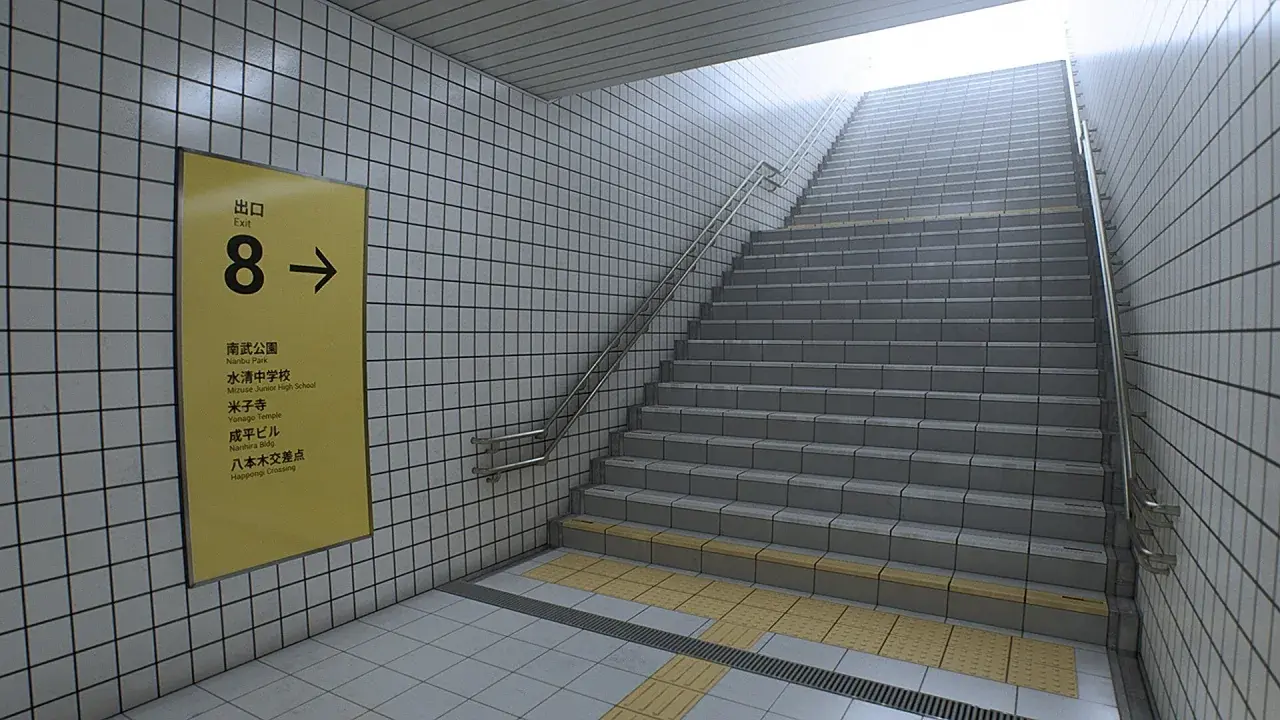
The Exit 8 belongs to the type of games where playing on your own is sometimes less exciting than watching on YouTube. Especially if there is a charismatic host on the other side of the screen - for example, a certain Dmitry K. with his funny refrain "a man is walking, a dog is being cut, people are hanging out...". He tries not to miss anything, but inevitably misses something - and the viewer exclaims indignantly: "How could that be!" This is the charm of the formula. It is no coincidence that Kotake Create boasted primarily not the number of copies sold, but the millions of views on streaming platforms.
Against this background, Kawamura's super task was not just to reproduce a recognizable experience that evokes a sense of involvement in the viewer, but also to expand it: to offer not another "someone else's" playthrough, but an independent author's statement. And he succeeded. This is not a film for the mass audience, it does not throw adrenaline every five minutes and does not seek to hold attention with cheap tricks.
But it explores the fear of enclosed and border spaces, the impossibility of breaking out of the usual circle, the paralyzing feeling of guilt and escape from responsibility. This is a meditative journey through the backwaters of consciousness, where everyone can recognize themselves. But if you are only looking for a nerve-wracking entertainment, it is better to pass by.
Never miss our newsAdd this site to your preferred sources to see us more oftenAdd on Google