Fighting for every player. Lords of the Fallen review after patch 2.0 — what changed in a year and a half
Translated with AI from the Russian original.
Cases where creators fix their games after a troubled launch are rare. Most studios simply move on to new projects. That makes the value of each such story multiply, and one of them happened not long ago. On April 17, “Update 2.0” was released for the 2023 Lords of the Fallen. It introduced a number of significant changes to a project that took a severe beating at launch. We completed the game after this update and want to share how the Polish soulslike plays today and what has changed in it.
The Poles set the right example
In October 2014, Lords of the Fallen was released. It was developed by the Polish studio CI Games (known at the time as City Interactive), in collaboration with their German colleagues from Deck13 Interactive.
It was a project in the then-emerging soulslike subgenre — inspired by FromSoftware’s Dark Souls series. “Lords” was met with a lukewarm reception and was criticized for almost everything: unresponsive controls, terrible optimization, a small roster of bosses, poor combat system balance, and its sluggish pacing.
However, instead of throwing in the towel, CI Games made another attempt. Their paths with Deck13 Interactive diverged, and Hexworks took their place, a studio founded by CI Games specifically for this project — it handled development, while the parent company served as publisher.
The second iteration of Lords of the Fallen — keeping the original title — was announced in August 2022. Development began in 2014 and had already been underway for 8 years at that point. In October 2023, the game was released, without the number “2” in the subtitle.

Image belongs to CI GAMES S.A., Source: PS Store
The second “Lords” also proved problematic. Our website published a review of the launch version, where our author — run.code — evaluated the project. He praised Lords of the Fallen for its world, art design, dual-realm mechanics, gameplay, audiovisual presentation, and combat system. The main targets of criticism were the gratuitous abundance of enemies, the checkpoint system, encounter staging during certain boss fights, and poor technical performance.
Yet CI Games once again refused to abandon the game, steadily rolling out updates — over fifty were released throughout a year and a half of support, culminating in version 2.0.
Even at this point, one feels compelled to shake their hands, but the Polish developers went further and began making changes based on player surveys. For instance, an update that replaced traditional “Male” and “Female” character creator options with “Type A” and “Type B” was rolled back after roughly 90% of respondents voted against it. If only all developers were this committed to customer satisfaction and fixing their own mistakes, rather than abandoning half-finished games after launch!

What is Lords of the Fallen?
Lords of the Fallen is an Action-RPG offering an extensive arsenal of gear and diverse character progression paths. For example, you can build a classic knight in full plate armor with a sword, shape your hero into a dual-wielding greatsword berserker with no armor at all, or pick from three spellcasting schools for mages: fire, radiance (holy/lightning), and umbral — more on the latter below.
The combat system includes light attacks, heavy attacks, dodging, blocking/parrying, and casting spells — which require a specialized catalyst. Thus, building a pure mage isn't strictly necessary; instead, you can blend magic with other classes, or substitute a catalyst with physical ranged weapons like crossbows, bows, or throwing javelins.
The game places heavy emphasis on boss encounters. These battles are engaging and enjoyable without being overwhelmingly punishing — though exceptions exist. Hexworks opted not to blindly follow the trend toward extreme difficulty, leaning closer to hack-and-slash territory instead. There is a catch, however: truly unique adversaries are scarce, and a notable portion of bosses are standard mobs that begin repopulating regular areas shortly after their debut as formidable threats.
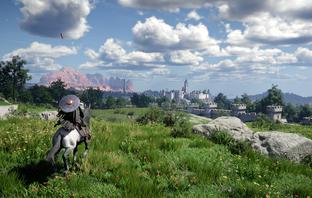
The game world is expansive and features several biomes: frozen peaks, a burning city, mines, gloomy castles, and, of course, a swamp. Levels follow a “progress and shortcut” design philosophy, packed with hidden passageways, shortcuts, and alternative routes.
Bonfire equivalents — spots for respawning and fast travel — are present as well. There is even a portable checkpoint system allowing you to plant vestige seeds in designated spots, though only one can be active at a time: a convenient, if costly, mechanic.

The developers did overdo it in some areas, though. Doors that “cannot be opened from this side” are scattered around every corner, most of which have nothing to do with critical path progression. Some even require specialized keys. This is largely a positive, as it encourages thorough exploration.
The downside is that level design does not always guide the player well — at times, it is hard to figure out where to go next, since the environment does little to highlight key landmarks. For instance, I spent roughly three hours wandering in circles through the mines, even though the lever opening the path forward was right under my nose — I simply missed it in the dark. There were several such spots, even if I did not get as lost as I did in the mines. It was far from enjoyable!
Midway through the game, progression grinds to a halt as you hit a dead end. You have to return to the hub area, locate a key and a note dropped on the floor by an NPC offering vague hints on where to go — hints you still need to interpret correctly. Without a direct guide, solving this puzzle without the internet will prove challenging for many — unless you happen to stumble upon previously locked doors in earlier areas and try unlocking them, as happened in my case.

What truly sets the world apart is the aforementioned dual-realm mechanic. The world is split into two layers: the realm of the living — Axiom — and the realm of the dead — Umbral. Shifting into the latter is required in two scenarios: solving spatial puzzles or upon dying — the game gives you a second chance, similar to Sekiro: Shadows Die Twice.
In Umbral, your health bar is cut in half, with the rest converted into wither damage that must be regained by attacking enemies — just like in Bloodborne — who spawn infinitely. Lingering there boosts your experience multiplier, but eventually summons a dread creature that is tough to fight: it disables healing items and teleports constantly, making it difficult to land a hit.
To interact with the realm of the dead, the player carries an Umbral Lamp. Using it allows you to peer into or cross over to the other dimension at any moment, but getting back out is not as simple — you must find a dedicated effigy.
The lamp is equally useful in combat. For example, you can soulflay an opponent for a few seconds — stunning them and leaving them vulnerable to attacks. Other enemies are shielded by an Umbral parasite that either rapidly regenerates their health or renders them completely immune to damage — forcing you to scan the arena with your lamp to locate and destroy it.

Cooperative play also deserves praise; in “Lords”, it is far more seamless than in FromSoftware titles, where multiplayer remains stuck in 2009 — the era of Demon’s Souls.
While in Hidetaka Miyazaki’s games you must reconnect after every death or boss victory, and summoned allies are tethered to the zone they were summoned in, Lords of the Fallen keeps you connected until someone leaves or the session drops. You can explore the entire game together — even teleporting between vestiges. Partners can even revive each other in combat — which undermines hardcore tension, but massively boosts convenience and fun!
However, if difficulty is what you seek, the game features a modifier system allowing granular balance adjustments — introduced in version 1.5:
- Randomized enemy encounters in the world — excluding bosses;
- Permadeath reset upon dying in Umbral — while retaining character levels and inventory;
- Randomized enemy loot drops;
- Increased enemy density — excluding bosses;
- Healing restricted entirely to dealing damage to enemies;
- Adjustable rest frequency;
- Upgraded item drops matched to the player's level.

Lords of the Fallen 2.0
With the release of update 2.0, the game has been thoroughly transformed and refined.
Combat feels significantly smoother: animations were polished, sound design reworked, and balance tweaked. Encounters feel better not because enemies were nerfed, but because core mechanics finally function properly.
Exploration has improved alongside combat. The developers reworked the controls, adding a dedicated jump button similar to Elden Ring — eliminating the awkward sprint-then-press-again input reminiscent of older Dark Souls games.
A guidance mechanic was added to the Umbral Lamp as well, helping navigate environments by showing the path forward — a feature I sorely missed during my initial run.
Enemy placements were revised, resulting in noticeably fewer mobs. Hexworks realized that excessive standard enemy counts undermine enjoyment rather than adding genuine challenge — an issue Dark Souls II was heavily criticized for.
Optimization is now in a solid state, and the visuals look sharper than ever — presenting richer, more atmospheric imagery. The netcode received similar attention and feels much more reliable.

The UI was redesigned for better usability and less clutter, making interface elements much easier to process at a glance.
The character creator was expanded with new customization tools, allowing players to craft anything from heroic warriors to delightfully grotesque creations.
The crowning feature of the update, however, is the addition of the Friend Pass system, popularized by Josef Fares’ games — allowing two players to team up in co-op using only a single purchased copy.
The host simply sends an invite to a friend, who then downloads a free client. While the guest can only play when joined to the host’s session, all their progress is preserved; should they decide to purchase the full game later, they can pick up right where they left off.
This feature not only expands co-op opportunities, but helps introduce a wider audience to the entire subgenre — particularly since “Lords” is more approachable than traditional soulslikes. You can now invite friends at no cost to them — and who knows, they might just get hooked!

Diagnosis
Lords of the Fallen was already a solid release, but update 2.0 has elevated it into one of the best soulslikes around: satisfying combat, an impressive world with a unique dual-dimension mechanic, and frictionless co-op. The developers deserve genuine credit for standing by their game and reshaping it around community feedback — a rarity in the industry today.
Playing “Lords” feels vastly improved thanks to rebalanced combat, smoothed animations, and upgraded audio design. World navigation was streamlined by the new lamp-tracking mechanic and a dedicated jump button. Meanwhile, the Friend Pass system is a game-changer for the subgenre, significantly lowering the barrier to entry — a shame we will likely never see anything like it from FromSoftware.
Today, Lords of the Fallen mirrors another high-profile Polish release that walked a similar road — Cyberpunk 2077. Both were fundamentally ambitious projects cut short by launch woes, and both blossomed into greatness with their 2.0 updates. Well done!
Pro
- Satisfying combat system
- Flexible character progression
- Large, biome-rich world
- Unique dual-realm mechanic
- Great visuals and performance
- Seamless co-op integration
- Friend Pass feature
Contra
- Key path markers are easy to overlook
- Limited variety of truly unique bosses
***
All images used belong to Hexworks and CI GAMES S.A.
Never miss our newsAdd this site to your preferred sources to see us more oftenAdd on Google